Alex Hormozi's Lead Generation Framework: The Missing Infrastructure Layer
You read $100M Leads. Maybe twice. You implemented the lead magnet, restructured the offer, pushed more content. Your team ran ads. You had a few good months, genuinely good months, where pipeline felt real and the calls were coming in.
And yet. Six months later, twelve months later, you still can't answer the one question that determines whether a business scales or stalls: What will pipeline look like next month?
You've done the work. The framework isn't the problem. So what is?
One pattern comes up repeatedly in conversations with founders who've been here. A founder who closes well describes having a 90% close rate with recent clients, then admits they haven't run any real advertising yet. The skill is real; the pipeline is empty. Another arrives after a string of agency and vendor failures: "I was with other providers before. They all screwed it up. They broke every promise, so now I'm starting over." The knowledge was consumed. The work was done. The system still isn't running.
There's a name for this stage: The Implementation Wall. It's the gap between consuming a lead-generation framework and having predictable pipeline, the point where you've understood the offers, the lead magnets, and the Core Four, done the work, and still can't forecast next month's revenue. Almost every founder who has read Alex Hormozi's lead generation material and tried to implement it hits this wall. Almost none of them recognises it for what it actually is.
This isn't a knowledge problem. You don't need another tactic. You're missing the infrastructure layer that makes the framework run, consistently, without you holding it together every week.
That's what this article is about.
What Alex Hormozi Actually Gets Right
Before anything else, this needs to be said plainly: $100M Leads and the broader body of work behind it contain genuinely sound principles. If you've consumed the material and applied it seriously, you started from a good place.
The argument in this article is built on having read all four books in the series. $100M Leads teaches how to get strangers to want your stuff. $100M Offers teaches how to build an offer so good people feel stupid saying no. $100M Money Models chains those offers into a deliberate sequence: Hormozi's own framing is that a Money Model covers "what you offer, when you offer, and how you offer it to make as much money as you can as fast as you can." And $100M Lost Chapters delivers the tactics he held back from the first three, the material he described as "too advanced, too niche, or too much math." Four playbooks. Four routes to building a scalable business. What no single book installs is the connective tissue that makes all four run as one system when you're not in the room. That connective tissue is the GTM-OS.
Here's what the framework gets right, and why this article builds on it, not against it.
The offer comes before everything.
Hormozi's Grand Slam Offer concept is correct: a weak offer cannot be fixed with better distribution. Most founders at the $1M–$10M stage are scaling an undifferentiated service into an increasingly expensive auction. Getting the offer architecture right first (who it's for, what outcome it produces, why they can't get it elsewhere) is the legitimate starting point for everything downstream. Amplification only works on what's already working.
The Core Four: what to do.
$100M Leads names four ways to get leads: warm outreach, posting free content publicly, cold outreach, and running paid ads. These four have been the foundation of lead generation long before Hormozi named them, and the framework for applying them is genuine. They're not prescriptive tactics: they're a structural model for where acquisition volume comes from.
What the Core Four doesn't tell you is how to run all four coherently so you know which one produced revenue. That's where the KFC Method (Key First Click) comes in, the acquisition infrastructure layer that engineers and measures the one conversion event that predicts downstream revenue. The Core Four is what to do; the KFC is how you make all four systematic, connected, and attributable.
Lead magnets: give before you ask.
The give-before-ask principle (using lead magnets, free content, and lead nurture to earn trust before a sales conversation) is one of the highest-leverage structural decisions a founder-led business can make. Cold strangers don't buy from people they don't yet trust. The buying cycle for high-ticket offers, particularly in B2B and expert markets, runs 30–90 days. A lead magnet starts the belief chain. Infrastructure finishes it across the full decision cycle.
The Rule of 100: do the volume.
Hormozi's Rule of 100 (commit to 100 primary lead-generation actions per day) is a discipline principle that's genuinely useful. The problem is that 100 actions per day is founder-heroics. It's a volume prescription that works when you're running it personally, and breaks the moment you try to delegate or scale. The Rule of 100 is right about volume; what it doesn't install is the operating cadence and SOPs that make that volume sustainable and delegable. That's Gap 5.
The thesis.
$100M Leads teaches the principles of lead generation. The framework is the map. What most founders discover, usually after twelve months of good-faith implementation, is that the map and the vehicle are different things. You can know exactly where to go and still not have a car that runs consistently.
Hormozi's Core Four, straight from the source, the framework this article builds on, not against.
Raoul Plickat is the founder of Marketing.MBA, the firm behind $1.5B+ in client revenue across 400+ brands. What follows is what the team sees repeatedly when founders who've consumed the Hormozi framework arrive looking for the piece that's still missing.
Where the Pipeline Breaks: The Implementation Wall
You don't hit the Implementation Wall because the framework is wrong or because you're missing one more tactic. You hit it because knowledge and infrastructure are different things.
The framework tells you what predictable lead generation looks like. The Wall is everything between knowing that and running it consistently: narrative architecture, a unified acquisition system, a 90-day pre-sell, attribution, and sales that works without you. The five diagnostic questions later in this article are how you locate which brick in the Wall is yours.
There are five infrastructure gaps that sit between "I understand Alex Hormozi's lead generation framework" and "I have predictable revenue." They show up in almost every conversation with founders who've done the work and still can't stabilise pipeline. Each one is an architectural problem, not a knowledge problem. Another book, another tactic, another ad campaign won't close them.
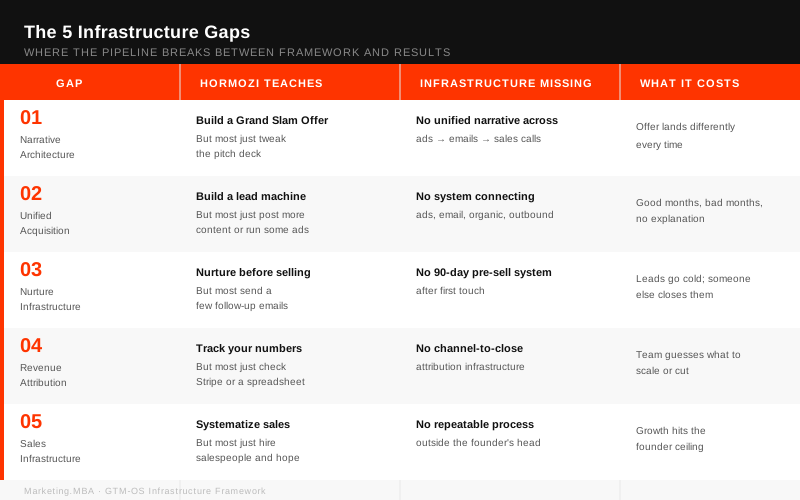
The 5 Infrastructure Gaps: Full Mechanism
Gap 1: No Narrative Architecture
Hormozi teaches: Build a Grand Slam Offer so differentiated it becomes a category of one. The subtitle of $100M Offers names the standard: "How to Make Offers So Good People Feel Stupid Saying No." Win on offer, not on price.
What most people do: Tweak the pitch deck. Update the homepage. Rewrite the sales script, but not the underlying structure of the offer or the chain of claims that carries it.
Why this happens: The Grand Slam Offer exists in a document, not in the funnel. The ad describes it one way, the landing page another, the email sequence a third, and the sales call starts by re-explaining it from scratch. The offer travels through every touchpoint as a concept, not as a system. Each person involved in the sales process recreates the narrative from scratch based on their interpretation, so the buyer gets a different experience depending on which rep they spoke to and which ad they clicked first.
The positioning failure shows up plainly in the language prospects and team members use. An agency owner reviewing ad scripts for a high-ticket coaching client described it precisely: "The output was a little bit off. It was talking about the wrong issues, the wrong pain. I was targeting the wrong person." And a B2B services founder with multiple products: "We're open to cold outreach. We just don't know which offer to go out with, or who to target." Both are symptoms of an offer that hasn't yet been translated into one consistent, targeted belief chain.
What it costs: The offer lands differently every time. One call it resonates completely; the next it falls flat. Teams blame "lead quality" or "the closer," when the actual problem is that the buyer's experience of the offer is inconsistent. You can't optimise what isn't consistent. More troublingly, when positioning doesn't create category separation, price becomes the default comparison metric. Prospects ask what you charge before they've understood why you're different, and you're in a race you didn't want to enter.
The infrastructure response: A Grand Slam Offer that lives in a doc is not yet a system. The infrastructure job is to carry one belief chain from first ad impression to signed contract, so the offer is carried rather than re-pitched at every touchpoint. That's the Narrative Architecture layer.
Self-diagnose: Does your market immediately know you're different, or do they compare you to competitors? If they compare, this gap is yours.
What the GTM-OS layer does: Installs one belief chain, the same core claim and proof from the first ad impression to the signed contract. The offer isn't re-pitched at each touchpoint; it's carried. Ads, landing pages, email sequences, and sales calls are expressions of the same narrative, not independent translations of it. Performance branding, the desire/identification/belief model, is the operational framework for building this chain. The result is that conversion rates stabilise because the buyer's experience becomes consistent across every touchpoint and every team member.
Gap 2: No Unified Acquisition System
Hormozi teaches: Build a lead machine using the Core Four (warm outreach, post free content, cold outreach, paid ads) and do the volume. The Rule of 100 prescribes 100 primary lead-generation actions per day. Do more of what works before you try something new.
What most people do: Post more content, run some ads, try a cold outreach campaign, each as a separate initiative, each measured in isolation, each blamed for the bad months.
Why this happens: The Core Four is a structural model, not a connected system. Nothing connects the channels or optimises for the one conversion event that actually predicts revenue downstream. Paid ads run on their own metric. Content gets tracked by engagement. Cold outreach has a separate CRM. Organic traffic lives in Google Analytics. When you have separate initiatives instead of a unified acquisition architecture, good months are lucky and bad months have no explanation, because nothing is actually connected.
The acquisition breakdown has a consistent shape in how founders describe it. "We have no leads. So now we're forced to go out and do cold outreach." That reactive scramble is what an absent acquisition system produces. At the channel level, the constraint is equally clear: "The biggest issue to me is the top-of-funnel campaign just not generating enough leads. That's the main problem I see." And when unit economics surface: "Everything's a bit too high. Cost per lead's a bit high, and cost per click's high." These aren't ad-platform problems. They're acquisition-system problems that surface in the metrics.
What it costs: Pipeline you can't forecast and a cost-per-lead that makes no economic sense at scale. Operators describe ending a multi-week push with a couple of relevant leads and a cost-per-lead far too high to justify. Then the paid ceiling arrives. At the $30K–$50K/month level, paid acquisition stops scaling linearly with more budget and starts requiring a fundamentally different approach. The team has no framework for what to do when the channel stops working. See the full breakdown on scaling high-ticket Facebook ads past that ceiling, the mechanism matters more than the budget.
The infrastructure response: The Core Four describes what to do. The KFC Method is how you make all four channels work together. Engineer and measure the one first-click event that predicts downstream revenue, so all four channels feed one acquisition architecture instead of four separate experiments.
Self-diagnose: Can you predict next month's revenue within 15%? If no, this gap is almost certainly part of it.
What the GTM-OS layer does: Installs the KFC Method (Key First Click), engineers and measures the first meaningful conversion event so that downstream show rates, close rates, and LTV become predictable. Rather than treating each channel as a separate experiment, a unified acquisition architecture means paid channels feed the database, content feeds the nurture system, and outbound targets the bottom of the funnel. Pull one lever and the others compensate. The Key First Click is the measurement point that makes the whole thing attributable and the whole acquisition system coherent.
Gap 3: No 90-Day Pre-Sell / Nurture Infrastructure
Hormozi teaches: Give before you ask. Lead magnets and free value earn trust before the sales conversation. A lead is someone who took an action, and the best lead source is a happy customer. Warm the stranger first.
What most people do: Send a few follow-up emails. Run a retargeting ad. Check in once or twice. Then mark the lead cold and move on.
Why this happens: "A few follow-ups" treats the nurture window like a 48-hour window when the actual decision cycle for high-ticket offers is 30–90 days. Leads opt in, go through a week of emails, and then fall into a gap, because nothing carries them across the full buying cycle. During that gap, someone else grabs the customer you warmed up. The problem isn't the lead quality. The problem is that the infrastructure stops before the decision does.
The gap shows up clearly in how follow-up actually gets handled. When asked what the follow-up looked like after a lead opted in, an agency owner said: "Only via email. Only the automated emails that go out." On a deal that had stalled: "I've done follow-up, I've spoken to them. But the last conversation was pretty much a no, so I could follow up again." Both describe leads left in limbo: warmed but not converted, with no systematic process to carry them across the 60-to-90-day decision cycle.
What it costs: Calls that start from zero. Low show rates. Revenue sitting in the 60-day window that nobody's capturing. Founders describe it precisely: "the danger with webinars is they see nothing from you afterward, then someone else grabs the customer I warmed up." A large share of the calls that do book only happen because of the follow-up sequence, not the initial opt-in. Up to 50% of webinar revenue comes from the follow-up sequence, not the webinar itself, which means that if your follow-up ends at day 7, you're leaving the majority of the potential revenue on the table (pattern observed across the portfolio; not a guaranteed result for any individual business).
The infrastructure response: The give-before-ask starts the belief; it doesn't finish it. High-ticket decisions run 30–90 days, so the infrastructure is a 90-day gradualization sequence (symptom-awareness to mechanism understanding to goal conclusion), behavior-triggered and mapped to the objections buyers carry at each stage. The sales call confirms a decision that's been building for weeks, not starts it.
Self-diagnose: Do leads that don't close immediately still convert 60 days later? If no, this gap is open.
What the GTM-OS layer does: Installs the 90-day gradualization sequence (symptom awareness to mechanism understanding to goal conclusion), automated, behaviour-triggered, and mapped to the specific objections your buyers carry at each stage of the decision cycle. Leads that eventually book calls have already been educated. The sales call confirms a decision that's been building for weeks, not starts it. The high-ticket lead generation system, the 4-pillar framework covering mathematical foundation, audience targeting, message architecture, and journey coherence, is the operational guide for this layer.
Gap 4: No Attribution Connecting Spend to Revenue
Hormozi teaches: Know the math. Work in lifetime gross profit to customer-acquisition cost (LTGP:CAC) and the cash cycle. $100M Money Models sets the bar precisely: "A Money Model is a deliberate sequence of offers. It's what you offer, when you offer, and how you offer it to make as much money as you can as fast as you can."
What most people do: Check revenue in Stripe. Maybe export a spreadsheet. Review ad-platform dashboards without connecting them to closed deals.
Why this happens: Attribution infrastructure (UTM discipline, CRM-as-source-of-truth, server-side tracking, and a weekly review cadence) is a system build, not a report. Most businesses have data in three systems that don't talk: the ad platform, the email tool, and the CRM. Connecting them takes deliberate infrastructure work that doesn't happen as a side effect of running ads. So decisions keep running on gut and retrospective memory: "I think Facebook was working better in Q3."
The attribution need is clear when founders articulate it: "At the end of the day, it's about being able to easily trace which leads came in through which ads." That's not a reporting request. It's a description of what the system doesn't yet do.
What it costs: Scaling decisions made on instinct. The team doubles the lucky campaign and cuts the working one. "We spend a fortune and still can't tell which part of that spend produced clients." And: "I can't calculate the whole thing." Without attribution, every optimisation is a guess. Every budget decision is a bet. Deterministic Backward Pressure, the 5-layer constraint framework that runs 90% math and 10% judgment, is the decision spine that makes spend-to-revenue attribution calculable rather than intuited.
The infrastructure response: Hormozi's LTGP:CAC math only runs if you can see it. The infrastructure traces spend to closed revenue by channel, offer, and rep, via server-side tracking, CRM-as-source-of-truth, and a weekly attribution cadence. Then the cash-cycle math stops being a theory and becomes a dashboard.
Self-diagnose: Do you know exactly which channel drove each of your last 10 clients? If no, this gap is yours.
What the GTM-OS layer does: Installs tracking that traces spend to closed revenue (not leads, not calls booked, but signed clients), by channel, by offer, by sales rep. Server-side tracking, CRM-level source mapping, and a weekly attribution review cadence are the three structural components. With this layer in place, the team knows where to scale and where to cut with actual data. Scaling stops being a bet. The full framework: Marketing Attribution for B2B.
Gap 5: No Sales Infrastructure Beyond the Founder
Hormozi teaches: Systematize people. $100M Leads names "Lead Getters" (customers, employees, agencies, affiliates) who multiply reach beyond the founder. $100M Lost Chapters expands the employee play with the 3 Ds (Document, Demonstrate, Duplicate) for turning team members into repeatable performers.
What most people do: Hire closers. Train salespeople informally. Put them on commission and expect the process to transfer.
Why this happens: "Train salespeople" without first standardising the call structure, the qualification criteria, the objection handling, and the pre-sell that the call is supposed to confirm. The process and the judgment live in the founder's head, and when a new closer gets on a call, they're improvising from a different starting point. The founder's close rate becomes a personality trait, not a system output.
The strain shows up in how founders describe their own situation. From co-founders of a B2B services firm: "We're the salespeople and at the same time the faces who go out in public on social media, so we keep slipping out of sales and too far into marketing, and now we're trying to find the balance to get our focus back on sales." The other co-founder framed the same tension from a different angle: "The challenge is that we, as the salespeople, have slipped into the marketing role, even though our core business should be sales." When the founders are both the only closers and the only demand engine, neither function scales.
What it costs: Growth hits the founder ceiling. The team doesn't know which offer to push, which lead to prioritise, or how to handle edge cases without escalating. Close rate becomes something the founder has and the team doesn't. "Heavy convincing on a sales call usually means system failure upstream." The positioning, the pre-sell, or the qualification criteria haven't done their job before the call began. The business can't grow beyond the founder's personal capacity to be on calls. Understanding why your CAC keeps rising almost always leads back to a system failure upstream of the sales call itself.
The infrastructure response: Document, Demonstrate, Duplicate is exactly right. The highest-leverage place to apply it is the sales call itself: standardize the call structure, qualification criteria, and talk tracks that extend the pre-sell, so close rate is a system output, not a founder personality trait. Then you hire into a system instead of cloning yourself.
Self-diagnose: Does your sales process produce the same result regardless of who runs the call? If no, this gap is open.
What the GTM-OS layer does: Standardises the call structure, qualification criteria, and talk tracks that extend the pre-sell, so that close rate is an output of the system, not a personality trait. The process runs the same regardless of who runs the call, which means you can hire into a system and measure it. The GTM operating system for $1M–$10M founders covers the sales standardisation layer in Phase 2 of the implementation sequence, alongside the five failure modes the GTM-OS is designed to eliminate.
The Map vs. The Vehicle: A Direct Comparison
$100M Leads teaches the principles. The operating system is what deploys them consistently.
What Hormozi's framework gives you | The infrastructure layer that deploys it |
|---|---|
A Grand Slam Offer | Narrative architecture that carries the offer across every touchpoint |
The Core Four (warm outreach, content, cold outreach, paid ads) | A unified acquisition system that measures the one click that predicts revenue (KFC) |
Lead magnets / give-before-you-ask | A 90-day pre-sell & nurture system that converts the 30–90-day buyer |
The Rule of 100 (volume of daily action) | An operating cadence + SOPs so volume is systematised, not founder-heroics |
"Know your numbers" / unit economics | Attribution that ties spend to closed deals, not revenue-in-Stripe |
Hire and train a sales team | Sales infrastructure that produces the same result regardless of who runs the call |
The principles of lead generation | The operating system that runs the principles when you're not in the room |
You consumed the map. This is the vehicle.
What the Infrastructure Actually Looks Like
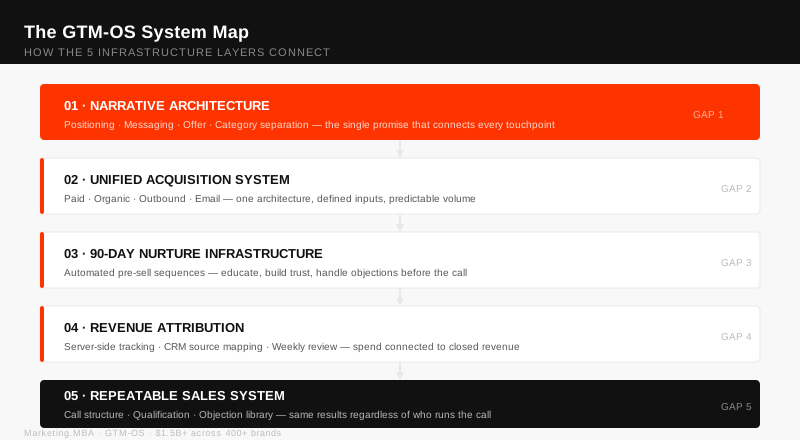
The GTM-OS (the Go-to-Market Operating System developed by Marketing.MBA) was built specifically to close these five gaps for founder-led B2B businesses between $1M and $10M in revenue. It's not another framework to layer on top of what you already know. It's the operating system that runs the tactics Hormozi teaches, so the framework produces consistent output rather than unpredictable results.
Where Hormozi's four books each hand you one playbook, the GTM-OS is what runs all four routes at once: positioning, acquisition, nurture, attribution, and sales wired together as one system.
Raoul Plickat, founder of Marketing.MBA, on building marketing systems that scale.
Here's how the GTM-OS maps to each gap:
Narrative Architecture → Positioning & Messaging Layer. The GTM-OS starts with a positioning and messaging audit that builds the single coherent narrative your offer needs to travel across every channel. Ads, emails, landing pages, and sales scripts are connected to one core promise, so conversion rates become predictable because the buyer's experience becomes consistent from first ad to signed contract.
Unified Acquisition → Multi-Channel Acquisition System. Rather than treating each channel as a separate experiment, the GTM-OS builds a unified acquisition architecture with the KFC at the measurement core. This is the layer where results compound fastest. A consulting-company client (running a complex, long-cycle B2B offer) generated $110M+ in revenue over five years on approximately $17M in ad spend, with 550%+ ROAS sustained across the full engagement and 17,400+ qualified leads generated (verified public source: GTM-OS case studies, fetched 2026-06-25). That's not a campaign result; it's what a unified acquisition system produces when it runs consistently over time.
Nurture Infrastructure → Pre-Sell & Lead Nurture System. The GTM-OS installs the 90-day pre-sell sequence, automated, behaviour-triggered, and mapped to the specific objections buyers carry. For health and wellness clients using webinar-based models, the mechanism gets sharp: Healing Humans scaled to $2,069,353 in revenue with 1,645% growth over 13 months, sustaining 8–10x webinar ROAS (verified public source: GTM-OS case studies). The mechanism was structured nurture infrastructure connecting first touch to close, not a bigger ad budget or a better pitch.
Attribution → Tracking & Revenue Attribution. The GTM-OS integrates server-side tracking, CRM-level source mapping, and a weekly attribution review cadence so the team knows (with data) which channel drove which client, what the cost-per-acquisition was, and where to scale or cut. Scaling stops being a gut call.
Sales Infrastructure → Repeatable Sales System. The GTM-OS documents the sales process from first touch to closed deal and decouples it from the founder. The process runs the same regardless of who runs the call, the only way to scale a sales team without becoming its quality manager.
None of this replaces what Hormozi teaches. It operationalises it.
A $1M–$10M Pipeline Walkthrough: Breaking, Then Fixed
Make this concrete. Consider a composite founder (consultant, $1.8M revenue, B2B, high-ticket offer at $15K–$25K) who's read $100M Leads, implemented the framework in good faith, and still can't forecast pipeline.
The breaking state.
They run paid ads (the Core Four). Lead volume is inconsistent: some weeks 20 leads, some weeks 4, and they can't explain the variance. The cost-per-lead fluctuates unpredictably. Illustrative: at a 50% show rate and 20% close rate, hitting $200K/month in revenue from a $15K ACV offer requires roughly 133 booked calls, which at 20 leads/week and a 40% opt-in-to-booking rate requires consistent lead volume sustained for months without interruption. Any gap in the nurture sequence or the acquisition system resets the effective clock. (Model sourced from the published Reduce CAC for B2B SaaS framework, illustrative, not a client figure.)
The follow-up ends at day 10. Leads go cold. The sales calls that do happen start from zero: the prospect remembers opting in three weeks ago but hasn't been warmed since. Close rate is 18% when the founder runs the call personally, 9% when the associate does. Nobody knows which ad or which sequence drove the clients who did close. Budget decisions are made on gut and recency bias.
The founder runs the five diagnostic questions. Every answer is no. The business is running on founder-heroics rather than infrastructure, and every good month is followed by a bad month with no structural explanation.
The installed state: what the verified case data shows.
With unified acquisition infrastructure in place, the results documented in verified GTM-OS case studies are compounding, not linear:
Consulting-company client: $110M+ in revenue, ~$17M in ad spend, 550%+ ROAS sustained over 5+ years, ~6,365% growth, 17,400+ qualified leads generated, 92,000+ books sold. The mechanism: a unified acquisition system running consistently over time, not a single campaign spike.
Healing Humans: $2,069,353 in revenue, 1,645% growth over 13 months, 8–10x sustained webinar ROAS. The mechanism: structured nurture infrastructure that captured the 60-day buyer, not a bigger ad budget.
Do not read these numbers as predictions for your business. They are what the installed system has produced for specific clients, documented and verified publicly. The principle: consistent infrastructure produces compounding results. Inconsistent tactics produce a flatline with occasional spikes.
The Deterministic Backward Pressure framework makes the math run backward from the revenue target, so you know exactly how many leads, at what conversion rates, with what nurture length, are required to produce a predictable outcome. That's what changes when infrastructure replaces improvisation: decisions become math rather than instinct.
The 5 Diagnostic Questions
Here's the fastest way to identify which gap is your binding constraint. These are the same five questions used in the GTM Audit. Answer honestly. A "yes" you're not certain about is a no.
1. Can you predict next month's revenue within 15%?
If no, you're missing a unified acquisition system (Gap 2) or a nurture infrastructure that creates consistent pipeline timing (Gap 3). Likely both. Unpredictable revenue is almost always an acquisition or nurture failure, not a closing failure. Hiring a better closer into a broken acquisition system produces a better-paid closer with the same pipeline problem.
2. Do you know exactly which channel drove each of your last 10 clients?
If no, that's Gap 4. You have an attribution gap. The data either isn't being captured at source level or isn't being connected at the CRM level. Every scaling decision you make without this is a bet dressed up as a strategy.
3. Does your sales process produce the same result regardless of who runs the call?
If no, that's Gap 5. The process lives in the founder's head. When the founder runs the call, it closes. When someone else does, it doesn't. That's a sales infrastructure problem, not a sales talent problem. The gap is upstream of the call, in the pre-sell and the process documentation, not in the closer.
4. Do leads that don't close immediately still convert 60 days later?
If no, that's Gap 3. High-ticket decisions take 60–90 days from first awareness to close. If you're not nurturing for the full decision cycle, you're generating pipeline you're not capturing. This is often the most expensive unclosed gap: the revenue was already warmed up; the infrastructure just wasn't there to close it.
5. Does your market immediately know you're different, or do they compare you to competitors?
If no, that's Gap 1. Narrative architecture. Your positioning isn't creating category separation, which means price is the default comparison metric. Fix this before scaling acquisition: you're spending money to run a race you shouldn't be in.
A single "no" points to a specific layer. Multiple "no" answers mean the infrastructure isn't in place, and adding another tactic will produce another good month followed by another bad one.
This is the starter version of the GTM Audit (free self-assessment). The full version maps your specific constraints to the GTM-OS infrastructure layers and tells you which one to fix first.
How to Actually Deploy Hormozi's Framework at Scale
The founders who get the most out of $100M Leads are not the ones who study it the hardest. They're the ones who build the infrastructure that makes its principles run continuously.
Deployment for a $1M–$10M founder-led business follows a specific sequence, not because there's one right order for every situation, but because fixing the wrong constraint first is expensive and rarely compounding.
Step 1: Positioning before acquisition.
Before running a single new campaign, run the five diagnostic questions. If you can't answer #5 (positioning) or #1 (revenue predictability), you're not ready to scale acquisition. Spend the budget on installing narrative architecture first. Ads amplify what's already working. They don't fix what isn't. Every dollar you spend before the positioning layer is solid accelerates the problem.
Step 2: Install the Key First Click.
The first touchpoint is the moment a stranger decides whether to go deeper or move on. Most businesses treat this as a traffic problem. It's a message architecture problem. The wrong message to the right audience is still the wrong result, and adding more budget makes it a more expensive wrong result. The high-ticket lead generation system, the 4-pillar framework covering the mathematical foundation, audience targeting, message architecture, and journey coherence, is the operational guide for building this correctly.
Step 3: Build the 90-day nurture before scaling spend.
Most founders skip this step. They want more leads before they've built the system that converts the leads they already have. The math is direct: if your 90-day nurture infrastructure converts 15% of warm leads versus 3% without it, you need five times the lead volume to produce the same revenue. That's five times the ad spend. Build the nurture infrastructure first. Scale acquisition second.
Step 4: Get attribution to channel level before scaling.
You need to know which channel is driving closed revenue (not leads, not calls booked, but signed clients) before you double any budget. This means CRM-level source tracking, weekly reviews of cost-per-acquisition by channel, and a decision rhythm that runs on data. Without this, scaling is structured guesswork. The GTM operating system for $1M–$10M founders builds this attribution layer as part of the Phase 2 infrastructure install.
Step 5: Systematize sales before hiring.
The founder ceiling is almost always a sales infrastructure problem. Document the call structure, the qualification criteria, the objection library. Build the pre-sell that the call is supposed to confirm, so the conversation on the call is a confirmation, not an education. Then hire into a documented system, not into a void. A second closer hired into an undocumented process doesn't halve the founder's workload; it doubles the quality-control problem.
The businesses that successfully deploy Hormozi's framework aren't doing different things than the ones that don't. They're doing the same things through a system that makes those things consistent, measurable, and scalable without the founder running every piece personally. That's the infrastructure layer. That's what the GTM-OS builds.
The Difference Between Reading the Map and Having the Road
Alex Hormozi's lead generation framework is not the problem. The principles are right.
The Implementation Wall is the problem, the gap between "I understand this" and "this runs in my business without me holding it together every week." That wall is an infrastructure wall. It shows up in the same five places, in almost every founder-led business, regardless of the vertical. The five gaps aren't random: they're the five components every predictable revenue machine needs, and the five components the Hormozi framework rightly describes but doesn't install.
If you answered "no" to any of the five diagnostic questions above, you know which layer is your binding constraint. That's where to start, not with another lead magnet or another ad campaign, but with the layer that's preventing the work you've already done from compounding.
The GTM Audit (free self-assessment) maps your specific constraints to the GTM-OS infrastructure layers and tells you exactly which one to fix first.
No pitch. No price. Clarity on where the system is breaking and what addressing it first looks like.
FAQ
What is Alex Hormozi's lead generation framework?
Alex Hormozi's lead generation framework (detailed in $100M Leads) is built around three core ideas: a compelling, differentiated Grand Slam Offer; the Core Four methods for getting leads (warm outreach, free content, cold outreach, paid ads); and the discipline of consistent volume (the Rule of 100). The framework establishes that lead generation is a system with defined inputs and outputs, not a collection of disconnected activities. The principles are sound. The gap most founders hit is the infrastructure layer that makes the model run consistently once the founder isn't personally operating every part.
Does Alex Hormozi's $100M Leads actually work?
The principles in $100M Leads are sound: the offer logic, the Core Four, the give-before-ask discipline. The framework is a genuine and useful map. Where most founders stall is that understanding a framework and operating one are different things. The Implementation Wall is the gap between consuming the framework and having predictable pipeline, and it's an infrastructure problem, not a knowledge problem. More reading doesn't close it. Installing the five infrastructure layers does.
What are the Core Four in $100M Leads?
The Core Four are the four ways Hormozi identifies to get leads: warm outreach (contacts you already have), posting free content publicly (organic), cold outreach (cold calls, email, DMs), and running paid ads. The framework is correct that all four work and that a real lead machine systematises them. The extension is a unified acquisition system, the KFC Method (Key First Click), that runs all four coherently and measures the one conversion event that makes each channel attributable to closed revenue, not just leads generated.
What is the Rule of 100?
The Rule of 100 is Hormozi's prescription: commit to 100 primary lead-generation actions per day (DMs, calls, posts, or ads shown). It's correct about volume, and most founders underestimate how much consistent volume matters. The extension is an operating cadence and SOPs that systematise that volume, so the Rule of 100 survives when you're not the one executing it personally. Volume that depends on founder heroics doesn't survive delegation. Infrastructure is what makes the discipline scalable.
Why am I still stuck after reading $100M Leads?
You've hit the Implementation Wall. It's not a failure of the framework and it's not a failure of effort, it's the gap between a framework that tells you what predictable lead generation looks like and the infrastructure that makes it run continuously. The Wall has five bricks: no narrative architecture, no unified acquisition system, no 90-day nurture, no attribution, and no sales infrastructure beyond the founder. The five diagnostic questions in this article identify which brick is yours.
Why is my lead generation inconsistent even though I followed the framework?
Inconsistency at the pipeline level almost always traces to Gaps 2, 3, or 4, or some combination of all three. No unified acquisition system means you can't explain the variance between good months and bad months. No 90-day nurture means you're not capturing the leads you already warmed up. No attribution means you're likely scaling the wrong channel. Any one of these gaps alone produces "good months, bad months, no explanation." All three together produce a business that feels like it should be working but isn't.
What's the difference between lead generation and lead-generation infrastructure?
Lead generation is the activity: ads, content, outreach. Lead-generation infrastructure is the system that makes those activities produce consistent, predictable output rather than variable results that depend on who's running them today. The activity is the tactical layer; the infrastructure is the operating system that runs the tactics when you're not in the room. Hormozi's framework is excellent at defining the activity layer. This article is about the infrastructure layer that deploys it.
How do I make my pipeline predictable and forecast next month's revenue?
Revenue predictability comes from two infrastructure layers working together: attribution (knowing which channel is producing closed revenue, not just leads) and acquisition consistency (a unified system producing stable lead volume across all channels). Without attribution, you don't know what to scale. Without a unified acquisition system, volume is subject to which channel happened to work this week. The GTM Audit (free self-assessment) maps exactly which of these constraints is your binding one and what addressing it first looks like.
How is high-ticket lead generation different from low-ticket?
Three structural differences change the infrastructure requirements entirely. First, the buying cycle is 30–90 days rather than minutes, which means you need nurture infrastructure that runs the full decision cycle, not a short email sequence. Second, the intangible nature of high-ticket offers means the prospect is buying on trust and belief built over time, not on product features they can evaluate immediately. Third, the cost of the wrong lead is high because of the sales time invested per call. For the full framework: high-ticket lead generation system.
What is a GTM operating system, and how does it deploy Hormozi's principles?
A GTM operating system is the connected infrastructure that makes a go-to-market strategy run consistently: positioning, acquisition, nurture, attribution, and sales in one coherent system rather than five separate experiments. It deploys Hormozi's principles beyond the founder's personal execution: narrative architecture carries the Grand Slam Offer across every touchpoint; the unified acquisition system runs the Core Four with attribution; the 90-day nurture finishes the lead magnet's job across the full decision cycle; attribution connects spend to closed revenue; and sales infrastructure runs the sales process without the founder on every call. The GTM operating system for $1M–$10M founders is the full guide to how this system is structured and what installing each layer produces.
By Raoul Plickat, founder of Marketing.MBA, the firm behind $1.5B+ in client revenue across 400+ brands.