
Facebook Ads for High-Ticket Offers: Scaling Beyond $50K/Month
Have you ever had great results at $500/day that completely fell apart at $2,000/day?
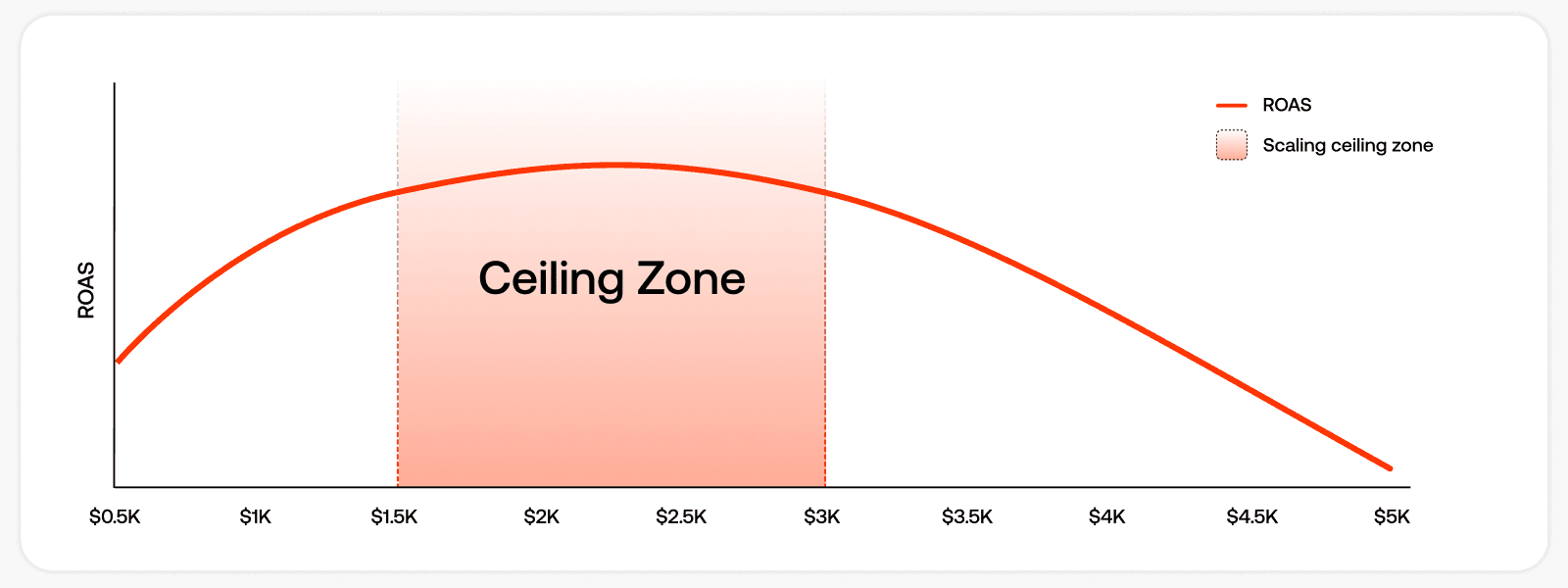
At low spend, everything looks incredible, cheap bookings, strong ROAS, a calendar full of qualified calls. Then you increase the budget and watch it unravel. CPMs spike. Creative fatigues overnight. The same audience that was converting stops converting.
The instinct is to blame the algorithm, the creative, or the targeting. But the real problem is structural: you built a campaign that works at test budget, not a system that scales.
Why Most High-Ticket Businesses Hit a Facebook Ads Ceiling at $30–50K/Month
There's a predictable wall between $30K and $50K in monthly Meta spend. The symptoms are consistent:
ROAS declining as you scale, what worked at $100/day fails at $500/day
Creative fatigue accelerating, new ads burn out in days instead of weeks
Frequency climbing: your audience has seen your ads 3, 4, 5+ times
Cost per booked call increasing despite constant "optimization"
Performance volatility, great Monday, terrible Tuesday, no explanation for either
The root cause is the algorithmic echo chamber. Meta's delivery system (Andromeda, GEM, Lattice) optimizes to find people most likely to convert. At low spend, this is brilliant. The algorithm zeroes in on your ideal audience fast. But as you scale, you exhaust that initial high-intent pool. The algorithm reaches into broader, colder segments who haven't engaged with you and have no reason to trust you yet.
Your ad that converted warm prospects now needs to convert cold prospects. That's not an optimization problem. It's an architecture problem.
The Math That Must Work Before You Scale
Before touching a single campaign setting, apply mathematical backpressure to your Meta spend specifically:
Revenue target → allowable CAC → maximum cost per booking (CPB) → required show rate → daily budget allocation.
Work backward from your revenue target to determine what your Meta spend should be, based on unit economics, not based on what you can afford to spend or what the agency recommends. If the math says your allowable spend is one number but you're spending three times that, you're subsidizing Meta's revenue with negative-ROI impressions.
The rule: define the mathematical foundation before tactics. If the numbers don't support the spend level you want, fix the numbers, improve close rate, increase price point, improve conversion rate, rather than forcing the budget and hoping the math catches up.
The Reach Problem Nobody Talks About
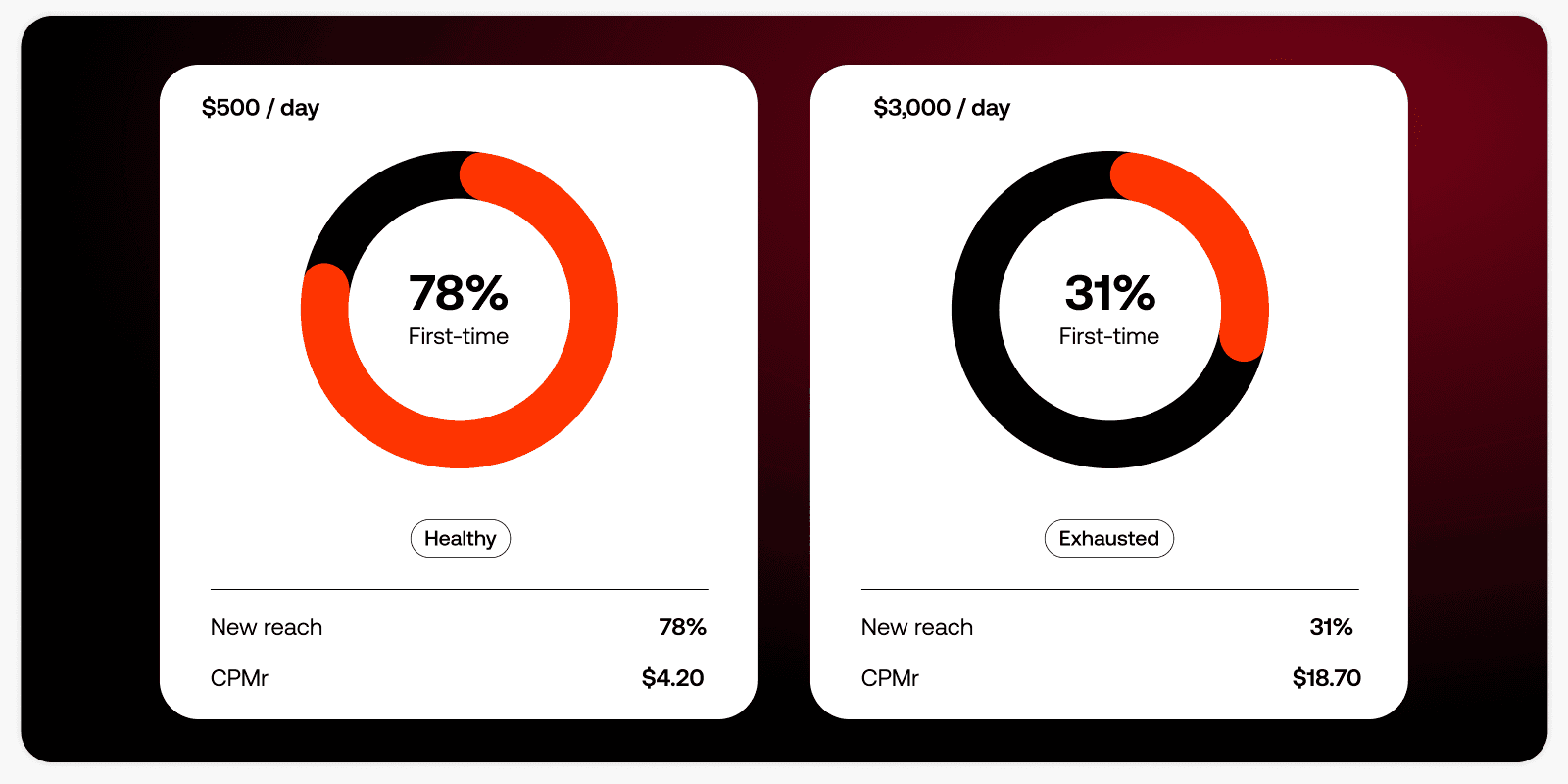
FTIR. First-Time Impression Ratio, is the metric that explains why scaling kills performance. It measures what percentage of your impressions reach people for the first time vs. re-hitting people who've already seen your ads.
At low spend, FTIR is naturally high. As you scale, FTIR drops, more budget goes toward showing ads to the same people again. For high-ticket offers, incremental impressions to the same person have rapidly diminishing returns.
CPMr (Cost Per Mille. Reach) becomes more important than standard CPM at scale. CPM tells you what you pay per 1,000 impressions. CPMr tells you what you pay per 1,000 unique people reached. As you scale, the gap widens, and that gap is pure waste.
The structural fix:
Top-of-funnel: Broad reach campaigns optimized for video views or content engagement, not conversions. Introduce your brand and mechanism to new audiences at low cost.
Middle-of-funnel: Retarget people who engaged with TOF content. Conversion ads to people who already have context. Cost per booking drops because belief has started forming.
Bottom-of-funnel: High-intent retargeting, website visitors, page viewers, partial form completions. Tight audiences, direct response creative.
This is performance branding applied to campaign architecture: conversion campaigns only hit warm audiences, people the brand layer has pre-qualified.
Creative Strategy That Scales
At scale, your ads need to disqualify the wrong people more than they attract the right ones.
At test budget, you want the most compelling creative possible. At scale, you want creative that repels the wrong people and attracts only the right ones. At $2,000/day, every unqualified click costs real money.
The believability architecture applied to ad creative works in graduated claims:
Level 1: Symptom identification. Describe the prospect's specific pain in their own language. This filters for people actually experiencing the problem.
Level 2: Mechanism introduction. Introduce the idea that a structural reason exists. Not a tactical fix. This filters for people ready for a systems-level answer.
Level 3: Proof + authority. Specific results from real work. This filters for people who respond to evidence over hype.
The critical principle from the content brief: "Never ask the market to identify with an image they can't reach from their current position." If your audience is at $1M ARR struggling to break $3M, don't lead with "$100M empire" messaging. Meet them where they are and graduate them toward the aspirational state through the funnel, not in a single ad.
The Testing Framework
Testing at scale requires discipline:
Rule 1: Separate tests from your main landing page. Your main LP is optimized for warm traffic. New creative tests should go to a dedicated test page to measure cold traffic performance without contaminating warm traffic data.
Rule 2: Fresh ads to fresh audiences. When testing new creative, exclude anyone who's interacted with your content in the last 30–90 days. Measure how the ad performs with genuinely cold prospects, that's who you're scaling into.
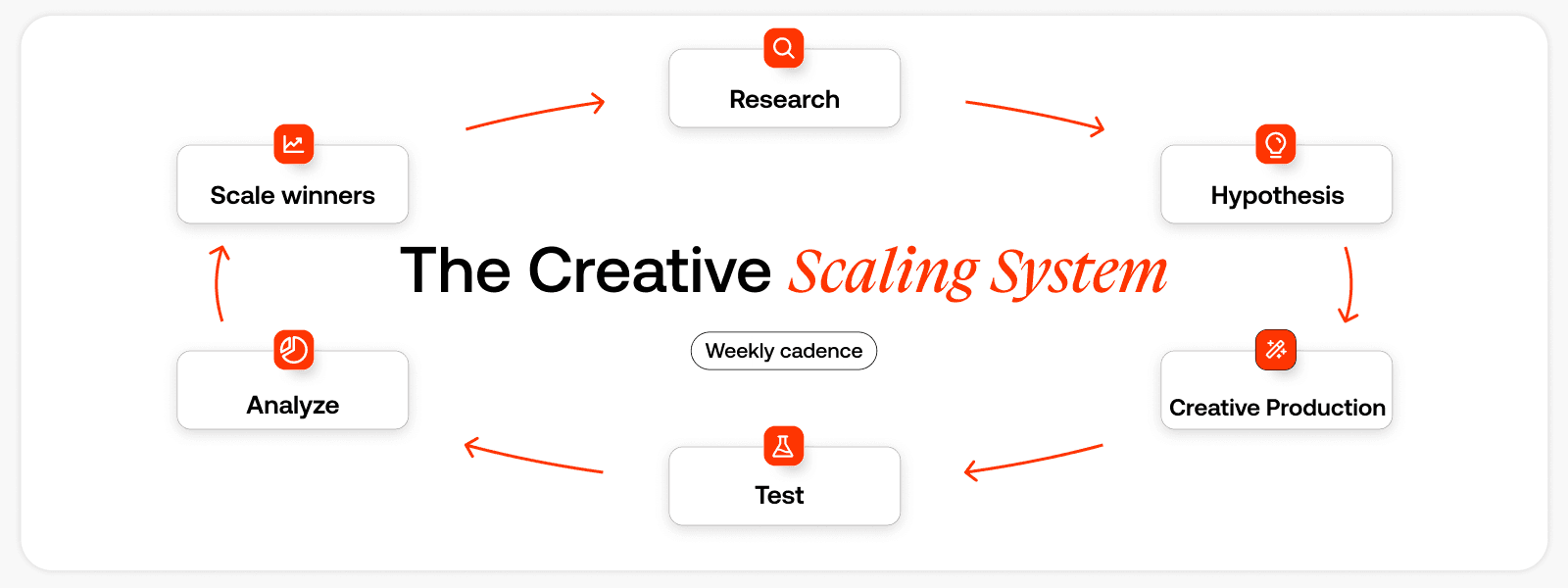
Rule 3: Hypothesis-driven, math-connected. Every test has a thesis, a metric, a threshold for success, and a decision rule. No "let's just see how it does."
Rule 4: Time-boxed. If a creative hasn't proven itself in 30 days with sufficient spend, it won't. Kill it, extract the insight, move on.
Beyond $100K/Month: When Infrastructure Matters More Than Tactics
At $100K+/month, performance is determined by infrastructure:
Unit economics: Is the math sound at scale, not just at test budget?
Journey coherence: Does every touchpoint from ad to close tell one story?
Attribution clarity: Can you actually measure what's working at this spend level?
Creative velocity: Can you produce enough high-quality creative to prevent fatigue?
Sales infrastructure: Can your team handle the volume without close rates dropping?
None of these are "Facebook ad" problems. They're GTM infrastructure problems. They're exactly what the GTM-OS is designed to solve.
The difference between businesses that stall at $50K/month and those that scale past $100K is not better ads. It's the system behind the ads. A GTM operating system rather than a collection of campaigns duct-taped together.
Verified Results: High-Ticket Meta Ads at Scale
From Marketing.MBA's case study portfolio, real campaigns, real numbers:
Philipp Plein: 13 million impressions through $65K ad spend during a 6-day campaign. $8M+ in revenue. 3,960% ROAS. This is what happens when performance branding, brand perception control fused with direct response precision, is compressed into a single launch window. View full case study.
Jürgen Höller: $430,000+ in monthly peak ad spend driving $10.3M+ in revenue over 7 months. 8.65x ROAS sustained. 2,000+ leads per week at peak performance. View full case study.
Finance Trading App: Scaled from $11K to $718K+ revenue with ~$200K total ad spend. 3.6x ROAS. ~$99 CAC through complete brand rebuild and structured campaign architecture. View full case study.
Frequently Asked Questions
Is Facebook still viable for high-ticket B2B in 2026?
Yes. Meta remains one of the most effective paid channels for high-ticket offers. Advantage+ and AI-driven optimization continue improving, and Conversions API has improved tracking accuracy. The businesses struggling on Meta aren't struggling because the platform is broken, they're struggling because their campaign architecture doesn't support scale.
What's a good cost per booked call for high-ticket offers?
It depends entirely on your price point and close rate. Always evaluate CPB relative to your unit economics using the mathematical backpressure model. Not against generic industry benchmarks that may not apply to your price point.
How do I prevent creative fatigue at scale?
Treat creative production as a system, not a project. At $50K+/month, you need a continuous pipeline of new creative. Not just a library of "evergreen" ads. Batch production (multiple concepts filmed in one session, edited into variations) is the most efficient approach.
What budget increase is safe without disrupting performance?
The general guidance is 20–30% increases per 3–5 day period. Larger jumps can trigger learning phase resets. If you need to scale faster, clone winning ad sets at the new budget rather than increasing existing ones.
Next Steps
Whether you're hitting the scaling ceiling on Meta right now or about to invest $50K+ and want the infrastructure built before the spend, the starting point is the same: figure out which layer of the system is breaking. The Infrastructure Audit runs your campaigns through the same five-layer diagnostic that produced the results above.
See how the KFC Method and campaign architecture fit within the GTM operating system, or apply for an Infrastructure Audit to diagnose where your current system breaks at scale.
Marketing.MBA | $1.5B+ in verified client revenue across 500+ businesses.