
Deterministic Backward Pressure (DBP): The Decision Framework Behind $1.5B in Revenue
"If you find yourself relying on judgment more than math, the system is broken."
Every marketing decision your team makes falls into one of two categories: deterministic (the math says yes or no) or judgment-based (someone's opinion says yes or no). In most 7-figure businesses, the ratio is inverted. The majority of decisions about creative, channels, budget, and messaging are driven by gut feel, past experience, or whatever the loudest voice in the room thinks will work.
That's not a strategy. That's an expensive guessing game.
Deterministic Backward Pressure (DBP) is the decision framework that reverses this. Every decision traces backward from the terminal revenue event. The ratio rule: 90% deterministic quality checks, pass/fail gates based on math. 10% is where judgment lives, constrained, informed, and accountable to data. This is the framework behind $1.5B+ in client revenue across 500+ businesses.
What Is Deterministic Backward Pressure?
DBP is a constraint-based decision system. Start with the revenue outcome you need, then work backward through every required input, testing each one against mathematical reality before proceeding.
The "backward pressure" means every upstream decision is constrained by downstream requirements. Your ad creative isn't judged by how clever it is. It's judged by whether it produces a cost per booking that the unit economics model can sustain. Your landing page isn't evaluated by conversion rate in isolation. It's evaluated by whether the leads it produces actually close at the rate and price point the math requires.
The "deterministic" part means these aren't subjective evaluations. Each checkpoint has a clear numerical threshold. Either the math clears or it doesn't. There's no "let's see how it feels." If the math doesn't clear, you stop. Full stop.
The Five Constraint Layers
DBP operates through five sequential layers. Each must pass before proceeding to the next. Skip a layer, and everything downstream is built on an unverified assumption, which is how 7-figure businesses end up spending heavily on campaigns that "should" work but don't.
Layer 1: Mathematical Backpressure
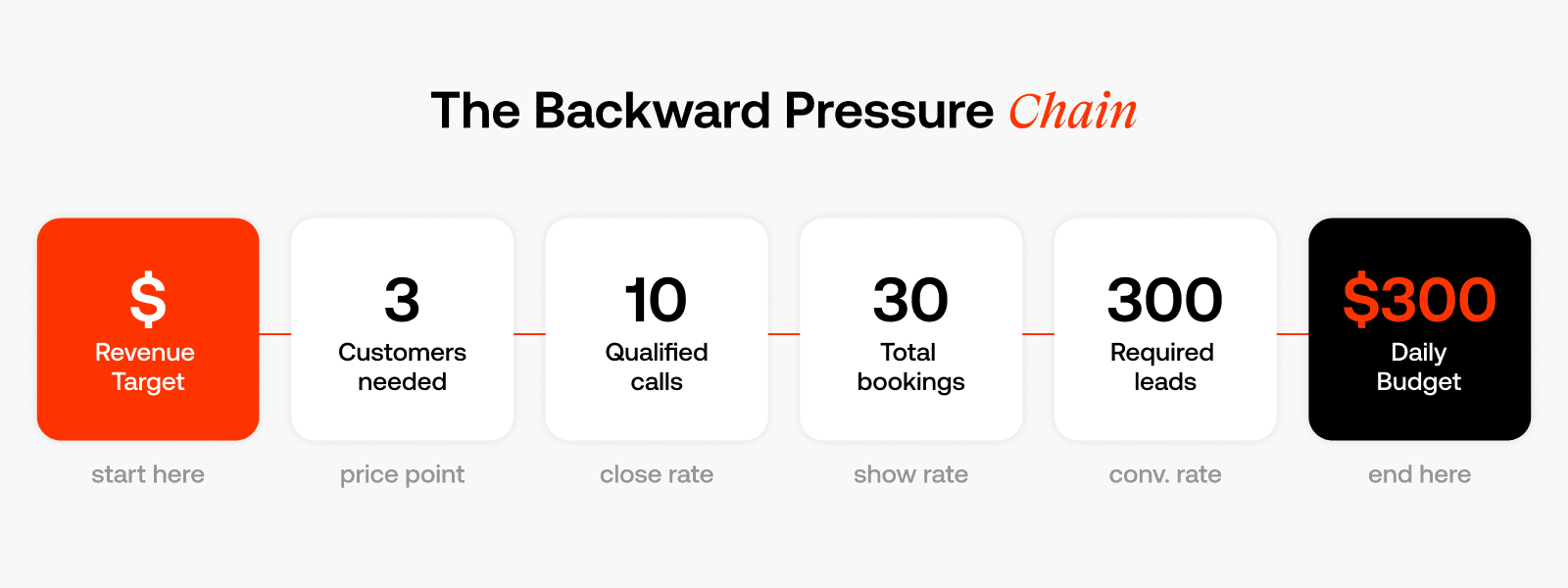
Start from the end: Revenue Target → Price Point → Required Customers/Month → Close Rate → Required Qualified Calls → Show Rate → Required Bookings → Conversion Rate → Required Leads → Allowable CAC → Maximum Cost Per Click → Daily Budget.
Each number constrains the next. If the math doesn't work at any step, if the required spend exceeds what the unit economics can sustain, something in the chain needs to change: the price point, the close rate, the conversion rate, or the revenue target. What can't change is reality. The math doesn't care about your ambition.
"If the math doesn't clear, stop. Do not proceed to creative, copy, or media buying."
Gate check: Does the math clear? Yes → proceed. No → stop. Adjust inputs until it does.
Layer 2: Research Backpressure
With the math validated, the next gate is research. Your copy, messaging, and positioning must be grounded in documented customer language. Not assumptions, not marketing-speak.
The checkpoint: do you have documented customer quotes categorized by pain point, desired outcome, and objection? Do you have the top objections ranked by frequency? Do you have clear language patterns showing how your ICP describes their problem in their own words?
If the answer is no, your copy is a guess. And a guess at this layer means every ad, every landing page, every email downstream is built on an unverified assumption about what motivates your buyer.
Gate check: Is copy grounded in documented research? Yes → proceed. No → stop. Do the research.
Layer 3: Offer Backpressure
Does the offer address the top objections structurally, through guarantees, proof, deliverable clarity, and risk reversal, rather than requiring sales to handle them conversationally?
If sales is spending 60 minutes per call overcoming the same objections, the offer is failing this gate. Those objections should be resolved before the prospect ever speaks to a human.
Gate check: Does the offer handle objections structurally? Yes → proceed. No → stop. Rebuild the offer.
Layer 4: Journey Backpressure
Can you trace a straight line from the ad's core claim through the landing page's mechanism explanation through the email nurture's proof sequence through the sales call's qualifying questions, and does it all tell one story?
If not, you have journey incoherence, which presents as high CPL, low show rates, or low close rates, depending on where the chain breaks. Each incoherence forces the prospect to re-evaluate. Re-evaluation kills momentum.
Gate check: Is the journey coherent? Yes → proceed. No → stop. Map the journey and fix the breaks.
Layer 5: Tracking & Attribution Backpressure
Can you trace a closed deal back to the campaign, channel, and creative that initiated the relationship? Can you calculate true CAC and payback period by acquisition source?
Without this layer, you can't optimize. Every "optimization" is another guess. This layer is what makes the entire system learnable and improvable. See the full treatment of this topic in Marketing Attribution for B2B.
Gate check: Can you track spend to revenue? Yes → launch. No → stop. Build the tracking layer first.
DBP Applied: How a Campaign Goes From Revenue Target to Live Ads
Here's how the framework works in practice. At each step, the math either clears or it doesn't:
Step 1: Set the revenue target. Everything starts here. Not "we want to grow", a specific number tied to a specific timeframe.
Step 2: Work backward through the chain. Revenue target ÷ price point = required customers. Required customers ÷ close rate = required qualified calls. Required calls ÷ show rate = required bookings. Required bookings ÷ conversion rate = required leads. Required leads × cost per lead = required ad spend.
Step 3: Test viability. Does the required ad spend produce a sustainable CAC? Is the LTV:CAC ratio viable? If not, which input needs to change?
Step 4: Validate research. Is the messaging built on documented customer language, or assumptions? Are the top objections mapped?
Step 5: Validate offer. Does the offer address those objections structurally? Would your ICP, reading the offer cold, immediately see why value exceeds cost?
Step 6: Map the journey. Ad → content → landing page → qualification → booking → pre-call → call. One story, no contradictions.
Step 7: Confirm tracking. UTMs standardized. CRM connected. Attribution configured. Dashboard built. Weekly review scheduled.
Step 8: Launch. Only after all five gates have cleared.
This is the sequence that's been applied across 500+ businesses. It's not creative inspiration. It's engineering. The same five gates, applied to every campaign, producing predictable results because the inputs are validated before spend begins.
Why Most Marketing Fails the DBP Test
Red flags that indicate a business is operating without backward pressure:
"Let's just test it." Without a hypothesis tied to the math, a "test" is spending money to see what happens. Real testing has a defined metric, a threshold for success, and a decision rule: if X, then scale; if not, then kill.
"The agency said it's working." Working by what standard? CPL might look good, but if those leads close at a low rate, the effective CAC may be unsustainable. Without downstream metrics, "working" is meaningless.
"We need more creative." Usually means the current creative isn't converting, but the team doesn't know why. DBP would diagnose which layer is failing before touching creative.
"Our funnel converts fine, we just need more traffic." More traffic is never the answer to a conversion problem. If show rates are low or close rates are poor, more volume amplifies the problem.
"We'll figure out tracking later." Then you'll figure out what's working later too. Which means you'll optimize later. Tracking is the foundation of every decision that follows.
How DBP Connects to the KFC Method and GTM-OS
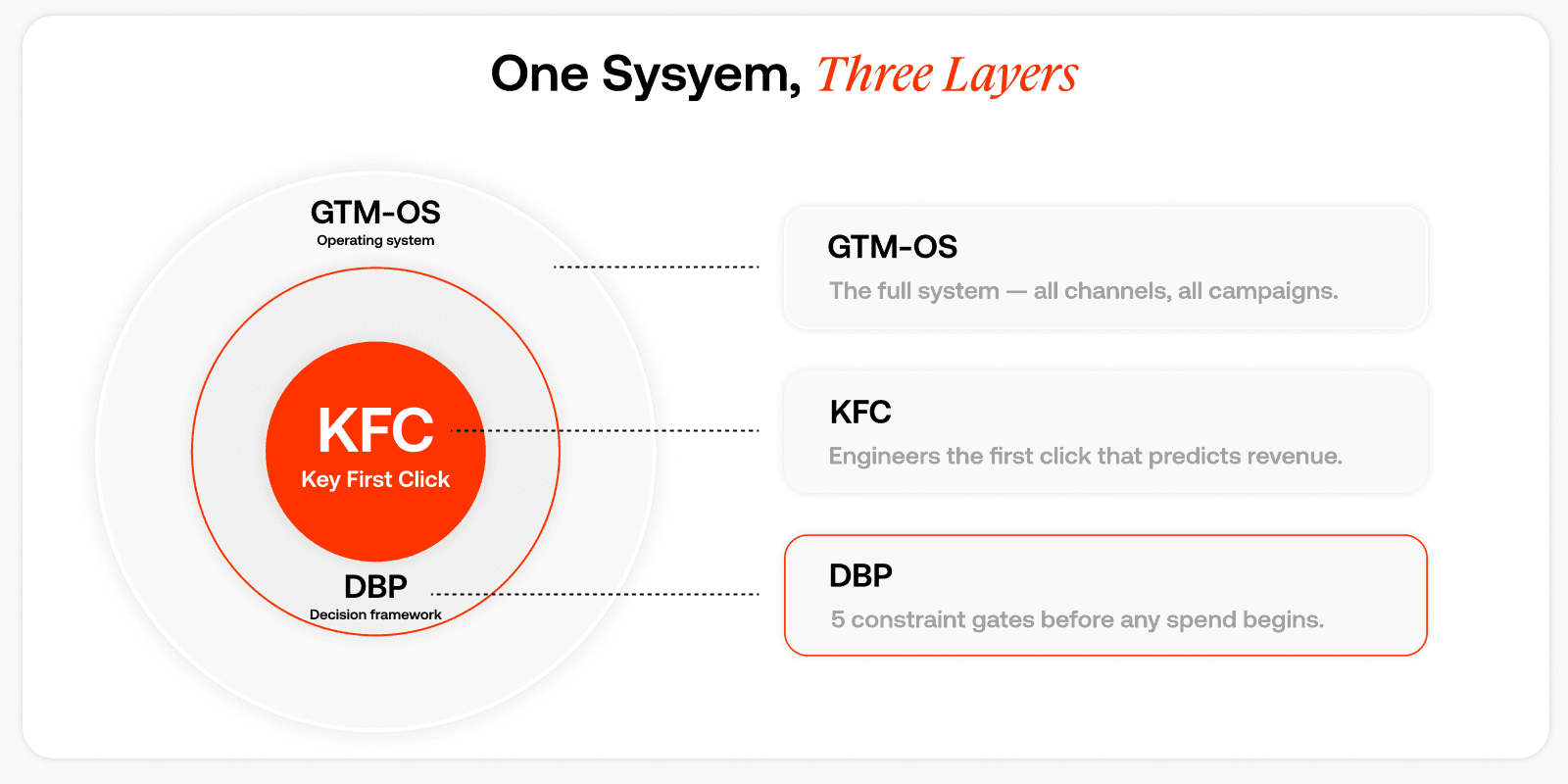
DBP is the decision architecture. The KFC Method (Key First Click) is the acquisition engine that runs on it. GTM-OS is the complete operating system that houses both.
KFC provides the specific campaign structure, how ads, landing pages, and conversion events are designed to produce the highest-quality first click. But without DBP, KFC has no constraints: you'd be optimizing the first click without knowing whether the math supports the system it feeds into.
And without GTM-OS wrapping both, the math and the method exist in isolation, applied to individual campaigns instead of operating as a continuous system across all channels, all campaigns, and all time periods.
The sequence is: DBP validates the system can work → KFC engineers the acquisition → GTM-OS operationalizes both into a repeatable engine
Frequently Asked Questions
Is DBP only for paid media?
No. DBP applies to any revenue-generating marketing activity, paid, organic, outbound, events, partnerships. The framework is channel-agnostic. It asks: does the math clear, is the research done, does the offer hold up, is the journey coherent, and can you measure it? Those questions apply regardless of traffic source.
What if my business doesn't have enough data for the math to be precise?
Use conservative assumptions and plan to iterate. If you don't know your close rate, assume a conservative estimate. If you don't know your CPC, use industry benchmarks with a buffer. The math doesn't need to be perfect . It needs to be realistic enough to reveal whether the model is viable. As real data comes in, replace assumptions with actuals.
How does DBP relate to the KFC Method?
KFC is the acquisition methodology that operates within the DBP framework. DBP provides the constraint layers and quality gates. KFC provides the campaign structure. Think of DBP as the operating system and KFC as the engine running on it.
Can I apply DBP to my existing campaigns?
Yes. Take your current top campaign and run it through all five layers. You'll likely find one or two where the gate check fails, and that failure will explain the performance problems you've been trying to solve with tactical fixes.
How to Apply DBP in Your Business
Start with a self-assessment. For each of the five layers:
Math: Can you write out the complete chain from revenue target to daily budget, and does every number check out?
Research: Do you have documented customer language driving your copy, or is your messaging based on assumptions?
Offer: Does your offer handle the top objections before the sales call, or is your closer doing heavy lifting?
Journey: Can you trace one coherent story from ad to close, or does the narrative break?
Tracking: Can you calculate true CAC by channel and campaign, or are you relying on platform-reported metrics?
If even one layer fails, you've found the constraint limiting your growth. Fix that layer before optimizing anything downstream, because downstream optimization on a broken upstream layer is just making a broken system run faster.
Get a DBP-based GTM Diagnostic to have all five layers audited for your specific business.
Marketing.MBA | $1.5B+ in verified client revenue across 500+ businesses.