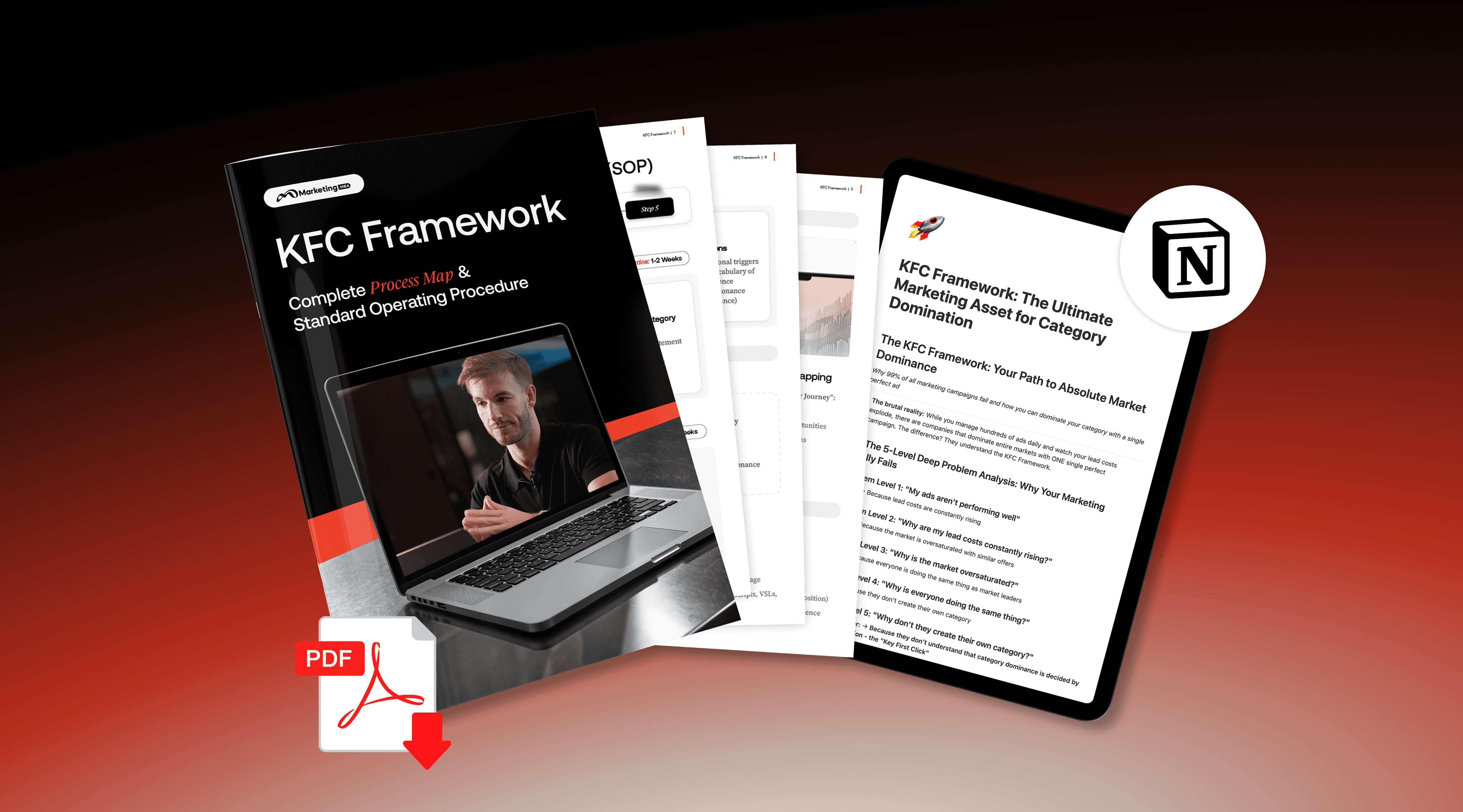
The KFC Method: How Key First Click Engineering Generates Predictable High-Ticket Leads
Most marketers optimize for the wrong metrics. They chase clicks, impressions, cost-per-mille. They build vanity dashboards that look good but don't predict revenue. Then they wonder why their $80K/month ad spend produces unpredictable qualified lead flow every other week.
The KFC Method fixes this. Developed by Raoul Plickat and Marketing.MBA over 14 years in performance marketing and validated across 500+ brands generating $1.5B+ in results, it's the system that makes lead generation deterministic, not lucky.
Here's how the KFC Method was born. Raoul used first principles thinking and asked a question most marketers never consider: "What if there were one single ad that could drive all the sales?" He knew it wasn't literally possible, but the question forced a different kind of thinking. Instead of optimizing within the existing playbook, he studied what actually makes content go viral. He consumed thousands of viral YouTube videos, Instagram Reels, and TikToks, reverse-engineering the patterns: what makes people resonate, share, comment, follow.
What he discovered: you don't need a lot of ads. You need the right ads. If you upload 100 ads to Meta, about 95 will fail. Maybe 5 have the potential to scale hard because of the message, the angle, the creative, the copywriting. Most marketers accept this as a numbers game and try to brute-force their way to the 5% by generating endless variations with AI. The KFC Method does the opposite: it engineers that 5% deliberately through research, planning, and psychological architecture, then pushes those few ads with predictability.


This is the core principle: Everything downstream depends on the quality of the first meaningful conversion event. Get that right, and your show rate climbs. Your close rate climbs. Your unit economics compound. Get it wrong, and no amount of sales skill or follow-up repairs the damage.
The KFC is what Raoul calls the brand oscillator. It defines all following interactions. It sets the perception and the narrative for everything that comes after. The stronger the KFC, the easier everything downstream becomes: the nurture, the sales call, the close. Because the first impression didn't just capture attention. It established authority, built trust, and controlled how the prospect thinks about your brand from that moment forward.
What Is the KFC Method?
Watch the complete YouTube video to see the Key First Click method in detail.
The KFC Method (Key First Click) is a framework for generating predictable high-ticket leads through paid acquisition, primarily Facebook and Meta ads, though the principle applies across all channels.
But here's what most people miss when they hear "paid acquisition framework": the primary goal of the KFC Method is to engineer ads that mimic viral content posts.
Not ads that look like ads. Ads that look like the most shared, most engaged-with organic content on the platform, because that's what stops the scroll, earns the algorithm's favor, and controls the narrative before the prospect even knows they're in a funnel.
A KFC ad doesn't interrupt. It belongs in the feed. It generates 2,500+ likes, 700+ comments, 350+ shares, not because the budget is high, but because the creative is engineered to trigger the same psychological response as the best-performing organic posts on the platform. When your prospect sees an ad with that level of social proof, something shifts. It's no longer "a company trying to sell me something." It's "something thousands of people are engaging with, maybe I should pay attention."
Raoul Plickat calls this the "first date" principle: most businesses show up to paid media disheveled, with bad creative, no social proof, generic copy. A KFC-optimized ad shows up groomed, confident, and surrounded by evidence that other people already trust this brand. The ad itself becomes a status symbol in the newsfeed.
This is the perception layer. Control the narrative. Engineer the social proof. Make the ad look like it belongs alongside the content your prospect already follows. That's what gets the click.
And here's where most people get the creative wrong. They open ChatGPT, say "write me 20 ad scripts," hand them to UGC creators, and upload the results. Almost all of it is garbage because it's written in marketer language, not customer language. Raoul's principle: "Great copy is not written. Great copy is assembled." Every target audience is its own tribe. They share a collective vocabulary, the same words, metaphors, stories, and analogies, even without knowing each other. A SaaS founder at $3M ARR uses different language than an agency owner at $2M. The KFC Method starts with deep research to excavate that tribal language: what frustrates them, what they desire, what vocabulary they use to describe their problems. Then you assemble the creative from their words, not yours. When the prospect sees the ad, they don't think "someone is marketing to me." They think "someone understands me." That feeling, feeling understood, is what separates great copywriting from good copywriting. Good copywriting tells you about a product and sells you something. Great copywriting makes people feel understood and makes them come to their own belief: I need this in my life.
Then, and only then, does the mathematical model take over.
A Key First Click is the first meaningful conversion event in your funnel. Not a page view. Not a click on an ad. The first action that indicates genuine buyer intent and predicts downstream show rate and close rate.
For a SaaS founder selling $40K annual team plans to enterprises and mid market companies, the KFC might be: application submit + qualification call booked.
For an agency selling $5K monthly retainers, it might be: lead magnet opt-in + immediate qualification email response.
For a personal brand selling $8K courses, it might be: webinar registration + attendance confirmation.
The specificity matters. Because once you isolate that ONE conversion event, you can measure its quality. And once you measure quality, you can predict revenue.
The math becomes deterministic:
Quality of KFC → Booking rate → Show rate → Sales conversation quality → Close rate → LTV
You are no longer asking "Did the ad work?" You're asking "Did the ad produce the right kind of first click?" And that question has a measurable answer 30-90 days in advance of the revenue event.
The Problem KFC Solves: Attribution Chaos and Wasted Spend
Here's what we hear in nearly every GTM audit:
"We spend $200K/month on ads and can't tell which channel produced our last five clients."
"Our dashboards show amazing metrics, thousands of clicks, 3% CTR, $8 CPC, but our cost per qualified demo keeps climbing."
"We scaled to $10K/day and our close rate didn't move. We're just buying more unqualified volume."
"Sales is drowning in calls with 'just exploring' leads. The ads are working. The leads are worthless."
This is the universal anger point across every ICP we work with.
The SaaS founder at $3M ARR sees this: "I'm running GTM experiments on $25K/month ad spend. They get good metrics, 2% CTR, solid engagement. But I can't trace those clicks to closed deals. So I scale blindly, and by month two my CAC has tripled."
The agency owner sees this: "My cost per booked call is $250 on LinkedIn and $80 on Facebook. But I have no idea which of those calls actually close. So I'm optimizing for the wrong channel."
The personal brand sees this: "My webinar gets 500 registrations and 150 attendees. But only 3 of them buy. That's $200 per paying customer. And I still don't know which type of person actually converts, so I can't run cohort analysis or build lookalikes."
The root cause is not the ads. The ads are often fine.
The root cause is that most marketers optimize for vanity metrics: clicks, hold-through rate, and cost per lead. They build entire funnels around this. Then they act shocked when the revenue doesn't follow.
Have you ever scaled a campaign to $1-5K/day only to watch your cost per qualified lead triple?
Can you trace your last 10 paying clients back to the specific ad that started their journey?
If you're spending $5K-$500K/month on ads, can you show the math that proves you'll hit your revenue target next quarter, or are you just hoping?
Most businesses answer "no" to all three. That's not a marketing problem. That's an architecture problem.
How KFC Works: The Mechanism
The KFC Method is built on deterministic backward pressure (DBP), a principle that says: every upstream action must trace backward from the terminal revenue event.
Why this matters especially for high-ticket: the difference between high-ticket lead generation and ecom is fundamental, and it's why almost all strategies that work well for ecom fail for high-ticket. An ecom product is tangible. You can see it, you know how to use it, and the price is low enough for impulse decisions. High-ticket services are intangible. There's a time delay between purchase and result, anywhere from 7 to 120 days depending on the price, the product, and how well the market knows your brand. You almost never get a same-day sale. The prospect needs to trust you before they invest $5K-$100K in something they can't see or touch.
This is why the KFC Method exists as a distinct framework. It's not a variation of ecom advertising. It's a fundamentally different approach to a fundamentally different buying psychology.
The KFC framework defines four key stages in the buyer journey: the first click (the initial interaction with your brand or offer), the first opt-in (someone shows interest but hasn't purchased), re-engagement (additional problem-solving angles for existing leads to increase mental availability and drive conversion, such as a new VSL, a webinar, an ebook, a YouTube video), and retargeting (reminding a prospect to complete the last action where they stopped, including final objection handling and the shortest path to sale). Knowing what comes at which point in the customer journey is the most important part of KFC engineering.
Step 1: Define the key first click.
You work backward from closed deals. You identify the moment in the customer journey when someone moved from "interested spectator" to "serious buyer." That moment is your KFC.
It's not the first click on an ad. It's not an email open. It's an action (application, booking, form submission, callback request) that correlates measurably with show rate and close rate.
For high-ticket ($5K+) offers, the KFC is almost always a qualified booking or application submission. The quality of that booking predicts everything downstream.
Step 2: Design your funnel to produce quality KFCs, not volume clicks.
This is where most campaigns fail. They optimize for traffic volume. KFC optimizes for buyer intent density.
Your ads, landing pages, and qualification steps are sequenced to filter for the right audience state (awareness, consideration, decision), establish emotional anchors that make the KFC feel natural (not transactional), pre-qualify ruthlessly so only genuine buyers reach the KFC event, and make the KFC so frictionless that qualified prospects want to convert.
The sequence matters more than the individual assets. A brilliant ad followed by a mediocre landing page produces low-intent clicks. A good ad followed by a graduated landing page that builds conviction into a qualified booking produces predictable revenue.
Step 3: Measure KFC quality, not KFC volume.
Here's where the determinism emerges:
You track not "how many leads did we generate?" but "what % of our KFCs show up?" and "what % of our KFCs actually close?"
These are your predictive metrics.
If 80% of KFCs show up and 40% close, and you know your LTV is $25K, then each KFC is worth $8K on average. If your cost per KFC is $500, your ROAS is 16:1. Predictable. Scalable.
If your KFCs have a 30% show rate and 15% close rate, you have an engineering problem upstream. The funnel is producing the wrong kind of click. Volume won't fix it.
Step 4: Scale backwards from unit economics.
Now that you know the quality of your KFC, you can run the math:
Revenue target this month: $500K. Average LTV: $25K. Required deals: 20. Close rate: 40%. Required opportunities: 50. Show rate: 80%. Required bookings: 62. Cost per KFC: $500. Required ad spend: $31K.
This is not a guess. This is infrastructure.
If you spend $31K and hit 62 bookings with the same quality profile, you will close 20 deals. You will generate $500K. This becomes repeatable.
Most marketers run ads and wait 90 days to find out if they worked. KFC practitioners know within 14 days whether they're on track because they're measuring the leading indicator (KFC quality) that predicts the trailing indicator (revenue).
The Social Proof Engine: Why KFC Ads Don't Just Convert, They Compound
Most advertisers treat an ad as a disposable asset. Run it, measure it, replace it. The KFC Method treats an ad as a living ecosystem that compounds trust over time.
The Comment Section as Evergreen Billboard
When a KFC ad generates hundreds of comments, the comment section becomes the most powerful sales asset you never built. Skeptics comment with objections ("Sounds too good to be true" or "What makes this different from every other marketing course?") and the brand responds. Not with defensive corporate replies, but with testimonials, free resources, case study links, and lead magnets.
Why does this matter? Because for every person who writes a comment, there are 50-100 people reading the comments without engaging. They're watching the skeptics get answered. They're seeing real customers vouch for the product. They're clicking on the free resources and entering your nurture funnel through a side door they didn't even know existed.
The comment section becomes an evergreen billboard that handles objections publicly, 24 hours a day, without your sales team lifting a finger. Every objection answered in the comments is an objection that doesn't show up on the sales call.
Social Proof as Status Signal
An ad with 2,500 likes and 700 comments doesn't just look popular. It sends a signal to the prospect's subconscious: "Other people like me have engaged with this. This is worth my attention." In a newsfeed full of generic ads with 12 likes and zero comments, a KFC-optimized ad stands out the way a packed restaurant stands out on a street of empty ones. You don't need to read the menu. The crowd tells you it's good.
This isn't vanity. It's conversion infrastructure. Social proof lowers the psychological barrier to clicking. The prospect doesn't feel like they're "clicking on an ad." They feel like they're joining a conversation that thousands of people are already having.
The Multi-Platform Compound Effect
KFC doesn't operate in isolation on a single platform. When a prospect sees your brand on Facebook, then again on YouTube, then in their LinkedIn feed, then in an email, each exposure amplifies the others. The sales cycle shortens because the prospect has been pre-sold across multiple environments. They arrive at the booking call already familiar, already trusting, already convinced that this isn't a random company but a brand that's everywhere.
This is what Raoul calls the compound effect: each platform isn't a separate channel. It's another layer in the same belief architecture. The prospect who saw your viral-looking Facebook ad, then watched your YouTube breakdown, then read your LinkedIn post doesn't need a 45-minute sales call. They need a 15-minute confirmation.
The Webinar Multiplier
For high-ticket offers, webinars are the most powerful KFC accelerant. They convert mid-intent leads (people who clicked the ad and opted in but aren't ready to book a call) into high-intent buyers. The data across 500+ brands: webinars triple ROAS within 90 days, moving typical returns from 1.4-2.1x to 4-6x. And up to 50% of webinar-driven revenue comes from the follow-up sequences after the webinar, not from the live event itself.
The webinar doesn't replace the KFC. It amplifies it. The prospect's Key First Click might be the webinar registration. The webinar builds belief. The follow-up sequence delivers the goal conclusion. The booking call confirms what the prospect already decided during the webinar replay they watched at 11pm.
Frequency as Reinforcement, Not Fatigue
Most advertisers fear frequency. They think showing the same ad repeatedly burns out the audience. For ecom, that's true because novelty-based ads wear out fast. But KFC ads operate on an entirely different principle. They don't grab attention through novelty (a pattern interrupt, a trending sound, something unexpected). They activate identity, showing the viewer a version of themselves they haven't met yet. Identity activation doesn't fatigue. It reinforces. Every time the prospect sees the ad, they see their future self again. The message doesn't get old. It gets stronger.
This is the ad fatigue death spiral that kills most campaigns: the algorithm shows your ad to the same audience repeatedly, the hook that worked on day one becomes invisible by day 30, your CPM spikes, your ROAS tanks, you're back to the drawing board. KFC solves this because the ads operate on depth, not surface. They don't need to be new. They need to be true.
The longest-running KFC ad in our portfolio ran for eight years continuously, from 2016 to 2023, without a single day offline. The target audience was large enough, and the ad was evergreen by design because Raoul invested the time in proper research and planning. That's not an anomaly. It's the point. When the creative is built on deep customer truth rather than trending hooks, it doesn't expire.
KFC Stacking: How One Ad Becomes Fifteen
You don't run one KFC and stop. You stack them. Each KFC ad addresses a different angle, a different objection, a different emotional trigger, but they all share the same brand architecture, the same visual identity, the same core truth. For Pressmaster AI, Raoul stacked approximately 15 KFC ads across the customer journey. Together, they created roughly 20 minutes of ad watch time per prospect over 4 months. That's 20 minutes of controlled narrative before the prospect ever talks to sales.
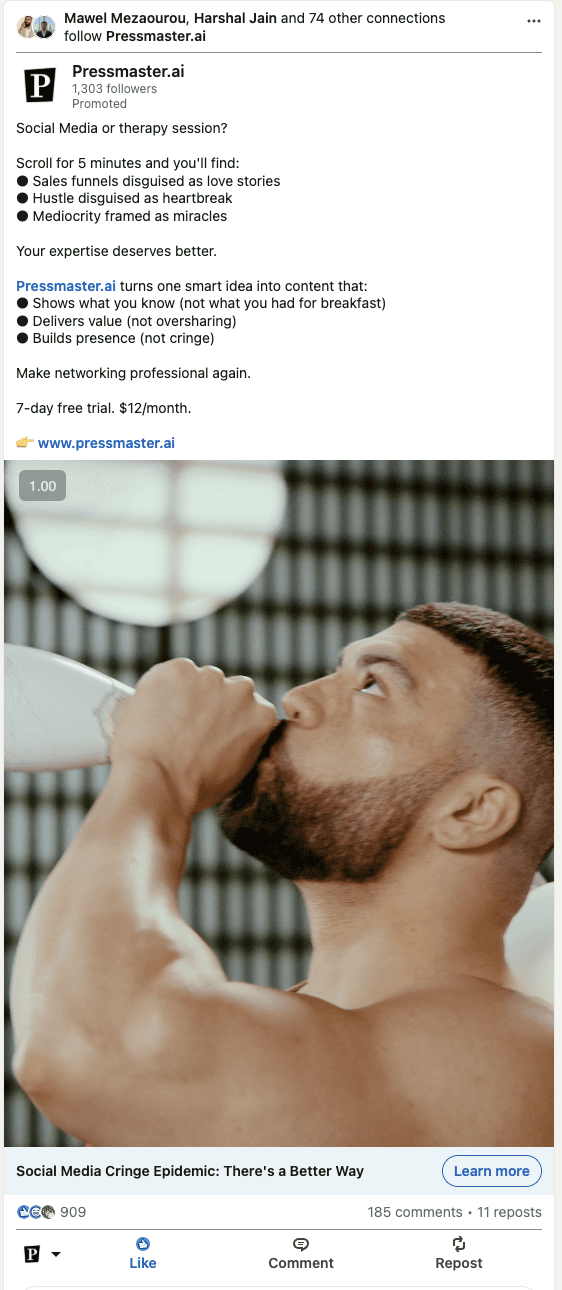
The stacking creates something no single ad can: a complete context map in the prospect's brain. They abstract the key message from this ad, the look and feel from that one, the proof point from another. Each KFC becomes a building block in a mental construct that's far more powerful than any individual creative. This is how you build mindshare that competitors running generic UGC and creator ads simply cannot match.
Counter-Positioning as Creative Strategy
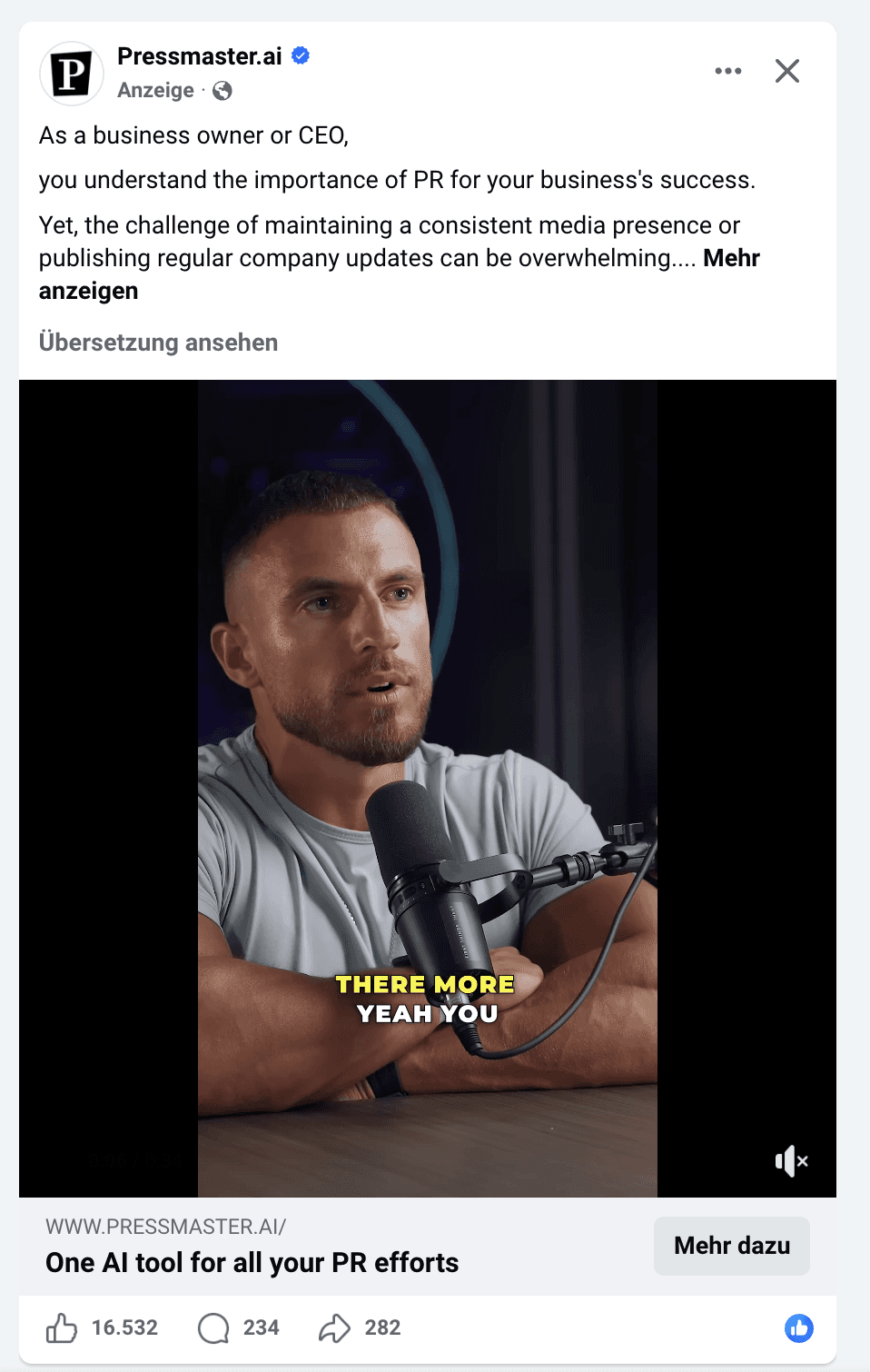
One of the most powerful KFC techniques is doing the exact opposite of what everyone else in your market does. When every competitor talks about how great and big and successful they are, the KFC approach might be irony, humor, self-deprecation. Making fun of yourself, intelligently, from a position of strength, signals confidence that polished corporate messaging never can. One client's counter-positioned KFC campaign hit 10 million views and 11,000 likes precisely because it broke every expectation the audience had about what a brand in that space would say.
The Shareability Principle
People only share content that makes them look better in front of others. This is a non-negotiable law of social distribution. If sharing your ad makes someone look cringe or stupid on their own social media, nobody will share it, no matter how good the ad is. KFC ads are engineered for shareability: the content reflects well on the sharer. It makes them look smart, informed, or entertaining for passing it along. This is what transforms paid distribution into organic amplification.
This is why KFC campaigns compound over time rather than fatigue. The ad builds social proof. The comment section handles objections. The multi-platform presence builds familiarity. The webinar converts intent into conviction. The stacking creates a complete mental model. And the mathematical architecture underneath ensures every dollar traces back to revenue.
Why Traditional Marketing Metrics Fail
The standard marketing dashboard is designed for volume, not velocity. It measures everything except what actually predicts revenue.
CPM optimization answers the wrong question. You're paying for eyeballs, not buyers. A $2 CPM that delivers 1,000 unqualified impressions costs you $2. A $4 CPM that delivers 100 high-intent impressions costs you $4 for the same outcome, but the second CPM is cheaper when measured against revenue.
Click-through rate (CTR) as a success metric is a financial trap. A 4% CTR with 2% intent is more expensive than a 2% CTR with 20% intent. You're optimizing for the metric, not the outcome.
ROAS (Return on Ad Spend) as your primary metric fails because it's measured within a 30-day attribution window (most B2B deals take 60-120 days), it doesn't account for customer quality or LTV variance, a high ROAS on low-intent leads produces unsustainable churn, and it encourages spending on volume rather than precision.
"More leads" or Cost-per-lead (CPL) as the strategy is how you end up with 100 calls booked and zero closed deals. Sales gets flooded. Your sales team spends 80% of their time qualifying trash. They get demoralized. They leave. Your close rate collapses.
The KFC Method inverts this logic: fewer, higher-quality first conversions that flow into a streamlined sales process produce higher close rates, lower CAC, predictable LTV. And that means optimizing for cost-per-qualified-booked-call (CPQBL).
The Psychology Behind KFC: Why It Works at the Neurological Level
The KFC Method isn't just a media buying framework. It's built on deep psychological principles that explain why certain ads convert for years while others die in days.
Self-Image and Psychocybernetics
Maxwell Maltz proved in Psycho-Cybernetics that humans cannot outperform their self-image. Every decision you make, every action you take is filtered through the mental picture you hold of who you are. You will always act in accordance with who you believe yourself to be.
This is why most ads fail. They try to convince you to buy something. They present features, benefits, social proof, urgency. But if the product doesn't fit your self-image, if you can't see yourself as a person who owns that thing, uses that service, lives that lifestyle, no amount of convincing will work. Your brain rejects it automatically.
Evergreen KFC ads don't convince. They transform the self-image. They show the viewer a version of themselves they haven't met yet, a future self, a possible self, and they make that self feel real, achievable, and desirable. Once the viewer sees themselves differently, the purchase becomes inevitable. Not because you convinced them. Because they convinced themselves.
This is the most critical distinction in all of high-ticket advertising. And it's why KFC ads actually become MORE effective with repeated exposure, the total opposite of ecom ad fatigue. Each time the viewer sees the ad, they see their future self again. The message doesn't degrade. It reinforces.
Neuroeconomics and the Pain Threshold
Research in neuroeconomics, confirmed by 14 years of Raoul's direct experience, shows that high-price purchases activate the pain centers in the brain (the anterior insula) before the reward centers. The brain processes loss before it processes gain. This means pain acknowledgment and reframing must precede benefit presentation in any high-ticket offer.
This is entirely different from ecom, where the product is tangible, the price is low, and the decision is fast. High-ticket services are intangible. There's a time delay between purchase and result, anywhere from 7 to 120 days. The prospect can't see or touch what they're buying. And because the price is high, their brain is actively searching for reasons not to buy, even after they've developed genuine interest.
The KFC Method engineers for this reality. The creative doesn't lead with benefits. It leads with the prospect's pain, mirrored so accurately that they feel understood. Then it reframes that pain as solvable. Then it introduces the mechanism. The benefit presentation arrives only after the pain has been acknowledged and the fear has been addressed. This sequence matters enormously, and it's why ecom ad strategies fail catastrophically for high-ticket lead generation.
Cognitive Load and Procrastination
High-ticket decisions create cognitive overload. The prospect encounters your ad, feels interest, recognizes the problem, and then their brain does something predictable: it procrastinates. Even if the offer is perfect and the prospect genuinely needs it, the cognitive weight of a $5K-$60K decision triggers avoidance. They bookmark the page. They tell themselves they'll come back later. They find every reason to delay.
This is why KFC is designed for repetition and re-engagement, not one-shot conversion. The framework assumes that the vast majority of your audience will not convert immediately. Maybe 0.5% to 3% convert within 30 days. The rest need multiple touchpoints over 60 to 120 days. The KFC ad is the oscillator that keeps pulling them back. Each time they see it, the cognitive load decreases slightly because the idea becomes more familiar. Familiarity reduces perceived risk. And at some point, the accumulated familiarity tips over into action.
Mirror Neuron Activation
Detailed success stories, case studies, transformations, before-and-after narratives, activate mirror neurons in the prospect's brain, allowing them to experience the transformation before purchasing. This neurological effect is more powerful than any logical argument. When a SaaS founder watches another SaaS founder describe how they went from attribution chaos to predictable pipeline, their brain doesn't just process the information. It simulates the experience. They feel what it would be like. And that feeling drives action far more reliably than any feature list or ROI calculator.
This is why the KFC Method is built on customer stories and real language from research, not on marketer-crafted promises. The prospect needs to see someone like them who achieved what they want. Not a generic testimonial. A specific, detailed, emotionally resonant transformation story that activates mirror neurons and makes the future state feel real.
The Watch Time Threshold
Across 500+ brands, a consistent pattern emerges: it takes an average of 4-7 hours of content consumption before a cold prospect becomes a customer. Not 4-7 minutes. Hours. This is the total accumulated time they spend watching your videos, reading your ads, consuming your emails, attending your webinar, reading your landing pages.
The KFC Method is designed to systematically accumulate those hours. The stacked KFC campaigns alone create 15-20 minutes of pure ad watch time per prospect. Add the landing page, the email sequence, the webinar, the retargeting, and you're building toward the 4-7 hour threshold where trust crystallizes into buying intent. Every piece of the system is calibrated to increase total watch time with your brand.
KFC in Practice: Campaign Architecture
A KFC-optimized campaign looks different because it's built backwards from revenue.
Stage 1: Awareness & Emotional Anchoring (The Viral Content Layer)
Your ad isn't selling the product. It's engineered to look like the best organic content on the platform.
The creative mimics what already goes viral in your prospect's feed: the format, the emotional triggers, the narrative arc. For a SaaS founder, the ad might show the chaos they live in: spreadsheets, Slack notifications at 3am, conflicting attribution reports. But it's presented as a story, not a pitch. It looks like a founder sharing a hard-won lesson, not a company running a campaign. The prospect thinks "That's me" and engages instinctively. That recognition is the first micro-conversion. You haven't asked for anything yet.
Stage 2: Consideration & Positioning
Now that you have attention, you position the alternative. Not "Buy our product," but "Here's why your current approach is capped. Here's what a proper system looks like."
A landing page. An email. A short-form video. Each asset builds on the emotional anchor and introduces the mechanism: how a different approach produces different results.
Stage 3: Qualification & Intent Confirmation
Before the KFC event, there's a final gate. An application form. A pre-call questionnaire. A calendar booking that requires answering three verification questions.
This gate serves two purposes: it filters out time-wasters, and it confirms intent. Someone who fills this out is seriously considering.
Stage 4: The Key First Click
The booking. The application submit. The qualified conversation scheduled.
This is the moment when a prospect becomes a lead. The ads and landing pages did the heavy lifting. They built conviction. The KFC event is just the formalization.
Stage 5: Show & Close
Everything is now in motion. Your email sequences prepare the prospect for the call. Your sales team opens with confirmation, not selling ("You applied for a demo. I'm confirming we're aligned on what we're looking at."). The conversation is a verification, not a pitch.
The entire sequence compounds. Each stage prepares for the next. There's no friction. There's no 50-question application that kills momentum. There's no sales call where the prospect is hearing the pitch for the first time.
By the time your sales team picks up the phone, the outcome is often decided. They're confirming, not convincing.
This is why KFC funnels have show rates 40-60% higher than standard funnels. And close rates 2-3x higher.
The math is not luck. It's architecture.
The SSR Execution Layer: Story, Style, Results
Underneath the KFC framework sits an execution layer called SSR, the three pillars that power every evergreen campaign we build.
Pillar 1: Story. Not storytelling in the generic content-marketing sense. Specific narrative structures that bypass the prospect's conscious filters and speak directly to their self-image. This is where philosophy becomes technology. The principles of Heidegger (confronting mortality to create authentic existence), Jung (shadow integration and the trickster archetype), Adler (the fictional final goal that pulls you forward), Nietzsche (creating values in the absence of certainty), and Frankl (finding meaning despite suffering) are psychological tools that have been moving humans for centuries, now applied to marketing. The story layer of a KFC ad doesn't just tell a narrative. It creates a psychological intervention disguised as content. The viewer doesn't know they're being moved through a carefully designed emotional sequence. They just feel something that stays with them longer than it should. That's not accident. That's architecture.
Pillar 2: Style. The visual and auditory language calibrated to your specific audience. Not trends, not best practices, not whatever editing style is popular on TikTok this week. The exact aesthetic, pacing, and tone that your audience recognizes as for them. Style is identity signaling. When the style matches, the viewer's brain says "this is for people like me." When it doesn't, they scroll. A luxury brand's KFC looks nothing like a SaaS startup's KFC, even if both are technically "high production value." The style must match the tribe. This applies to everything: the music, the pacing, the color grading, the editing rhythm, the thumbnail, the text overlays. Each choice signals either "this is for you" or "this is for someone else." KFC engineering means making every style choice deliberate.
Pillar 3: Results. Revenue and leads generated. Period. Everything else is vanity. The only question that matters: did it move the needle? Views, likes, comments, shares are inputs to the social proof engine. They matter because they drive the compounding effect. But the final measurement is always: did this KFC produce qualified pipeline that converted into revenue? This is what separates KFC from content marketing. Content marketers optimize for engagement. KFC practitioners optimize for revenue and use engagement as a mechanism to get there.
The Marketer's True Function: Psychocybernetics at Population Scale
Here's the insight that elevates KFC from a framework into a philosophy of marketing.
As a marketer operating the KFC Method, you don't just transmit your brand's message. You transmit the future selves of the brand. You see potential in the prospect that they haven't embodied yet. You create a message that represents that potential realized. They encounter the message. By encountering it, they begin to see themselves differently. Others observe and begin to embody it as well.
Raoul puts it directly: "As a marketer, you execute psychocybernetics at population scale." Maltz said you cannot outperform your self-image. As marketers, we create self-images for others to step into. The messenger performs their potential and becomes their potential. The observer witnesses someone becoming, and begins becoming themselves.
This is why the KFC Method works at a level that traditional advertising cannot touch. Traditional ads try to convince through logic. KFC transforms through identity. The prospect doesn't buy because they were persuaded by a better argument. They buy because the ad changed who they believe themselves to be, and the purchase is simply what that new person does.
Victor Frankl wrote: "The meaning of life differs from man to man, from day to day, and from hour to hour. What matters is not the meaning of life in general, but rather the specific meaning of a person's life." The KFC Method operates on this principle. You don't give the prospect generic meaning. You show them their specific meaning, the one that only they can fulfill, in their situation, at this moment. That's why the transformation works. Not because you impose your vision. Because you reveal theirs.
KFC in the Wild: What This Looks Like at Scale
Theory is nothing without proof. Here's what KFC produces when executed correctly.
Jürgen Höller, Germany's Tony Robbins. A personal brand with 30+ years of history, but his brand image hadn't evolved in 12 years. His demographic was aging. His products were great, but the front-end communication didn't reflect his evolution. The challenge: create a rebrand campaign that wouldn't just launch and die. It needed to run long-term, generate millions in revenue, and reposition a 30-year brand for a new generation.
We applied the KFC Method with full SSR execution. The strategic decision: launch with two videos, not one. Video one was pure entertainment: humor, irony, counter-positioning. It disarmed the audience, showed humanity, created goodwill. It signaled "this is not going to be what you expect." Video two was the psychological intervention: a cinematic piece with three interweaving timelines (past, present, future), philosophical depth drawn from Jung, Adler, Nietzsche, and Frankl, and a narrative structure inspired by Christopher Nolan's approach to layered storytelling. The entertainment video lowered defenses. Then the serious video penetrated where it otherwise couldn't.
The result: 3.6 million views. 10,000+ reactions. Doubled revenue. Eight-figure growth. The ads are still running. What we delivered wasn't a campaign. It was a psychological intervention disguised as a brand video. Read the full case study →
Pressmaster AI, zero to $1.2M ARR in 7 months. Raoul's own AI startup, built using the same KFC principles. The challenge: explain a category that didn't exist yet (thought amplification engine) by bridging it to the closest thing people understood (content generation). The approach: start with a meme (the Giga Chad meme applied to LinkedIn), see what resonates, then engineer a full video from the learning. The KFC video maximized cringe intentionally, making fun of typical LinkedIn posts ("My hamster died. Here's what I learned about B2B sales."), and went, in Raoul's words, "absolutely bonkers" across all channels, especially LinkedIn.
10M+ view productions. Multiple movie-set and cheap mobile phone KFC productions for German clients consistently hit 10 million+ views with 11,000+ likes and thousands of comments. These weren't lucky viral moments. They were engineered: proper research into what the audience responds to, counter-positioning against what competitors were saying, and creative that combined irony, unexpected narrative, and genuine value.
The 6.7 million view podcast clip. A 60-minute podcast was recorded. One 30-second clip was extracted and treated as a KFC. That single clip, selected and framed using KFC principles, generated 6.7 million views across all social media channels and continues to perform evergreen. The content already existed. The KFC framework identified which 30 seconds had the most resonance potential and engineered the distribution around it.
Christian Bischoff: 6,000 tickets and $5.6M. KFC-optimized campaigns sold 6,000 event tickets, generated $330K in direct sales volume, and compounded to $5.6M over three years from the same installed system. Read the full case study →
Philipp Plein: $8M in six days. Brand perception control plus direct-response precision compressed into a single launch window. The KFC architecture controlled the narrative across platforms and converted at scale within a tight timeframe. Read the full case study →
More results across sales trainers, consulting companies, and finance trading apps at our full case studies page.
How KFC Creates Category Ownership
The ultimate outcome of a properly executed KFC strategy isn't just leads and revenue. It's category ownership: becoming the only brand your prospect thinks of when they think of the problem you solve.
Here's the chain that makes this happen:
Digital availability → high watch time → resonant copy → direct brain impact → mental availability → becoming an abstract that's easily recallable → category ownership.
When Raoul says "toothpaste," you think Colgate. When he says "fast food," you think McDonald's. Maybe Burger King is number two. Number three or four? You don't even recall. There's only room for one or two brands in any category in the human mind. Your goal is to own position one.
Mental availability is not awareness. Awareness is "I've heard of that brand." Mental availability is "that brand comes to mind automatically when I think of my problem." The distance between those two states is enormous, and it's bridged by watch time, resonance, and repetition. Which is exactly what KFC engineering delivers.
The category creation imperative: if you don't create your own category, you're playing in a category somebody else developed, and you're playing by their rules. You cannot win by someone else's rules. You have to create your own rules to win. This means your KFC ads don't just position you as "better than competitors." They position you as the only option in a category that only you define. Your ads, your language, your framework names, your visual identity, all of it should make you incomparable and unmistakable.
When this clicks, something powerful happens: all other participants in the market start trying to copy you without understanding what you're actually doing. They see the social proof, the production quality, the engagement, and they imitate the surface. But the surface isn't the system. The system is the research, the psychology, the architecture, the stacking, the measurement. By the time they copy the aesthetic, you've already moved to the next evolution.
This is the true competitive moat of the KFC Method. Not a tactic. Not a template. An integrated system of psychology, creative engineering, mathematical modeling, and brand architecture that creates asymmetric advantage, the kind that compounds precisely because it's too complex for competitors to replicate.
The KFC Method Applied to Your ICP
For SaaS founders ($1-80M ARR)
Your KFC is: GTM audit application submitted + qualified booking confirmed.
Your ads identify the chaos state: "Can you trace your last 5 paying customers back to the channel that started their journey?" The founder thinks "No. And it bothers me."
Your landing page explains why: "Attribution chaos is not a reporting problem. It's a GTM architecture problem. Without clear visibility into your first-click quality, you can't scale predictably."
Your qualification flow asks three questions: revenue, team size, ad spend. The booking confirmation is immediate.
Your KFC is qualified when all three criteria are met: $1M+ ARR, someone on the team has budget authority, current ad spend is $30K+/month.
For agencies ($2-10M revenue)
Your KFC is: lead generation strategy call booked.
Your ads target the specific pain: "Your cost per booked call is $150-300. Your close rate on those calls is 15%. That math doesn't scale." The agency owner feels seen.
Your landing page positions the alternative: "What if you could drop your cost per booked call to $50-80 and triple your close rate? That's not luck. It's lead quality."
Your qualification requires: the owner or lead generator attends (not a junior team member), current paid spend disclosed, willingness to audit existing funnels.
For personal brands / expert businesses
Your KFC is: application to core program submitted + initial consultation scheduled.
Your ads target the specific frustration: "You have an audience that loves your content. Your email metrics look great. But your revenue is flat. Here's why." The expert recognizes themselves.
Your landing page builds the bridge: "Audience ≠ revenue. The gap is in your nurture sequence and positioning. Here's how the top 1% close their audience."
Your qualification asks: audience size, current revenue, program price point.
Getting Started: The KFC Diagnostic
You don't need to rebuild everything tomorrow. Start here:
Question 1: Can you define your KFC? What's the first meaningful conversion event in your funnel? Not a metric. An actual user action. If you can't name it, you don't have one.
Question 2: What's your KFC-to-close rate? Of every 100 people who hit your KFC (application, booking, opt-in), how many show up? How many close? If you don't know, you're operating blind.
Question 3: Does your ad spend math work? Multiply: cost per KFC × required KFCs to hit revenue target = required ad spend. If that number is higher than your budget, you have a funnel quality problem, not a budget problem.
Frequently Asked Questions
Is the KFC Method only for paid ads?
No. The principle applies to any acquisition channel: organic, email, partnerships, direct. KFC is about isolating the conversion event that predicts revenue. The channel is secondary.
How long does it take to see results from KFC optimization?
KFC metrics show quality within 14 days (show rate, call duration, application quality). Revenue impact appears within 30-90 days depending on your sales cycle. Infrastructure changes compound over months.
What if my sales cycle is 6 months?
KFC still works. You measure leading indicators (show rate, sales call quality) that predict the trailing revenue event. You don't wait 6 months to know if the funnel is working.
Can I use KFC on a limited ad budget?
Yes. In fact, limited budgets benefit most from KFC discipline. You're forced to optimize for quality over volume. This is where precision matters most.
How does KFC differ from other frameworks?
Most frameworks measure vanity metrics (clicks, impressions, CTR, ROAS, CPL). KFC measures the conversion event that actually predicts revenue. It's outcome-obsessed, not metric-obsessed. And unlike standard ad frameworks, KFC is built on psychological principles (self-image transformation, identity activation, neuroeconomics) that make ads evergreen rather than disposable.
Why don't KFC ads fatigue like normal ads?
Normal ads rely on novelty: pattern interrupts, trending sounds, unexpected visuals. Novelty wears off. KFC ads operate on identity activation, showing the viewer who they could become. Identity doesn't fatigue with repetition. It reinforces. That's why a KFC ad can run for years (our longest ran 8 years) while a novelty-based ad dies in weeks.
How is high-ticket lead gen different from ecom advertising?
Fundamentally different. Ecom products are tangible, low-price, and trigger impulse decisions. High-ticket services are intangible, high-price, and trigger cognitive overload and procrastination. High-price purchases activate pain centers in the brain before reward centers. This means KFC creative must acknowledge and reframe pain before presenting benefits, the opposite of most ecom ad structures.
How many KFC ads do I need?
Start with one engineered KFC, properly researched, planned, and produced. One great KFC ad can push you miles ahead in the market. Over time, you stack 5-15 KFC ads across the customer journey, each addressing a different angle or objection while sharing the same brand architecture. The stacking creates cumulative watch time and mindshare that single ads cannot.
Can we implement KFC ourselves?
You can apply the principle immediately. Identifying your KFC and measuring it costs nothing. Building funnels that consistently produce quality KFCs (the research, the psychological architecture, the creative engineering, the stacking strategy) requires either deep expertise or a structured implementation program. Most founders choose structured implementation because the cost is recovered in the first scaled quarter.
What's Next?
The KFC Method isn't theory. It's infrastructure that works.
We've built it across 500+ brands: SaaS companies, agencies, personal brands, service providers. The results are consistent: predictable lead generation, scalable unit economics, revenue you can forecast. Christian Bischoff used it to sell 6,000 event tickets and generate $5.6M over three years. Philipp Plein used it to generate $8M in sales in six days. Sales trainers, consulting companies, finance trading apps, and Jürgen Höller (Germany's #1 motivational trainer) all built their acquisition on the same KFC architecture. You can see the full portfolio at our case studies hub.
If you're spending $30K-$1M/month on ads and can't predict revenue 90 days in advance, you have a KFC problem. The first step is identifying where your funnel is leaking and what a KFC-optimized version would produce for your specific business.
There are three ways to fix it:
Learn the system: Join the GTM-OS program or book a 1:1 Workshop with Raoul. We install the full stack with you, from ads through close, with metrics and forecasting built in.
Get it installed: The Implementation Workshop is a 2-day in-person session in Dubai. Deep audit of your current stack, specific recommendations, hands-on training for your team.
Apply for a KFC Audit: 30-minute conversation to identify where your funnel is leaking and what a KFC-optimized version would produce for your business. Click here to apply.
The KFC Method was developed by Raoul Plickat over 14 years in performance marketing and validated across 500+ brands generating $1.5B+ in cumulative revenue. It's the acquisition engine behind every high-ticket GTM operating system we install. Because KFC requires deep integration of creative engineering, social proof management, mathematical modeling, and multi-platform compounding, it creates what Raoul calls an asymmetric growth advantage: the kind of competitive edge that works precisely because most competitors can't replicate the system complexity.