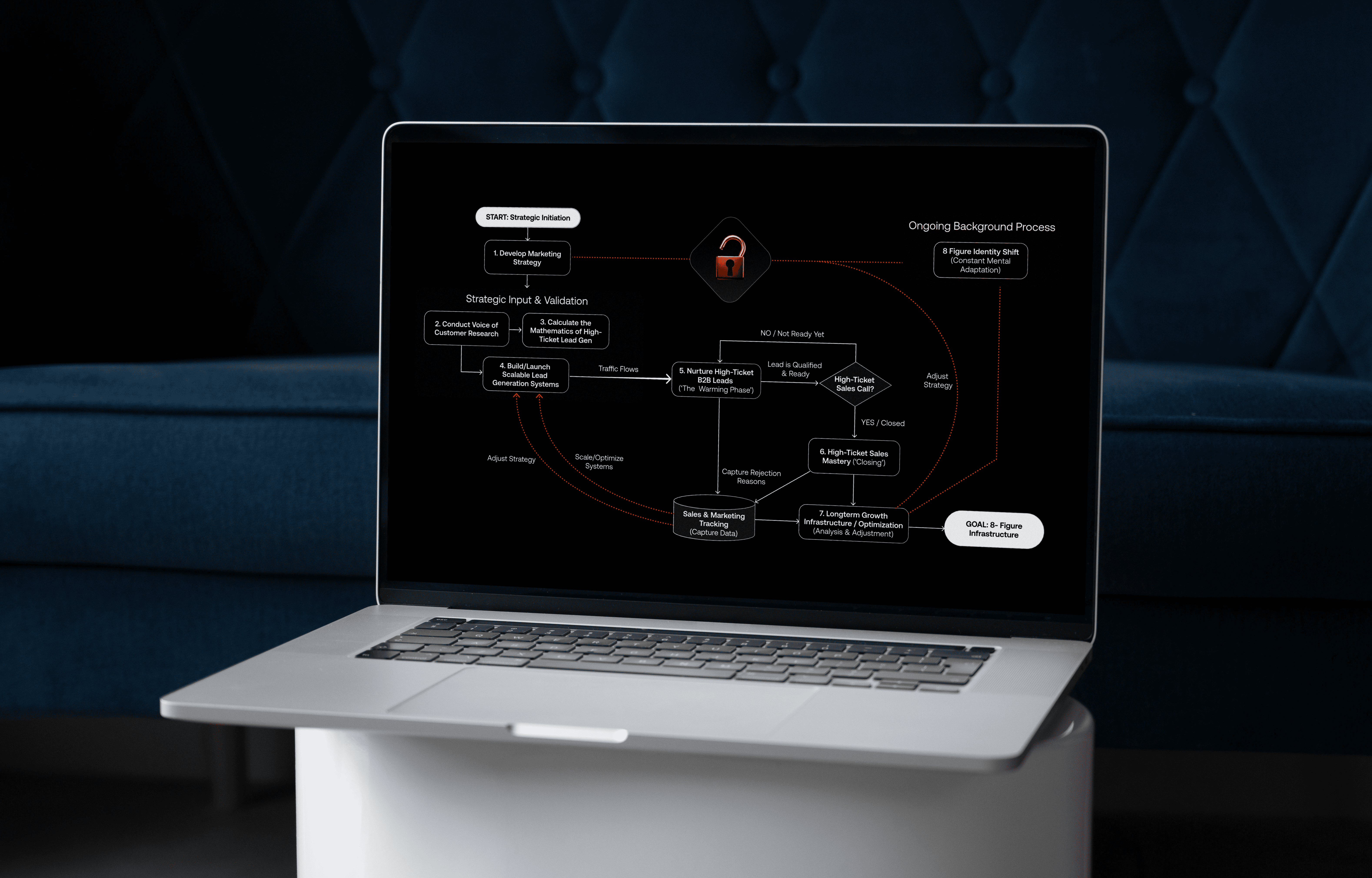
Go-to-Market Strategy for SaaS: The Complete Guide to Building a GTM Operating System
Your go-to-market strategy isn't a launch plan. It's not a pitch deck slide. It's not the campaigns your marketing team ran last quarter.
Your GTM strategy is the operating system that determines whether every dollar you spend on growth comes back as revenue, or disappears into metrics that look good but don't pay salaries.
Most SaaS companies between $1M and $10M ARR don't have a go-to-market strategy. They have a collection of tactics. Facebook ads here. A nurture sequence there. An SDR team making calls somewhere. Content going out on LinkedIn because someone said they should.
And the result is always the same: GTM feels fragmented and reactive. Experiments are random. Cost per qualified demo keeps climbing. Attribution is a mess. Performance tanks the moment you try to scale.
This guide is different from the 47 other "GTM strategy" articles you've skimmed. It's not a list of channels to try. It's the framework behind $1.5B+ in verified results across 500+ businesses, the same system we install for 7-figure SaaS companies through GTM-OS. It starts with math, not marketing. And it ends with infrastructure that compounds, not campaigns that expire.
Here's the insight that separates infrastructure from tactics: you're renting cognitive real estate. Every time your prospect opens their feed, they have limited mental space. Your brand either occupies that space or a competitor does. Visibility isn't a campaign, it's rent. You pay it consistently or someone else moves in. The GTM Operating System ensures you keep paying that rent through a system that doesn't depend on one person's energy or one campaign's lifespan.
What Is a Go-to-Market Strategy? (And Why Most SaaS Companies Get It Wrong)
A go-to-market strategy is the complete system by which a company converts market demand into revenue. Not awareness. Not pipeline. Revenue.
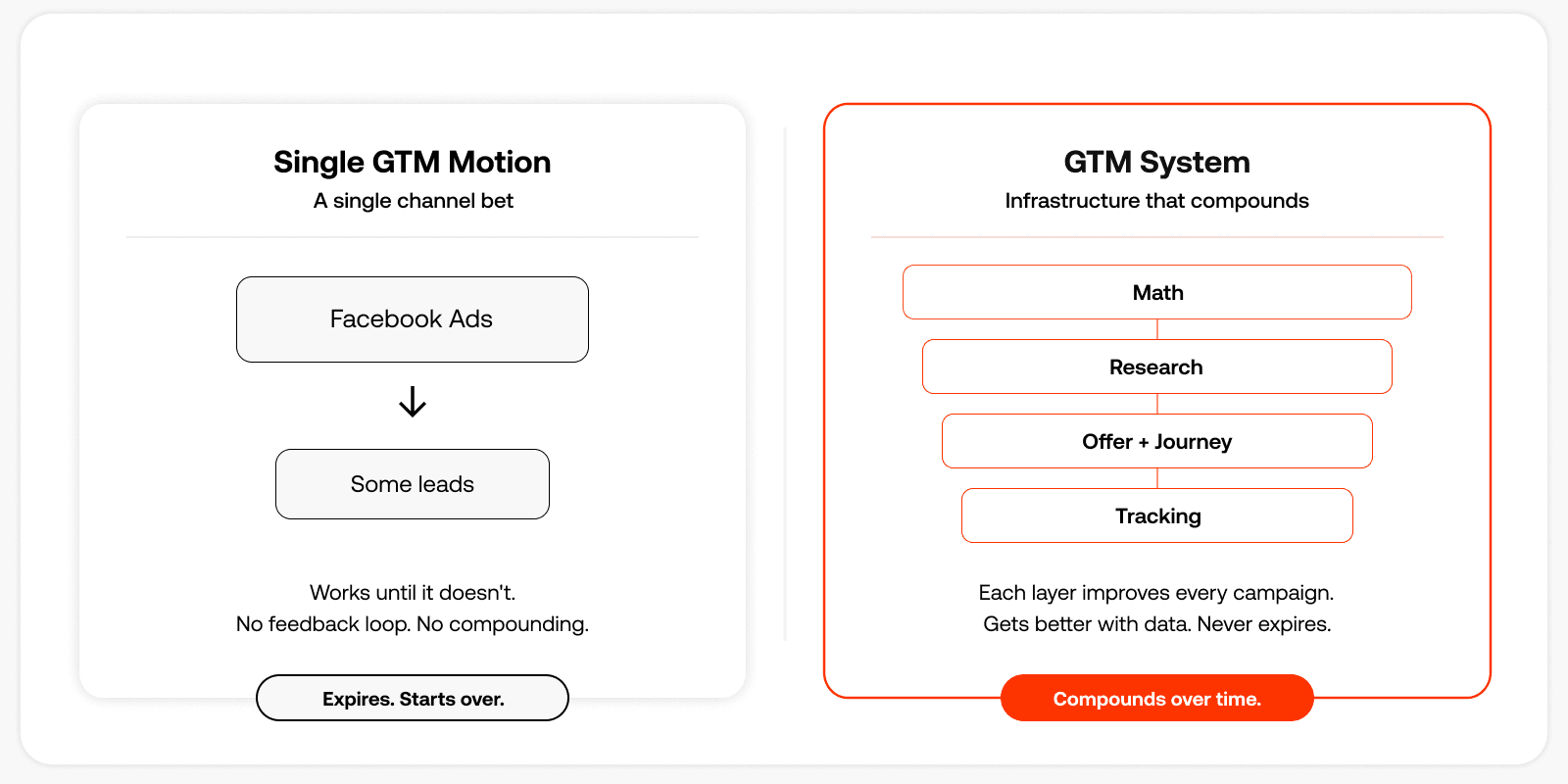
That distinction matters. Because most SaaS founders confuse a GTM strategy with a GTM motion, a single channel or tactic that generates leads. They'll say "our GTM strategy is product-led growth" or "our GTM is outbound sales." That's not a strategy. That's a bet on one motion without the infrastructure to know whether it's working.
Here's the contradiction most founders won't hear from their advisors: the problem with your GTM isn't that you haven't found the right channel. It's that you have no system to evaluate which channels work, no infrastructure to compound what does, and no math to tell you when to stop what doesn't.
A real go-to-market strategy answers five questions, in order:
What's the math? Revenue target → required customers per month → required close rate → required opportunities → required bookings → allowable cost per booking → required budget. If these numbers don't clear, nothing else matters.
Who exactly are we selling to? Not "SaaS companies" or "B2B decision-makers." Which specific human, in which specific role, at which specific company stage, with which specific pain, described in their words, not yours?
What's the offer? Not the product. The offer, the complete package of what they get, how it solves their top objections, why the price is justified, and what risk reversal makes saying yes easier than saying no.
What's the journey? From the first time a prospect sees your brand to the moment they sign. Every touchpoint mapped. Every transition engineered. Every awareness state addressed with the right message at the right time.
How do we know it's working? UTMs, CRM stages, conversion tracking, attribution modeling, and a weekly review cadence where data drives decisions, not opinions.
Most SaaS companies answer question 1 with a rough guess, skip questions 2 and 3, improvise question 4, and never build question 5. Then they wonder why growth plateaus at $3M.
This is what we call a GTM operating system, the permanent infrastructure that answers all five questions simultaneously and compounds every dollar of effort you invest. This is an operating system that runs whether you're in the room or not.
The 5 GTM Failure Modes We See in 7-Figure SaaS Companies
After working with 500+ businesses and spending 14 years deep in performance marketing, the patterns are unmistakable. Every SaaS company that plateaus between $1M and $10M ARR is stuck in one (or more) of five failure modes. Each one maps to a specific layer of infrastructure that's missing.
Failure Mode 1: No Mathematical Foundation
What it sounds like: "Let's just test it and see what happens."
There's no unit economics model. No one has calculated the allowable cost per booking based on close rate and LTV. The team runs campaigns, checks ROAS after two weeks, and makes emotional decisions about what to scale. Budget allocation is based on gut feel.
Why it kills growth: Without mathematical backpressure, you can't distinguish a winning campaign from a lucky one. You scale too early, cut too fast, or worst of all, you scale a campaign that looks profitable but bleeds money once you factor in the full sales cycle and churn.
The fix is not complex. It's a spreadsheet-level exercise that takes one afternoon. But it must be done before any campaign runs, not after. Revenue target → price point → required customers per day → close rate → required calls → show rate → required bookings → maximum cost per booking → required daily budget. If the math doesn't clear at any step, stop. Do not proceed to creative, copy, or media buying.
Failure Mode 2: Research Vacuum
What it sounds like: "We know our customers. We don't need more research."
The marketing team writes copy using internal language. The ads sound like the product team talks, features, capabilities, integrations. The customer's actual words, fears, and desires never appear in the funnel.
Why it kills growth: Copy that uses marketer language instead of customer language fails the believability test. The prospect reads it and feels nothing, not because the product is wrong, but because the words don't match their internal experience. They can't identify with it.
The standard before any copy is written: 50+ customer quotes collected and catalogued. The top 20 objections mapped. A customer language database populated with the exact phrases, metaphors, and stories your buyers use to describe their problem. Competitor analysis complete. Cross-domain pattern insights identified.
This is non-negotiable infrastructure. Without it, you're writing copy from imagination instead of evidence. And copy from imagination is the most expensive form of guessing.
Failure Mode 3: Offer Weakness
What it sounds like: "Our sales team is struggling. We need better closers."
The sales team is doing heavy convincing on calls. Prospects show up uncertain. Close rates are low. The sales leader blames lead quality. The marketing leader blames the sales process. Nobody looks at the offer.
Why it kills growth: Sales difficulty is offer failure, not sales team failure. If the offer structurally addresses the top 5 objections, if the value proposition uses actual customer language, if differentiation is substantive (not semantic), if risk reversal is built in, and if price is justified by a clear value equation, then the sales call feels like a confirmation, not a negotiation. When your sales team is fighting to close leads, the problem is upstream.
A strong offer means the prospect arrives at the sales call already 80% convinced. The call is a final checkpoint, not a persuasion exercise. If that's not happening, the offer needs surgery, not the sales script.
Failure Mode 4: Journey Incoherence
What it sounds like: "We're getting leads but they're not converting."
The ads promise one thing. The landing page says something slightly different. The email sequence shifts tone. The sales call introduces new concepts. The prospect experiences not one brand with one message, but a fragmented collection of communications that feel disconnected.
Why it kills growth: Incoherence between touchpoints shatters the belief chain. A prospect who encounters different stories at each step doesn't deepen in trust, they retreat. And a broken belief chain cannot be repaired by spending more. Every touchpoint must reinforce the same core message, build on the same proof structure, and deepen the same emotional current.
The journey isn't just about having touchpoints. It's about engineering transitions between them. From ad to landing page, what does the prospect expect, and does the LP deliver it in the first 3 seconds? From LP to email sequence, does the email extend the conversation or restart it? From email to sales call, has the prospect been pre-sold thoroughly enough that the call feels inevitable?
Each transition is a potential leak. In a mature GTM-OS, every transition is engineered.
Failure Mode 5: Tracking Black Holes
What it sounds like: "We spend a fortune and still can't tell which part of that spend actually produced clients."
This is the universal anger point. UTMs are inconsistent or missing. The CRM has leads but no clear mapping from campaign to opportunity to revenue. Multiple tracking tools give conflicting numbers. The marketing team reports on leads. The sales team reports on revenue. Nobody can connect the two.
Why it kills growth: Optimizing without attribution is driving with your eyes closed. You're making decisions based on which channel feels productive, not which channel is productive. This is why "more traffic" becomes the default answer to every problem, because without tracking, you can't see that the problem is conversion, not volume.
The infrastructure required: UTMs and naming conventions standardized across all campaigns. CRM stages mapped from first touch through close. Conversion tracking firing at every meaningful event. A dashboard that shows the complete chain: leads → SQLs → opportunities → revenue. CAC and payback calculated by channel and campaign. Show-up rate and close rate tracked. And a weekly review rhythm that turns this data into decisions.
The GTM-OS Framework: How Infrastructure Replaces Guesswork
Here's the shift that changes everything: stop treating GTM as a series of campaigns and start treating it as an operating system.
A campaign has a start date and an end date. It gets launched, measured, and retired. An operating system runs continuously. It processes inputs, produces outputs, and improves with data. It works whether or not the founder is paying attention.
The GTM Operating System is the framework we install for 7-figure SaaS companies. It's the infrastructure that makes each of the five failure modes structurally impossible. Not through discipline or heroics, through architecture.
The system rests on a principle we call Deterministic Backward Pressure (DBP). Every decision, every asset, every piece of copy traces backward from the terminal revenue event. The desired outcome, a closed deal, revenue in the bank, exerts pressure on every upstream action. Nothing enters the system that doesn't serve the causal chain from first impression to signed contract.
The operational rule: 90% deterministic quality checks, 10% judgment calls. If you find yourself relying on judgment more than math, the system is broken. If sales is doing heavy convincing, the deterministic layers, research, offer, pre-sell, failed.
This isn't theory. It's an engineering discipline. The same way a software engineer wouldn't ship code without tests, a GTM operator shouldn't ship a campaign without clearing the constraint layers.
The Five Constraint Layers
Every campaign, every piece of copy, every new initiative must pass through five gates before it goes live:
Layer 1. Mathematical Backpressure. Can this work mathematically? Run the numbers. Revenue target → price → customers needed → conversion rates required → budget implied. If the math fails, everything downstream is waste. This is the first gate, and the majority of failed GTM strategies never checked it.
Layer 2. Research Backpressure. Do we have the substrate? 50+ customer quotes. Top 20 objections. Customer language database. Competitor positioning mapped. Without this, you're guessing at what the market wants to hear.
Layer 3. Offer Backpressure. Is the offer strong enough? Top objections addressed structurally. Value proposition in customer language. Differentiation that's real, not semantic. Risk reversal included. Price justified. If the offer is weak, no amount of ad spend saves it.
Layer 4. Journey Backpressure. Is the experience coherent? Every awareness state mapped. Content matched to stage. Transitions engineered. Message consistency from first ad to signed contract.
Layer 5. Tracking & Attribution Backpressure. Can we measure what matters? UTMs, CRM stages, conversion tracking, dashboards, weekly review cadence. Without this, every decision is a guess wearing a data costume.
These five layers are not optional. They're not "nice to have." They are the structural difference between a GTM strategy that compounds and one that plateaus. Miss any single layer, and the ones below it are compromised.
Phase-by-Phase: Building Your GTM Operating System
The GTM-OS installs in three phases over 4-12 months, depending on the complexity of the business and the state of existing infrastructure.
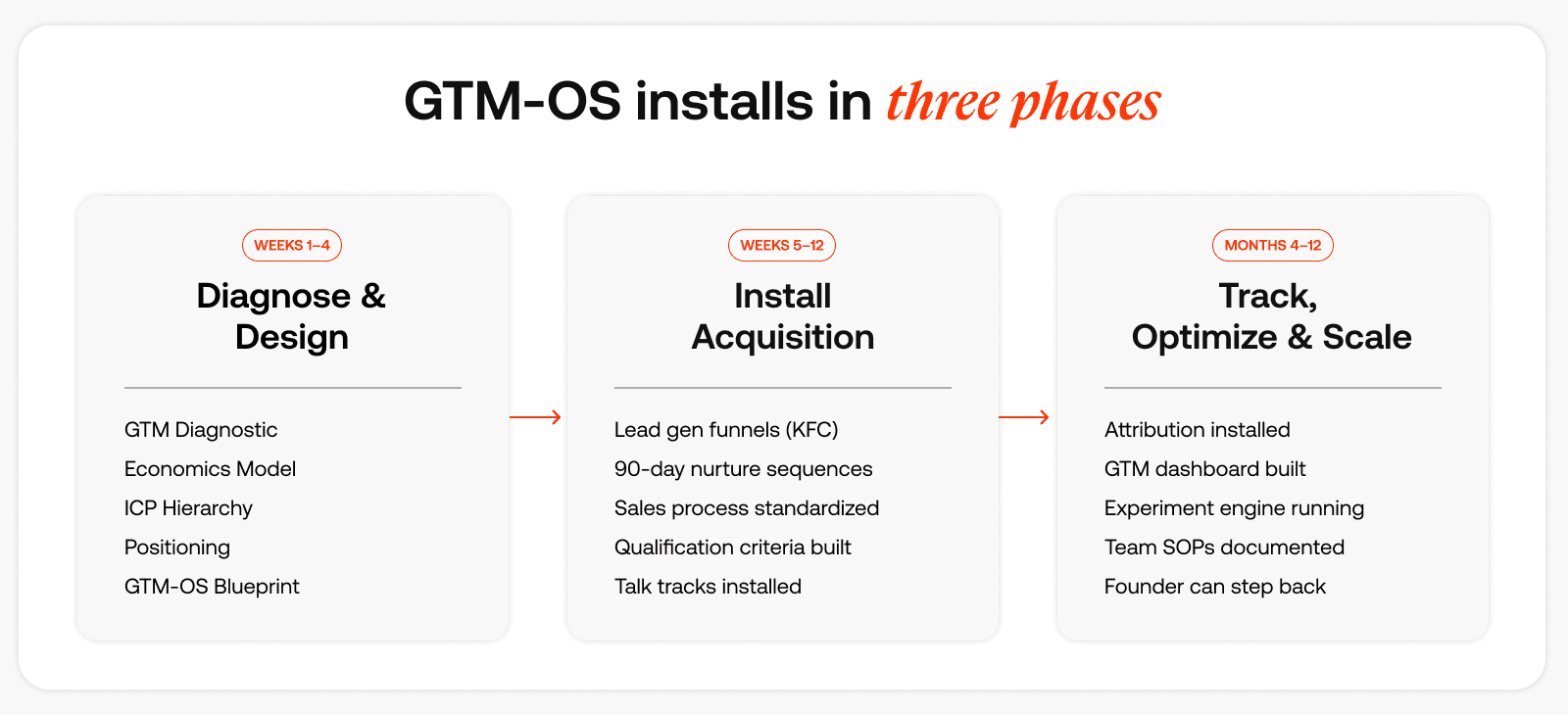
Phase 1: Diagnose & Design (Weeks 1-4)
This is the foundation. Nothing gets built until the diagnosis is complete.
GTM Diagnostic, a forensic audit of all five constraint layers. Where is the system broken? Which failure mode is primary? What's the gap between current state and required infrastructure?
Economics Model, the full mathematical backpressure chain, built from actual data. Not projections based on hope. Real close rates. Real show rates. Real CAC by channel. This model becomes the governing document for every budget decision going forward.
ICP Hierarchy, not one ideal customer profile, but a ranked hierarchy. Which ICP has the highest LTV? The shortest sales cycle? The most accessible channels? The best product-market fit? Priority determines where the first campaigns run.
Positioning, differentiation that's substantive, not semantic. What does this company do that no competitor can credibly claim? Expressed in customer language, not internal jargon.
GTM-OS Blueprint, the complete architecture document. What gets built, in what order, by whom, by when. This is the operating plan for the next 90 days.
Phase 1 deliverable: a blueprint that tells you exactly where the leaks are and exactly how to fix them.
Phase 2: Install Acquisition, Nurture & Sales (Weeks 5-12)
This is where the infrastructure gets built.
Lead Generation Funnels, designed around the KFC Method (Key First Click). Not just ads driving traffic to a page. A complete acquisition system where the quality of the first meaningful conversion event predicts downstream revenue. Campaign architecture, creative strategy, landing page design, qualification logic, all built to produce qualified pipeline, not raw volume.
90-Day Nurture Sequences, the email and content infrastructure that pre-sells so thoroughly that sales calls feel like confirmations. This is a macro-level gradualization chain: each touchpoint builds on the last, deepening trust and belief. Early emails build identification ("we understand your problem"). Middle emails introduce the mechanism ("here's how this works"). Late emails deliver the goal conclusion ("here's why this is the next step for you"). The prospect should feel more convinced with each email, never less.
Sales Process Standardization, close rate is not a personality trait. It's a function of how well the system has pre-qualified and pre-sold. Standardize the call structure. Install qualification criteria. Build talk tracks that extend the pre-sell rather than restart the conversation. Track outcomes at every stage.
Phase 2 deliverable: a functioning acquisition-to-close system that generates predictable pipeline.
Phase 3: Tracking, Optimization & Scale (Months 4-12)
This is where the system starts compounding.
Attribution Install, the complete tracking infrastructure from Layer 5. UTMs standardized. CRM stages mapped. Conversion events firing. Dashboard built. The goal: any team member can open the dashboard and see exactly which campaigns produced which revenue.
GTM Dashboard, not a reporting tool. A decision-making tool. Weekly review cadence: what changed, what's working, what's breaking, what action follows. The dashboard answers questions before someone has to ask them.
Experiment Engine, structured testing that compounds learning. Not "let's try TikTok." Hypothesis-driven experiments tied to specific mathematical outcomes. Every test has a success criterion defined before it runs. Results feed back into the system and improve every subsequent campaign.
Team SOPs & Founder Delegation, the operating procedures that let the system run without the founder in every decision. Documented processes. Clear KPIs per role. Decision trees for common scenarios. The goal: one person with the power of ten, amplified by infrastructure and AI.
Phase 3 deliverable: a self-improving growth engine that the founder can step away from.
The KFC Method: The Acquisition Engine Inside GTM-OS
Inside the GTM Operating System, acquisition runs on a framework called the KFC Method. Key First Click.
The premise starts upstream of where most marketers think: the primary goal of KFC is to engineer ads that mimic viral content posts. Ads that generate thousands of likes, hundreds of comments, hundreds of shares, not because of budget, but because the creative is designed to belong in the feed alongside organic content. The comment section becomes an evergreen billboard where objections are handled publicly, testimonials are posted, and free resources pull readers deeper into the funnel. For every person who comments, 50-100 more are reading along, pre-sold before they ever click.
Then the mathematical model takes over. Everything downstream in your funnel, show rate, close rate, LTV, referral rate, depends on the quality of the first meaningful conversion event. Not the first click. Not the first impression. The first action that indicates genuine buyer intent.
For a SaaS company selling $18K implementations, that might be an application submit plus a qualification call booked. For an agency selling $5K workshops, it might be a lead magnet opt-in plus an immediate qualification response. For a personal brand selling $60K annual programs, it might be a webinar registration plus attendance confirmation.
The specificity matters. Because once you isolate that one event, you can measure its quality. Once you measure quality, you can predict revenue. And once you can predict revenue, you can scale with confidence instead of anxiety.
The math becomes deterministic:
KFC quality → Booking rate → Show rate → Close rate → Revenue
Each conversion rate is measurable. Each is improvable. And the chain runs backward: if your close rate is 25% and you need 20 customers this month, you need 80 qualified calls. If your show rate is 70%, you need 114 bookings. If your KFC-to-booking rate is 40%, you need 285 Key First Clicks. Now you know exactly what your acquisition system must produce, and exactly what you can afford to pay for each one.
This is what separates infrastructure from improvisation. The full framework is detailed in our KFC Method guide.
GTM Strategy vs. GTM Tactics: Why Most Advice Fails
Google "go-to-market strategy" and you'll find 50 articles that are actually lists of GTM tactics. "Try product-led growth." "Build a sales-led motion." "Invest in content marketing." "Run LinkedIn ads."
These are not strategies. They're channel bets. And a channel bet without infrastructure is just organized gambling.
Here's the distinction:
A GTM tactic is a single motion. Run Facebook ads. Send cold emails. Publish blog content. Launch a webinar. Each one can work. None of them compound alone.
A GTM strategy is the system that connects tactics into infrastructure. It answers: which tactic, for which ICP, at which awareness stage, measured by which metric, governed by which mathematical constraint, reviewed at which cadence?
The reason most GTM advice fails is structural. Blogs recommend tactics because tactics are easy to describe and easy to sell. "10 ways to generate SaaS leads" gets clicks. "How to build the constraint architecture that makes your lead generation mathematically predictable" does not. But the second approach is what actually works at scale.
There's a deeper reason, too. Every marketing tactic has an expiration date. It works until everyone copies it. Raoul calls this asymmetric growth: the real advantage isn't knowing a tactic, it's discovering which approach works for your specific market before it's saturated, then building system-level complexity around it that competitors can't replicate. Tactics are commoditized. System architecture is not. That's why a GTM operating system creates defensible advantage where individual channels never can.
Why Common Alternatives Fail
Hiring a marketing agency: Agencies are incentivized to spend your media budget, not to audit your infrastructure. Their business model is percentage of ad spend or monthly retainer, both reward activity, not architecture. They'll optimize your campaigns. They won't tell you the offer is weak or the journey is incoherent because fixing those things is outside their scope and threatens their revenue.
Hiring in-house: A marketing hire operates inside your system. If the system is broken, even a talented marketer will produce mediocre results. They're too close to see the infrastructure gaps, and they lack the pattern recognition that comes from diagnosing 500+ businesses. You need someone who's seen 400 GTM systems fail and knows exactly which component breaks at which stage.
DIY from blog content: You can assemble a GTM strategy from free content, and you'll get the same results as assembling a car from YouTube tutorials. The individual parts might be correct. The integration will be wrong. GTM isn't a knowledge problem. It's an architecture problem. The value isn't in knowing the components. It's in knowing how they connect, in which order, for your specific constraints.
The alternative to all three: install the infrastructure once, correctly, with the pattern recognition of 500+ installations behind it. That's what GTM-OS provides.
How to Audit Your Current GTM: A Self-Assessment
Before you invest in any GTM initiative, ours or anyone else's, diagnose where you stand. Answer these ten questions honestly.
Mathematical Foundation
Can you state your allowable cost per booked call based on your LTV and close rate? (If no: Layer 1 is missing.)
Do you have a unit economics model that governs every budget decision? (If no: you're spending based on feel.)
Research & Messaging
Have you collected 50+ customer quotes and catalogued the language they use to describe their problem? (If no: your copy is guessing.)
Can you list your ICP's top 10 objections from memory, in their words, not yours? (If no: your offer has blind spots.)
Offer Strength
Do prospects arrive at sales calls already 80% convinced? (If no: your pre-sell is broken.)
Is your close rate above 25% for qualified calls? (If no: the offer or the qualification process needs work.)
Journey Coherence
Does every touchpoint, from first ad to signed contract, tell the same story and build the same proof structure? (If no: your belief chain is fragmented.)
Have you mapped and engineered every transition between touchpoints? (If no: you're leaking prospects at every handoff.)
Tracking & Attribution
Can you open a dashboard right now and see which campaign produced your last 10 paying customers? (If no: you're optimizing blind.)
Do you have a weekly review cadence where data drives specific decisions? (If no: data is decoration, not infrastructure.)
Scoring: 8-10 "yes" answers: Your GTM infrastructure is solid. Focus on optimization and scale. 5-7 "yes" answers: You have pieces of a system. The gaps are costing you, probably in CAC and close rate. 0-4 "yes" answers: You don't have a GTM strategy. You have a collection of tactics. Every dollar you spend on growth is working harder than it needs to because the system underneath is incomplete.
For a deeper diagnosis, take the free GTM Self-Assessment, the same diagnostic used by 500+ businesses.
What This Looks Like Installed: Real Results
The GTM-OS framework has produced verified results across industries and business models. Here are examples from our case study portfolio:
Christian Bischoff. Europe's Leading Life Coach
Challenge: High audience engagement, but event ticket sales weren't scaling predictably. Marketing felt like a constant reinvention rather than a compounding system.
GTM-OS result: KFC-optimized campaigns sold 6,000 event tickets. Generated $330K in direct sales volume. Over three years, the installed system compounded to $5.6M in revenue, from the same infrastructure, continuously optimized. Read the full case study →
Philipp Plein. Luxury Fashion Brand
Challenge: Needed to generate massive sales volume in a compressed launch window, the kind of result that requires both brand perception control and direct-response precision.
GTM-OS result: $8M in sales in six days. The KFC architecture engineered ads that controlled the narrative across platforms, funneled high-intent buyers through a compressed qualification sequence, and converted at scale within a tight window. Read the full case study →
Pressmaster.ai: 4x ARR Growth in 7 Months
Challenge: Explain a category that didn't exist yet (thought amplification engine) and build acquisition from zero across American markets.
GTM-OS result: $1,300,000 in revenue generated. 400% user growth in 7 months. 4x ARR growth. $60,000+ monthly ad spend managed through strategic email funnels and high-end ads.
Finance Trading App: ~6,425% Revenue Growth
Challenge: The product worked, but the brand didn't match the value. Scaling was capped by perception, not product quality.
GTM-OS result: Scaled from $11K to $718K+ revenue through complete brand rebuild. 3.6x ROAS. ~$99 CAC. +11,400% increase in sales. Read the full case study →
Consulting Company: $110M+ Revenue, 550%+ ROAS Over 5 Years
Challenge: Needed scalable lead generation that could sustain growth over years, not months.
GTM-OS result: ~6,365% revenue growth through approximately $17M in ad spend with clear positioning and strategic marketing assets. 550%+ ROAS maintained over 5+ years. 17,400+ qualified leads generated. 92,000+ books sold. Read the full case study →
More results across sales trainers, consulting companies, finance trading apps, and Jürgen Höller (Germany's #1 motivational trainer) at our full case studies page.
Next Steps: From Chaos to System
If you've read this far, you already know whether your GTM is a system or a collection of tactics. The question is what to do about it.
There are three paths, graduated by urgency and investment:
Path 1: Self-Assessment (Free) Take the GTM Self-Serve Audit. Ten minutes of honest answers. You'll know exactly which of the five constraint layers is your primary bottleneck. No cost, no call required.
Path 2: Infrastructure Audit The same forensic diagnostic we run for every GTM-OS client. A deep analysis of your unit economics, messaging, offer architecture, journey coherence, and attribution infrastructure. You get a complete blueprint: what's broken, what it's costing you, and exactly how to fix it. Apply for an Infrastructure Audit.
Path 3: Full GTM-OS Installation A 4-month done-with-you installation of the complete GTM Operating System, mathematical model, research infrastructure, offer architecture, acquisition system (KFC Method), nurture sequences, sales process, attribution stack, and weekly optimization cadence. This is the system behind $1.5B+ in results. Apply for GTM-OS Enterprise.
The SaaS companies that break through $10M don't get there by finding a better channel. They get there by building infrastructure that makes every channel more effective. That's what a go-to-market operating system does.
Stop guessing which GTM motion works. Install the system that tells you.
Frequently Asked Questions
What is a go-to-market strategy for SaaS?
A go-to-market strategy for SaaS is the complete system that converts market demand into revenue. It encompasses unit economics modeling, ICP targeting, offer design, customer journey architecture, and attribution infrastructure. Unlike a launch plan or channel strategy, a GTM strategy is a continuous operating system that governs all growth investments.
How is a GTM strategy different from a marketing strategy?
A marketing strategy typically focuses on messaging, channels, and campaigns. A GTM strategy encompasses marketing but also includes sales process, offer design, pricing, unit economics, and attribution. It's the complete revenue architecture, not just the top of the funnel.
How long does it take to build a GTM operating system?
For a SaaS company at $1-10M ARR, a full GTM-OS installation typically takes 4-12 months. The diagnostic and design phase takes 4 weeks. Core infrastructure (acquisition, nurture, sales) installs in weeks 5-12. Tracking, optimization, and scaling are ongoing from month 4 forward.
What's a good CAC for B2B SaaS?
There's no universal benchmark. The right CAC depends on your LTV, close rate, sales cycle length, and payback period target. A GTM-OS installation starts by building the mathematical backpressure model that defines YOUR allowable CAC based on your specific economics. Read our full guide on how to reduce CAC for B2B SaaS.
What is the KFC Method?
The KFC Method (Key First Click) is the acquisition framework inside GTM-OS. It identifies and optimizes the first meaningful conversion event in your funnel, the one action that predicts downstream show rate, close rate, and revenue. Full explanation in our KFC Method guide.
Do I need a GTM consultant or can I build this in-house?
You can build GTM infrastructure in-house if you have someone with deep cross-functional pattern recognition, meaning they've diagnosed and fixed GTM systems across hundreds of businesses, not just one. The challenge with in-house teams is proximity bias: they're too close to the system to see the structural gaps. Most companies benefit from an external diagnostic first, then execute internally with a blueprint.
How do I know if my GTM problem is strategic or tactical?
If increasing ad spend doesn't proportionally increase revenue, the problem is strategic. If your sales team has to convince prospects rather than confirm their decision, the problem is strategic. If you can't trace your last 10 customers back to the campaigns that acquired them, the problem is strategic. Tactical problems respond to campaign-level changes. Strategic problems require infrastructure.