
Marketing Attribution for B2B: How to Finally Know What's Working
Can you tell me, right now, exactly which campaign produced your last 10 paying clients?
If you can't. You're spending a fortune and still can't tell which part of that spend actually produced clients. That's not a reporting problem. It's an infrastructure problem. And it maps directly to the fifth constraint layer in the Deterministic Backward Pressure framework: Tracking & Attribution Backpressure.
Without this layer functioning, you can't optimize, you can't prove what works, and you can't allocate budget confidently. You're flying blind while competitors fly with instruments.
The Attribution Crisis in B2B Marketing
Attribution in B2B is fundamentally harder than in consumer businesses. Your buyer's journey doesn't happen in a single session. It happens over weeks, sometimes months. Multiple stakeholders research independently. Touchpoints span paid ads, organic search, LinkedIn, email, webinars, referrals, and sales conversations, most of which your analytics platform never connects.
The symptoms show up everywhere:
Attribution is a mess: your data lives in three different systems that don't talk to each other.
Google Analytics says one thing, your CRM says another, and the agency report says a third.
You can't tell if content marketing is contributing to pipeline or generating vanity traffic.
Tracking is unreliable. You're optimizing blind.
The cost of this ambiguity isn't abstract. It's real money leaving your account every month, flowing into channels that may be producing nothing while the channels that actually work are underfunded.
Why Standard Attribution Models Fail for High-Ticket B2B
There's a false belief that needs dismantling: "Google Analytics tells you what you need to know." GA tells you what's easy to measure. Those are very different things.
Last-click attribution gives 100% credit to the final touchpoint before conversion, usually a direct visit or branded search. It ignores every touchpoint that built the awareness and trust that led to that final click.
First-click attribution captures how someone entered your orbit, but says nothing about what convinced them to buy.
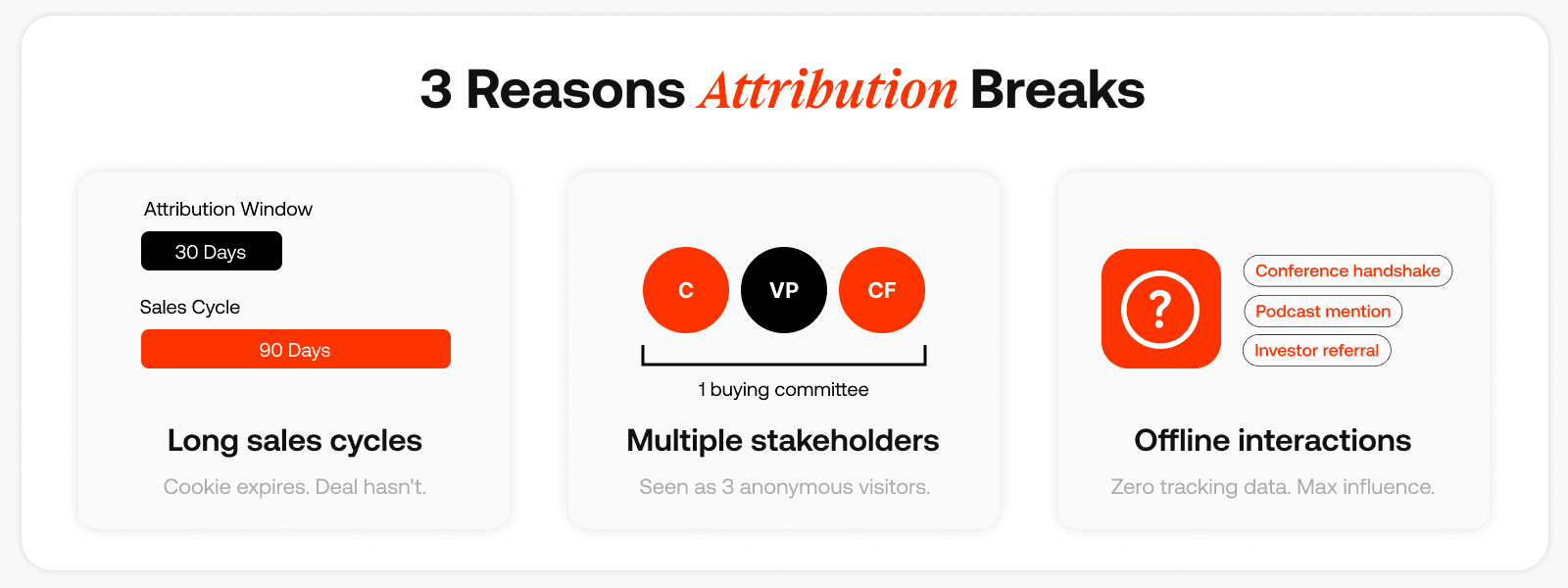
Multi-touch attribution is better in theory, but breaks down for high-ticket B2B for three structural reasons:
Long sales cycles destroy attribution windows. When deals take 30–90 days to close, most attribution tools have already expired the cookie or session before the revenue event occurs.
Multiple stakeholders create phantom journeys. Your champion Googles you in January. Their VP clicks a LinkedIn ad in March. Their CFO visits your pricing page directly in May. Standard tools treat these as three separate anonymous visitors, not one buying committee.
Offline interactions are invisible. The conference handshake, the podcast mention, the investor referral, high-influence moments that leave zero tracking data.
The result: B2B companies are making six- and seven-figure budget allocation decisions based on a model designed for e-commerce purchases that happen in a single browser session.
The Tracking Stack That Actually Works
Attribution isn't one tool. It's an infrastructure layer. In the GTM-OS framework, tracking and attribution is the fifth constraint layer because without it, you cannot close the feedback loop on any of the four layers above it (math, research, offer, journey).
Here's the stack architecture that connects spend to revenue:
Layer 1: UTM Discipline
Every link, every ad, every email must carry consistent UTM parameters: source, medium, campaign, content, and term. That includes quick social posts, agency-managed campaigns, and one-off email blasts. If it drives traffic, it gets tagged.
This is the most basic piece of marketing infrastructure, and it's the one most frequently broken. Without clean, consistent UTM protocols across all channels, nothing downstream works.
Layer 2: CRM as the Source of Truth
Your CRM (Salesforce, HubSpot, or equivalent) must be the system of record for revenue attribution. Not your ad platform, not GA, not a third-party tool. The CRM holds deal amounts, close dates, pipeline stages, and the contact-to-company associations that make account-level attribution possible.
Marketing touchpoints flow into the CRM. Revenue data flows out to your attribution model. The output: marketing-influenced pipeline and marketing-influenced revenue at the campaign and channel level. Not just lead counts or MQLs.
Layer 3: Third-Party Attribution
Tools like Hyros, Cometly, Dreamdata, or HockeyStack serve as the connective layer between your ad platforms and your CRM. They stitch together the cross-device, cross-channel, multi-stakeholder journey that native analytics can't see.
The key is integration, not replacement. GA4 + your attribution platform + your CRM + your ad platforms = one coherent picture.
Layer 4: Dashboard Architecture
Reporting must map to decisions. Not just display data. Your attribution dashboard should answer four questions:
Which channels are producing qualified pipeline (not just leads)?
What is the cost per acquisition by channel and campaign?
What is the payback period by acquisition source?
Where should we reallocate budget this week?
If your dashboard can't answer those in under 60 seconds, it's not a decision tool. It's a data graveyard.
From Data to Decisions: The Weekly GTM Review
Here's where most companies fail, even those with decent tracking. They collect data but never build a decision rhythm around it.
Tracking without a decision cadence is just expensive data collection.
Who's in the room: Marketing lead, sales lead, and whoever owns the budget.
What gets reviewed:
Show-up rate by acquisition source; are leads from Channel X actually attending calls?
Close rate by acquisition source; are those calls converting to clients?
CAC and payback period by channel and campaign
Pipeline coverage; enough qualified opportunities to hit this month's target?
What decisions follow:
Kill or scale individual campaigns based on downstream metrics (not just CPL)
Adjust creative or messaging where show-up or close rates are declining
Reallocate budget toward channels with the shortest payback period
This rhythm, data → review → decision → action, turns tracking from a cost center into a revenue accelerator.
Implementation Roadmap
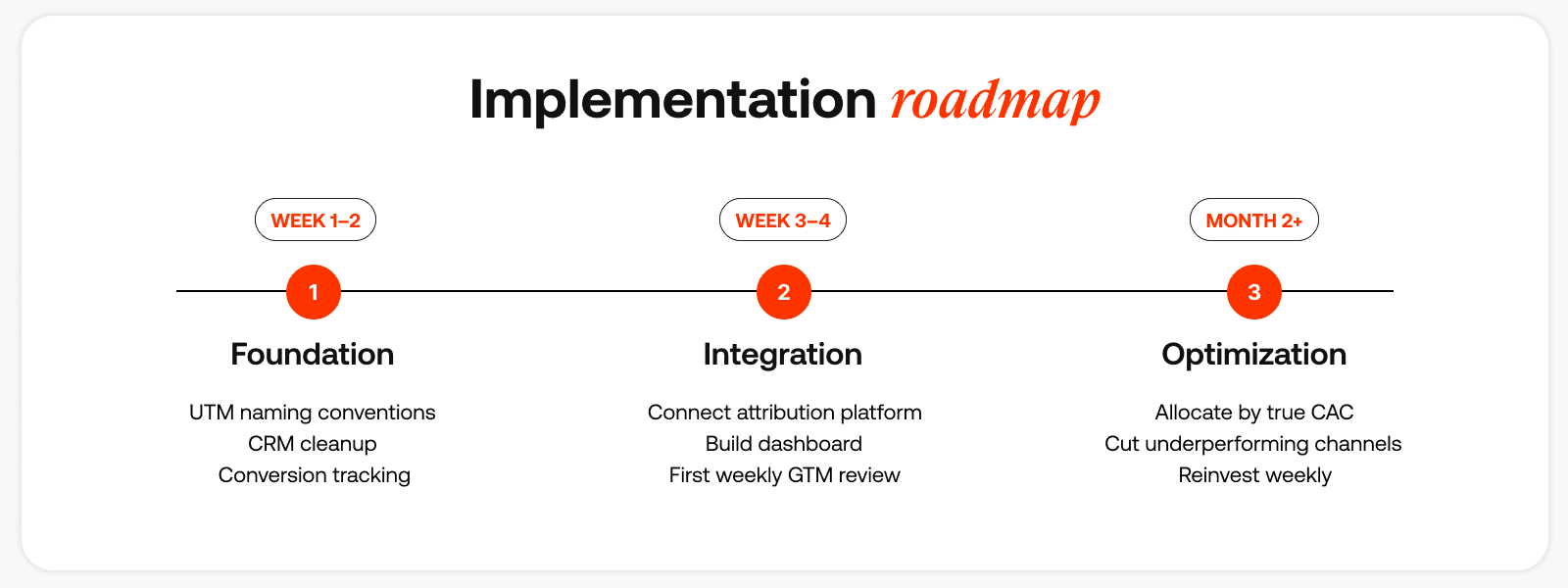
Week 1–2: Foundation
Audit and standardize UTM naming conventions across all channels. Clean your CRM: fix broken contact-company associations, standardize pipeline stages, ensure every deal has a source field populated. Set up conversion tracking (pixel, CAPI) on all key events, bookings, qualified leads, and closed deals, not just form submissions.
Week 3–4: Integration
Connect your attribution platform to both your ad accounts and your CRM. Build the initial dashboard answering the four decision questions. Run the first Weekly GTM Review, even if the data is imperfect. The cadence matters more than perfection at this stage.
Month 2+: Optimization
With clean data flowing, start making allocation decisions based on cost per acquired customer. Not cost per lead. Identify your highest and lowest performing channels. Cut waste. Reinvest in what's working. Iterate weekly.
Why This Matters in the Context of Your GTM System
In the DBP framework, tracking is Layer 5. The final constraint gate. If this layer fails, you cannot optimize any of the four layers above it: your math model has no feedback loop, your research-backed copy can't be tested against real conversion data, your offer can't be evaluated by downstream close rates, and your journey coherence can't be validated.
The KFC Method (Key First Click) depends on being able to trace that first meaningful conversion event all the way through to revenue. Without clean attribution, KFC can't function as designed. You're guessing which first click actually predicted a customer, instead of knowing.
This is why, in a GTM-OS installation, the tracking and attribution layer is built as part of the system. Not bolted on afterward. Every campaign produces measurable, decision-grade data from day one.
Frequently Asked Questions
What is marketing attribution in B2B?
Marketing attribution in B2B is the process of identifying which marketing touchpoints, ads, content, emails, events, contributed to a closed deal. Unlike B2C, B2B attribution must account for multiple stakeholders, long sales cycles (30–180 days), and offline interactions that standard tools can't track.
Which attribution model is best for B2B SaaS?
Position-based (U-shaped) attribution is a strong starting point. It gives 40% credit to the first touch, 40% to the last touch before sales handoff, and distributes 20% across middle interactions. This recognizes that awareness and decision moments carry more structural weight than mid-funnel nurture touches.
Why doesn't Google Analytics work for B2B attribution?
GA4 tracks sessions at the individual user level, but B2B deals involve multiple stakeholders on different devices and browsers. GA can't connect these into an account-level view, can't reliably handle 90+ day attribution windows, and can't tie marketing touches to revenue outcomes in your CRM without custom integration.
How long does it take to see results from attribution?
With clean implementation, you can start making better allocation decisions within 60 days. A full quarter of clean data is typically needed for high-confidence budget shifts, enough to see downstream metrics like show rates, close rates, and revenue by source.
What's the difference between attribution and analytics?
Analytics tells you what happened on your website, page views, sessions, bounce rates. Attribution tells you which marketing activities produced revenue. Attribution is the system that connects marketing spend to business outcomes and drives budget decisions.
Next Steps
If your attribution is broken, your entire GTM is flying blind. Every campaign, every dollar, every "optimization" is based on incomplete information.
The fix isn't another tool. It's an infrastructure layer that connects spend to revenue and installs a decision rhythm. The Infrastructure Audit identifies exactly where your tracking breaks down, what it's costing you, and what to fix first.
Skip the 3-month DIY setup. Get this installed in your GTM-OS.
Marketing.MBA | $1.5B+ in verified client revenue across 500+ businesses.