Performance Branding: How to Combine Brand Building with Direct Response
The biggest lie in marketing is that you have to choose between building a brand and generating revenue.
On one side, the brand purists: beautiful campaigns, emotional storytelling, massive reach, and no idea whether any of it produced a single paying customer. On the other side, the performance obsessives: every dollar tracked, every click optimized, until the well runs dry and scaling stops working.
Both camps are wrong. They're solving half the problem and pretending the other half doesn't exist.
Raoul Plickat was one of the first to combine branding video campaigns with direct marketing tactics in paid social media campaigns, a move that heavily influenced how other marketers approached their strategies from that point on. That fusion is what we call performance branding, and it's the approach behind $1.5B+ in client revenue across 500+ businesses over the last 14 years.
The False Choice: Brand vs. Performance
The marketing industry presents this as an either/or: you're either building brand equity (long-term, unmeasurable, expensive) or running performance campaigns (short-term, measurable, transactional). Pick a side.
This false dichotomy has cost businesses billions in wasted potential. Brand-only companies build audiences that never convert. Performance-only companies scale into walls they can't explain. Both are missing the same thing: a single campaign architecture where every asset simultaneously builds brand AND drives measurable action.
That's what performance branding delivers. Not brand awareness campaigns running alongside conversion campaigns. One integrated system where every piece of content does three jobs at once.
The Three Dimensions at Work
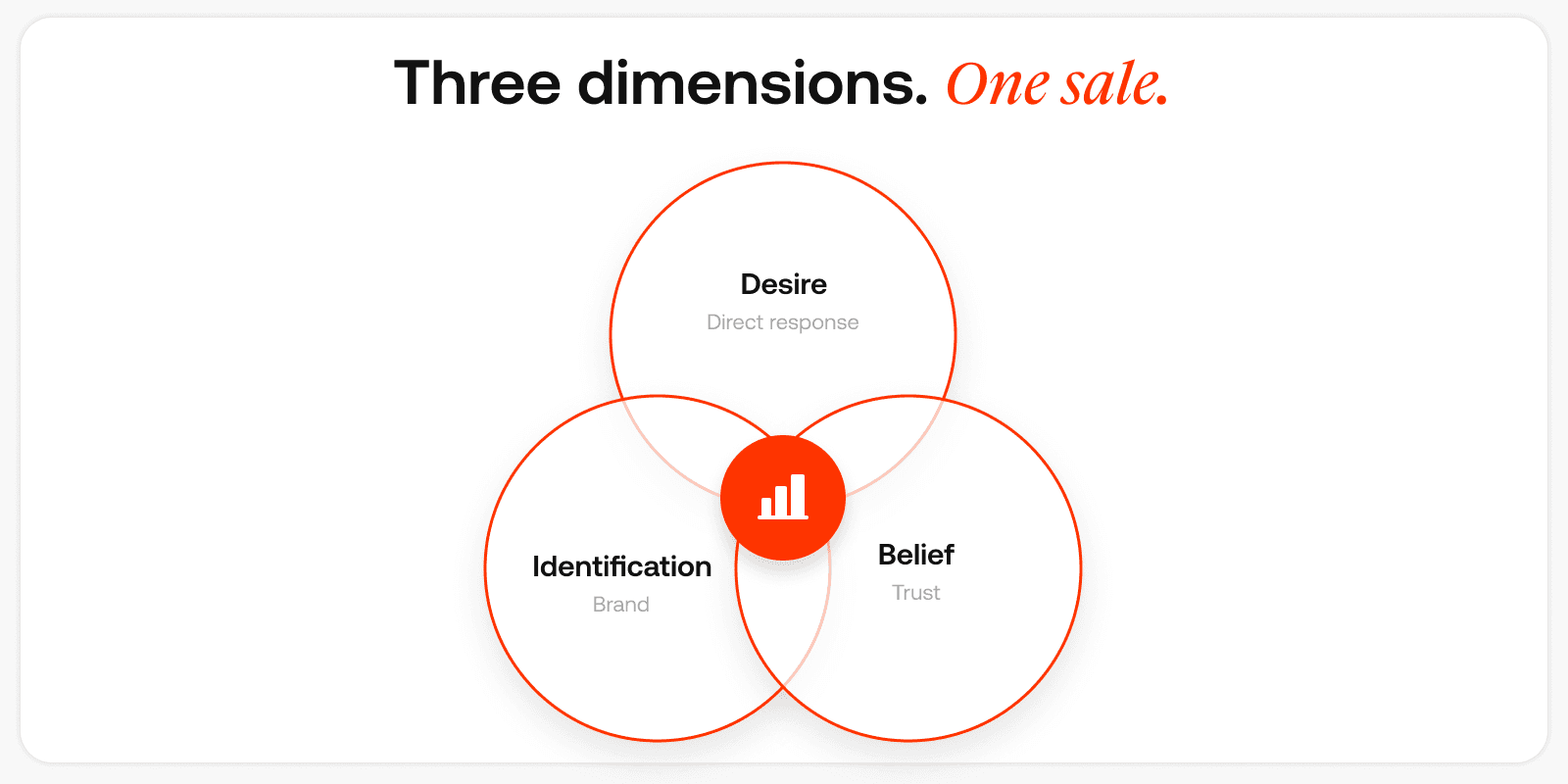
Every buying decision, especially high-ticket, sits at the intersection of three psychological forces. Miss any one, and the sale either never happens or requires enormous sales effort to close.
Dimension 1: Desire (The Direct Response Layer)
This is what performance marketing does well: activating desire. Pain amplification. Future pacing. Clear articulation of the problem and the promise of a solution.
But desire alone is shallow. It produces impulse clicks, not committed buyers. A prospect who acts purely on desire will no-show your call, ghost your follow-up, or buy from whoever they saw last.
Dimension 2: Identification (The Brand Layer)
Identification is the moment a prospect says, "These people get me. This brand is for people like me." It's not logo recognition. It's worldview alignment.
When your content consistently articulates a perspective the prospect already holds, they begin to identify with your brand before they ever speak to sales. They see themselves in your case studies. They forward your posts to colleagues. Identification turns a cold lead into a warm advocate, before the first call.
Dimension 3: Belief (The Trust Layer)
Belief is the conviction that your specific mechanism will produce the result they want. It's not enough for a prospect to want the outcome (desire) and feel aligned with your brand (identification). They need to believe that your approach is the one that will actually work for them.
Performance branding addresses all three simultaneously. When all three dimensions are present, the sale becomes inevitable. The prospect has already convinced themselves through repeated exposure to content that addressed every layer of the buying decision.
Why Pure Performance Marketing Hits a Ceiling
If you've spent $30K–$100K+/month on paid media, you've likely felt the performance plateau:
ROAS that looked incredible at $500/day collapses at $2,000/day
Creative fatigues faster with each cycle
The same audience sees your ads repeatedly with diminishing returns
Cost per booked call keeps climbing despite "optimization"
The root cause isn't targeting or creative. It's the absence of brand equity in your funnel. When you scale, you reach colder audiences who need to have heard of you before they'll click. They need to trust you before they convert. Without that brand layer, scaling is a losing game.
This is the algorithmic echo chamber problem. Meta's delivery system optimizes to find people most likely to convert. At low spend, it finds your warmest prospects fast. At scale, it exhausts that pool and reaches into colder segments, where pure direct response without brand recognition fails.
Why Pure Brand Marketing Burns Cash
"People love our content but they don't buy."
Pure brand marketing creates identification without activation. Prospects admire your perspective, even recommend you to friends, but never take action because the content never asks them to. The mechanism is missing, the belief bridge is missing, and there's no clear next step connecting admiration to a purchase decision.
And there's no accountability loop. Without performance metrics, you can't measure what's working, can't kill what's not, and can't iterate based on data.
The Performance Branding Playbook
Layer 1: Strategic Content Assets
Long-form content that builds belief and identification: video manifestos, deep-dive case studies, framework explanations, contrarian takes. These aren't designed to convert directly. They create emotional anchors. The prospect watches or reads, and something shifts in how they see their problem and your solution.
Strategic marketing assets in the right sequence create emotional anchors and predictable buying patterns, that's the KFC Method at the content level.
Layer 2: Direct Response Activation
Once a prospect has engaged with a strategic asset, they enter the direct response layer. Conversion campaigns hit differently when the prospect already knows your worldview and has seen your framework. The landing page doesn't convince from scratch . It activates a decision that's already forming.
Layer 3: Graduated Nurture
Email sequences that continue belief-building. Early emails focus on symptom identification. Middle emails introduce your mechanism and proof. Later emails present goal conclusions, what life looks like after the problem is solved. Each email is one link in a chain that graduates the prospect from "aware" to "convinced."
Content Types That Drive Performance Branding
Founder-led video content: A founder or expert on camera, speaking directly about the problem, the mechanism, and the proof. This is the highest-leverage format because it builds all three dimensions at once: expertise creates belief, personality creates identification, and specificity creates desire.
Mechanism explainers: Content that teaches your proprietary framework. The KFC Method. Deterministic Backward Pressure. When a prospect understands your mechanism, every other solution they evaluate gets measured against your framework.
Contrarian POV pieces: Content that takes a specific position challenging conventional wisdom. These create instant identification (people who agree feel seen) and instant disqualification (people who disagree self-select out). Both outcomes are valuable.
Before/after case narratives: Narrative stories from real client work. Not metric dumps, but the journey from frustration through diagnosis to results. Marketing.MBA's verified case studies include clients like Christian Bischoff ($3.23M+ revenue, 12,500+ event tickets), Philipp Plein ($8M+ in 6 days, 3,960% ROAS), and Jürgen Höller ($10.3M+ in 7 months, 8.65x ROAS).
Budget Allocation & The Algorithmic Advantage
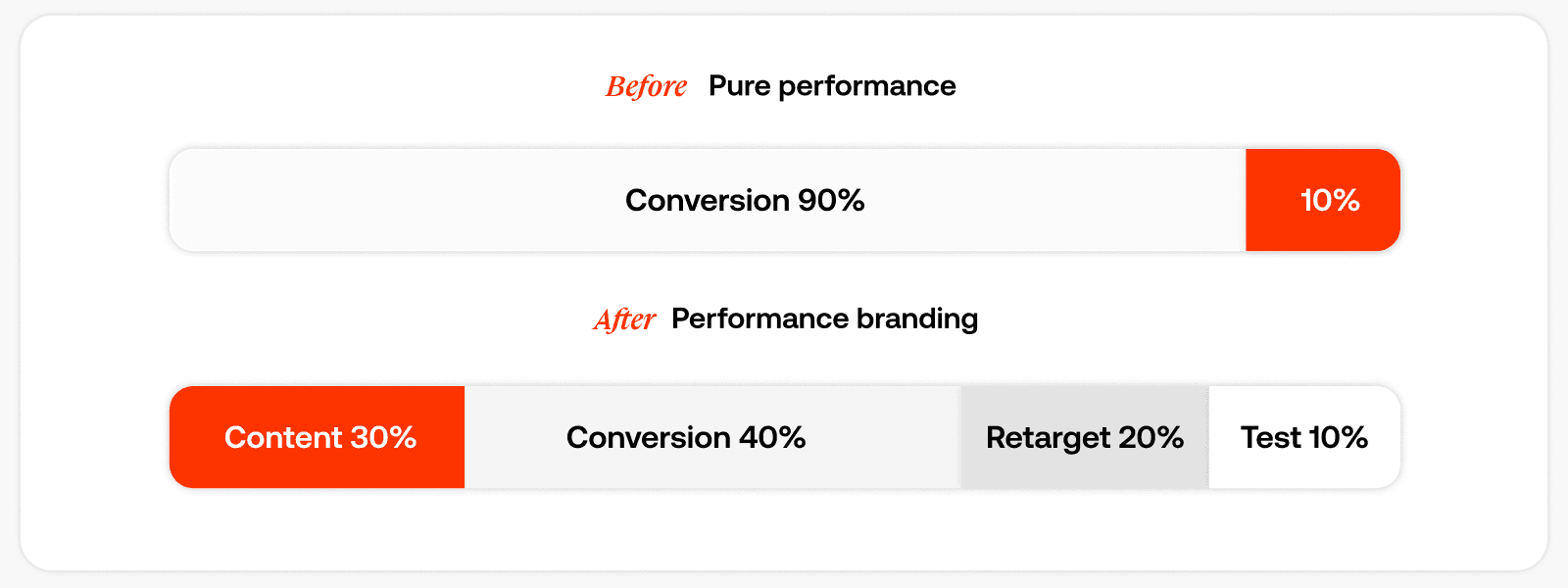
The shift from pure performance to performance branding typically reallocates spend from ~90% conversion / ~10% retargeting to roughly 30% strategic content distribution, 40% conversion campaigns, 20% retargeting, and 10% testing.
The concern is always: "You want me to spend 30% on content that doesn't directly convert?" Yes, because that 30% makes the other 70% dramatically more efficient. Without the brand layer, conversion campaigns fight cold skepticism. With it, they activate pre-existing conviction.
There's also a technical advantage: strategic content engagement trains Meta's algorithm with higher-quality signals. Long video views, saves, shares, and comments give the algorithm a richer model of your ideal customer, which improves conversion campaign targeting, even though they're separate campaigns.
The Measurement Framework
Performance branding isn't unmeasurable . It requires different metrics:
Branded search volume, are more people searching for you by name?
First-time impression ratio (FTIR), what percentage of impressions reach new people?
Cost per acquisition by touchpoint depth, do prospects who engage with 3+ content pieces convert at lower CAC?
Sales cycle length by acquisition path, does the performance branding path produce faster closes?
Payback period by channel, which blend of brand + performance produces the fastest return?
The compounding effect typically becomes measurable at 60–90 days: lower CAC, higher close rates, shorter sales cycles, and, critically, scalability that pure performance can't achieve.
Case Studies: Performance Branding in Action

These are verified results from Marketing.MBA's client portfolio:
Christian Bischoff: Generated $3,230,000+ in revenue with 12,500+ event tickets sold and 26.6+ million impressions through strategic digital campaigns that combined brand-building content with direct response activation. View full case study.
Philipp Plein: Achieved 13 million impressions through $65K ad spend during a 6-day Black Friday campaign and Milan Fashion Week. $8M+ in revenue generated. 3,960% ROAS. Brand perception control + direct-response precision compressed into a single launch window. View full case study.
Jürgen Höller: Generated $10.3M+ revenue in 7 months through complete rebranding and strategic lead acquisition achieving 8.65x ROAS, with $430K+ in monthly peak ad spend and 2,000+ weekly leads at peak performance. View full case study.
Healing Humans: Achieved 1,645% total revenue growth reaching $2,069,353 in 13 months with 8–10x sustained webinar ROAS through systematic scaling.
Frequently Asked Questions
Isn't performance branding just "full-funnel marketing"?
No. Full-funnel marketing typically means running separate brand campaigns at the top and conversion campaigns at the bottom. Performance branding is a single, integrated architecture where every asset does both jobs. The difference is engineering, not budget allocation.
How long does it take to see results?
Direct response results (leads, bookings) start within the first 2–4 weeks. The brand compounding effect, lower CAC, higher close rates, improved scalability, becomes measurable at 60–90 days.
Does performance branding work for B2B?
It works especially well for B2B and high-ticket offers, where the buying decision is complex and trust is a prerequisite. Performance branding was developed in this context. Raoul Plickat pioneered the approach specifically for high-ticket offers where belief-building determines close rates.
What budget do I need?
If you're spending $10K+/month on paid media, you have enough budget. The shift isn't about spending more. It's about restructuring how existing spend is allocated across content types and funnel stages.
How is this different from "content marketing"?
Content marketing says "create valuable content and hope it attracts buyers." Performance branding says "engineer every content asset to simultaneously build brand, create belief, and drive a specific measurable action." The content may look similar. The strategic intent, and the measurement framework, are fundamentally different.
Next Steps
If you're hitting a scaling ceiling with pure performance, or spending on brand without seeing pipeline, the answer isn't more of either. It's a system that fuses both. The Infrastructure Audit maps exactly where your current setup is leaving money on the table, and which performance branding elements to install first.
See how performance branding fits within the complete GTM operating system, or apply for an Infrastructure Audit to get it installed.
Marketing.MBA | $1.5B+ in verified client revenue across 500+ businesses.