High-Ticket Lead Generation: The System Behind $1.5B in Results
Are your booked calls full of "just exploring" replies?
The calendar is filling up, but when your closer gets on the call, the prospect isn't ready. They're "still researching." They "need to think about it." They vanish after the first conversation. The volume looks healthy. The pipeline is empty.
You can't scale $5K to $50K+ offers the same way you sell $47 products. The math, psychology, and infrastructure are all fundamentally different. This is what the KFC Method (Key First Click) was built to solve.
Why High-Ticket Lead Generation Is a Different Game
At $15K–$50K+ per customer, you don't need thousands of leads. You need a handful of deeply qualified, pre-convinced prospects who arrive at your sales conversation ready to make a decision.
The math illustrates why architecture matters: if your offer is $18K and you need 3 new customers per month, you need roughly 10 qualified booked calls (at a 30% close rate), which requires approximately 25–30 total bookings (accounting for show rates), which may require 300–500 leads depending on funnel quality.
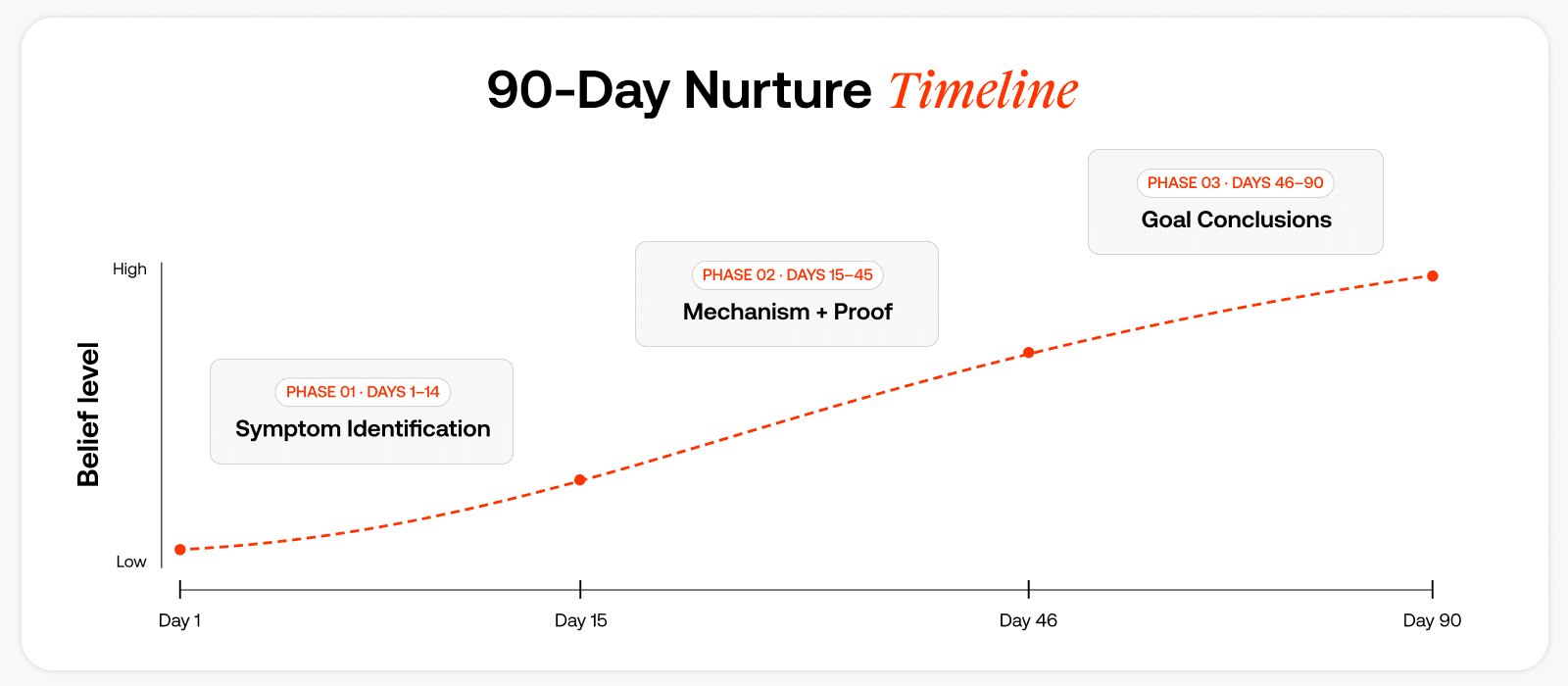
That's a small number, but only if those leads are the right people entering the right journey. The mistake most businesses make: they build a funnel designed for volume and hope quality shows up.
The 4 Pillars of Predictable High-Ticket Leads
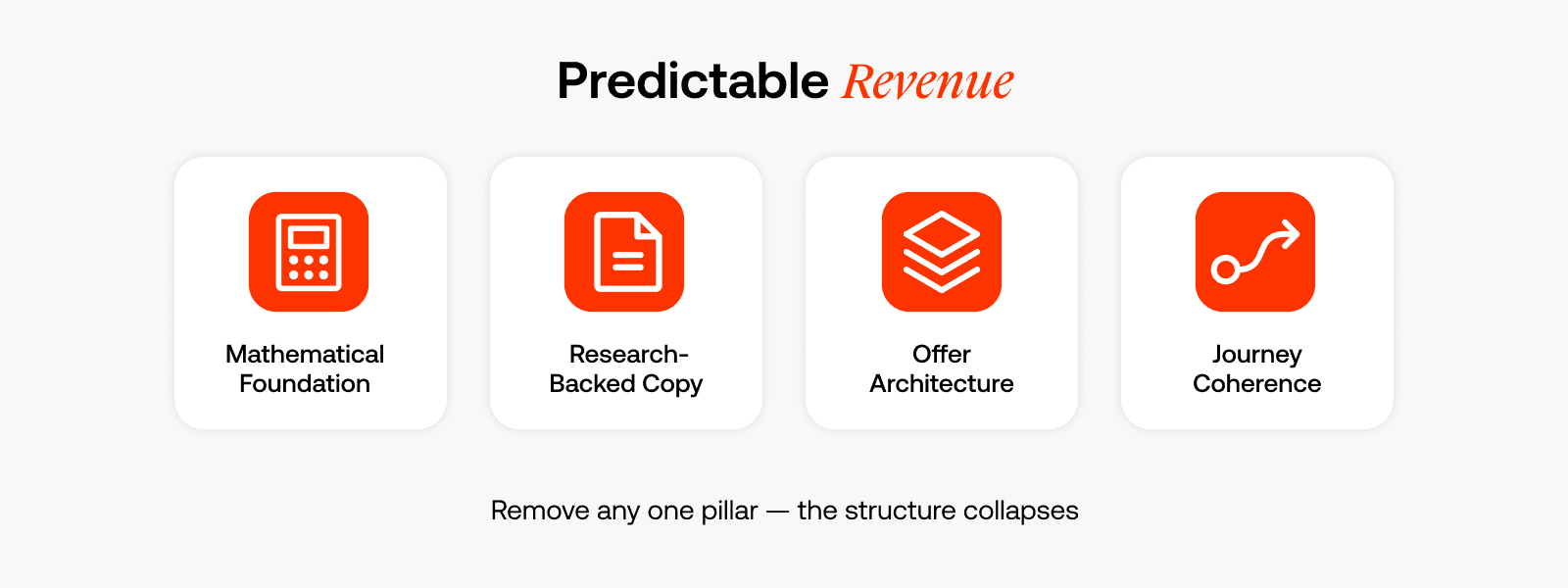
Pillar 1: Mathematical Foundation
Before you write a single ad, the math must clear. This is the first constraint layer in the DBP framework.
Revenue Target → Price Point → Required Customers/Month → Close Rate → Required Booked Calls → Show Rate → Required Bookings → Conversion Rate → Required Leads → Allowable CAC → Daily Budget.
If the math doesn't clear at any step, stop. Do not proceed to creative, copy, or media buying. No amount of great advertising fixes broken unit economics
Pillar 2: Research-Backed Copy
High-ticket prospects respond to their own language. The exact words they use to describe their problem. This requires documented research: customer quotes from sales calls, reviews, and interviews. The top objections categorized by type. The specific symptoms your ICP experiences. Not what you think they experience, but what they actually say.
When your ad copy mirrors the prospect's internal monologue, the quality of every lead changes. Not because you targeted differently, because you spoke differently.
Pillar 3: Offer Architecture
If your sales team spends 60 minutes on every call overcoming objections, the problem isn't sales technique. It's offer design. A well-architected offer addresses objections structurally: risk reversal handles "what if it doesn't work," clear deliverables handle "what exactly do I get," case studies handle "has this worked for someone like me," and price anchoring handles "it's too expensive."
When the offer does the heavy lifting, sales shifts from persuasion to qualification.
Pillar 4: Journey Coherence
One belief chain from first ad impression to closed deal:
Ad: Identifies the prospect's specific pain and introduces the idea that a system exists to solve it.
Landing page: Expands on the mechanism, how it works, who it's for, results.
Email nurture: Graduates the belief, from "this problem is real" to "there's a specific solution" to "this company has proven it works."
Sales call: Confirms fit and presents the offer as the logical next step in a decision already forming.
Every touchpoint builds on the last. Nothing contradicts. The prospect moves through the journey feeling like you built each step specifically for them.
The Funnel Most High-Ticket Businesses Get Wrong
The typical high-ticket funnel: Ad → Landing page → "Book a call" form → Calendar. The problem isn't the structure. It's the absence of pre-selling. The funnel collects names, but doesn't build belief. The prospect who books has expressed surface interest, not conviction.
Contrast this with a funnel designed around the KFC Method:
Ad → Strategic content (video, article, or lead magnet that educates on mechanism) → Landing page → Qualification form (filtering for revenue, challenge, timeline, and decision authority) → Calendar.
The KFC (Key First Click) is the first meaningful conversion event, engineered to filter for intent and begin belief-building. Everything downstream converts at a higher rate because you controlled the quality of entry.
Strategic marketing assets in the right sequence create emotional anchors and predictable buying patterns. That's the KFC Method. Not random volume posting.
90-Day Nurture: Turning Cold Traffic into Warm Pipeline
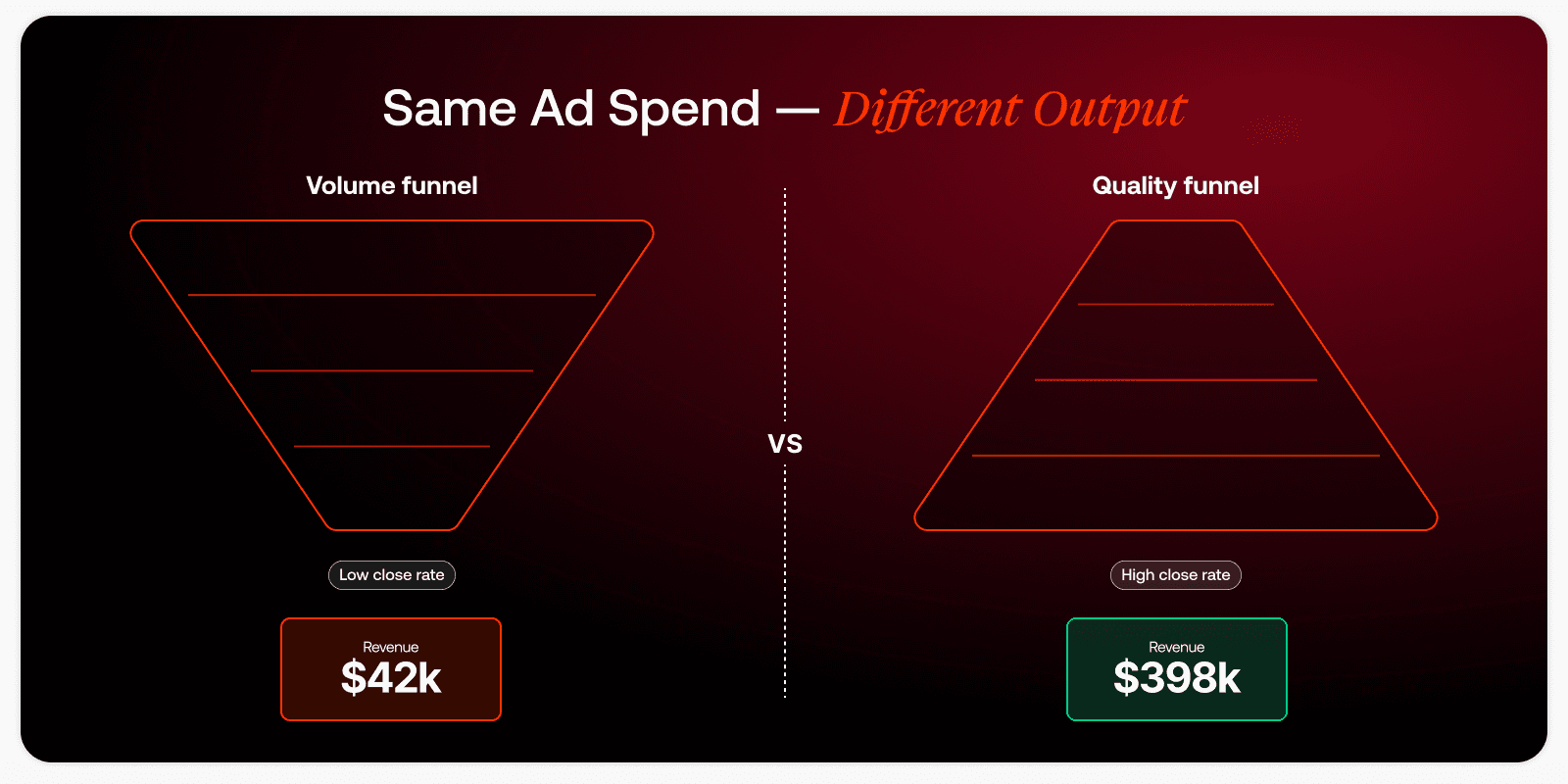
Not every prospect books a call on day one. In high-ticket, the average buying cycle is 30–90 days. Prospects who don't convert immediately aren't "lost", they're pre-buyers in an earlier stage of the belief journey.
The 90-day nurture sequence is designed as a graduated belief chain. This maps to how influence actually works, what Raoul describes as the macro-level gradualization chain, where each touchpoint is one link in a belief bridge.
Days 1–14: Symptom Identification
Emails that mirror the prospect's current pain using their actual language. The goal isn't to sell. It's to demonstrate that you understand their world.
Days 15–45: Mechanism + Proof
Introduce the framework. Show how it works. Share case studies with specific numbers. Present the logic: if A, then B, then C, here's the proof it works.
Days 46–90: Goal Conclusions
Paint the picture of life after the problem is solved. Make the future state vivid enough that not taking action feels like the riskier choice.
The KFC Method Applied to High-Ticket
The KFC Method (Key First Click) is the acquisition engine within the broader GTM-OS. For high-ticket offers specifically, it changes the quality equation at the point of entry.
Most marketers optimize for the wrong metric. They chase clicks, impressions, CPMs. KFC focuses on the one click that actually predicts revenue. The first meaningful conversion event. Everything downstream (show rate, close rate, LTV) depends on the quality of this first click.
When the Key First Click is engineered correctly, through strategic content that educates on the mechanism before asking for a booking. The entire downstream funnel improves: show rates increase because the prospect booked with conviction, close rates increase because the pre-sell did the heavy lifting, and LTV increases because the client understood what they were buying.
Results: What This Looks Like Installed
From Marketing.MBA's verified case study portfolio:
Consulting Company: Achieved ~6,365% revenue growth with 550%+ ROAS sustained over 5+ years, generating 17,400+ qualified leads through $17M in ad spend with clear positioning and strategic marketing assets. $110M+ in total revenue generated. View full case study.
Sales Trainer: Scaled from approximately $1M annually to $15M+ monthly peak revenue over 7 years through digital launches and webinars. 82,500+ event tickets sold. $115M+ in revenue generated. View full case study.
Finance Trading App: Scaled from $11K to $718K+ revenue, achieving ~6,425% growth with 3.6x ROAS and ~$99 CAC through complete brand rebuild. View full case study.
Frequently Asked Questions
What qualifies as a "high-ticket" offer?
Generally $3,000+ per transaction. The principles apply most powerfully at $5K–$100K+, where the buying decision involves significant consideration, often multiple stakeholders, and a longer sales cycle.
Can this work without paid media?
The system architecture works regardless of traffic source. Paid media makes it scalable and predictable, but the funnel structure and nurture sequence apply equally to organic, referral, or outbound traffic.
How much should I budget for high-ticket lead generation?
Work backward from your revenue target using the mathematical backpressure model. The budget is an output of the math. Not an input you set arbitrarily.
Why do my leads keep no-showing?
Low show rates almost always mean the funnel isn't pre-selling. The prospect booked out of curiosity, not conviction. Fix this with belief-building content between ad and booking, a qualification form that filters for intent, and a pre-call sequence that continues the belief chain.
What's the difference between lead generation and demand generation?
Lead generation captures existing demand. Demand generation creates it. High-ticket businesses need both: demand gen (strategic content) to build the audience, and lead gen (conversion layer) to convert them. The system described here handles both through the KFC Method architecture.
Next Steps
If your high-ticket funnel generates volume but not revenue, the fix isn't "more leads." It's better-qualified leads entering a journey designed to build belief. The Infrastructure Audit identifies exactly where your funnel breaks down and which of the four pillars needs work first.
Apply for an Infrastructure Audit to get a high-ticket lead generation system installed as part of your GTM operating system.
Marketing.MBA | $1.5B+ in verified client revenue across 500+ businesses.