
GTM Audit: Find Every Leak in Your Revenue Engine
You're spending six figures a month on growth. Your ads are running. Your emails are going out. Your sales team is calling.
And you still can't tell which part of that spend actually produced a qualified customer.
This is the $1.5B problem: marketing infrastructure built backwards. Tactics first, architecture later. Spend first, measurement never.
The same GTM diagnostic that's identified revenue leaks across 500+ businesses, generating $1.5B+ in verified results, is now available as your Infrastructure Audit. It goes beyond strategy memos and generic "best practices" reports. This is specific to your constraints.
A forensic analysis of where your GTM is mathematically broken.
The Problem: Why Growth Plateaus Even When You Scale Spend
You've hit a wall. Here's what it looks like:
For SaaS founders at $1M-$10M ARR: Your GTM is fragmented and reactive. Every quarter, you run experiments that feel promising for two weeks then disappear into the noise. Experiments don't compound into a system, they just consume budget. Your cost per qualified demo climbs with spend instead of dropping. Attribution is a mess because your data lives in three different systems that don't talk. When you try to scale, CAC goes up instead of down.
For agencies and high-ticket service providers: Most leads are just exploring. Cost per booked call sits at $150–$300+ and won't budge. You've hit a ceiling on every paid channel. Your follow-up sequences feel generic because you're not qualifying hard in the early stages, you're nurturing everyone equally. Tracking is unreliable. Your sales team complains they're getting "soft" leads. Your ad account manager keeps recommending more spend.
For personal brands and expert businesses: Your content performs. Engagement metrics are strong. But the people who engage don't buy. Email costs money to send and generates almost no revenue. Your sales cycle is 30-90 days because you haven't engineered the pre-sell. You're not tracking which content actually influences a buyer. Cost per application sits at $150-$300+ and feels like you're paying for brand awareness instead of customers.
Across all of these: You spend a fortune and still can't tell which part of that spend actually produced clients.
If you've scaled to $1M+ in revenue, this problem doesn't fix itself with more spend. It fixes with infrastructure, a system where your ads are engineered to generate social proof and compound trust over time (through the KFC Method), your nurture pre-sells so thoroughly that sales calls feel like confirmations, and your tracking shows exactly which dollar produced which customer.
What Gets Audited: The Five Breakpoints in Your GTM Engine
The Infrastructure Audit examines five specific layers of your growth system. Each one is a forcing function that either compounds your results or leaks them. Miss one, and the others can't save you.
1. Unit Economics & Mathematical Backpressure
What this is: The math that determines whether your GTM can work before a single ad runs.
This isn't revenue divided by spend. It's the entire chain backward from your revenue target: - Revenue target → required customers/month → close rate → required opportunities → show rate → required bookings → allowable cost per booking → required ad spend
If the math doesn't clear, no amount of optimization fixes it. You're running against physics.
What breaks: Most founders skip this layer. They know their LTV and CAC numbers but not the sequence that connects them. You don't know your required show rate. You don't know your actual close rate by stage. You don't know your maximum allowable CAC. So you spend to vanity metrics (leads, sessions, impressions) instead of the metrics that determine survival.
Why it matters: If your cost per booking is $400 and you only close 1 in 5, your CAC is $2,000. But if your LTV is $8,000, that math works at ROAS 1:4. Scale it confidently. But if your LTV is $5,000, you're underwater at that show rate. The math says: fix the close rate or raise prices or lower the cost per booking. Not "run more ads." The audit finds which lever is actually broken.
2. Research Backpressure & Customer Language
What this is: The validated understanding of your ICP's actual objections, motivations, and language.
Not what you think they want. What 50+ of them actually said when asked why they were stuck, what they tried, what failed, and what it cost them.
What breaks: Most founders build messaging based on what sounds compelling instead of what customers actually recognize. Your value prop uses marketer language ("scalable GTM system") instead of customer language ("I don't have to guess which channel produced this customer anymore"). Ads run against generalized pain instead of specific symptoms from your customer base. Objections get addressed in the sales call instead of being destroyed in the pre-sell.
Why it matters: When your messaging uses customer language verbatim, objection rates drop 40-60%. When you're solving the specific objections from your ICP instead of generic ones, qualification rate in your nurture increases. Conversion doesn't happen because your offer is technically good, it happens because every word the prospect reads or hears comes from their own mouth, researched and documented.
3. Offer-Market Fit & Structural Design
What this is: Whether your offer actually addresses the problems your ICP faces, or just claims to.
The five best offers address 80% of the ICP's top objections structurally within the offer itself. The offer becomes de-risk because it's built to remove the fears that are stopping the purchase.
What breaks: Weak offers rely on the sales call to convince. Sales has to do heavy lifting. Objections aren't destroyed in the pre-sell, they're encountered on the call and handled there. This creates a 3-5x higher close rate requirement just to break even.
Why it matters: A strong offer with a bad sales team often outperforms a weak offer with a great sales team. Because the offer pre-qualifies. It filters for intent. Sales becomes a confirmation, not a conversion event. Your close rate should be 50-70% because by the time they book, they've already sold themselves.
4. Journey Coherence & Message Architecture
What this is: Whether your customer experience, from ad → landing page → email → sales call → onboarding, tells one coherent story or seven different ones.
Incoherence between touchpoints shatters the belief chain. A prospect reads one thing in your ad, sees something different on your landing page, gets a generic email, hears a different angle on the call. Each incoherence forces them to re-evaluate. Re-evaluation kills momentum.
What breaks: Most companies treat each channel as independent. Ads are built one way. Landing pages another. Emails another. Sales call scripts another. The prospect should encounter the same brand, the same face, the same core promise across all five. Instead, they encounter a 300-person marketing committee trying to close them from five different angles.
Why it matters: When your journey is coherent, nurture sequences convert at 15-25%. When it's fragmented, conversion drops to 3-8%. The difference between coherence and incoherence is often worth $500K-$2M/year in recovered revenue with the same traffic.
Raoul calls this "cognitive real estate", you're renting space in your prospect's mind, and every incoherent touchpoint is a missed rent payment. Miss enough, and a competitor moves in. Coherent journeys keep that space occupied across every platform, every email, every conversation.
5. Tracking & Attribution Infrastructure
What this is: The systems that allow you to answer: "Which ad produced this customer? Which email sequence? Which stage did they stall in? Which objection?"
Not guessing. Not "probably." Knowing.
What breaks: Tracking is bolted on after the funnel is built, not before. UTM conventions don't exist. CRM stages don't map to your actual journey. Conversion events aren't tagged. Multiple attribution systems exist but none of them agree. You have web analytics, email metrics, ad account metrics, and CRM metrics, none connected. Your CEO reviews numbers on Tuesday that contradict numbers on Wednesday because the sources aren't aligned.
Why it matters: Without clean attribution, you can't optimize. You can't prove what works. You can't allocate budget confidently. You're flying blind while competitors are flying with instruments. This layer alone is worth $500K-$1M in recovered spend through elimination of waste channels and concentration on high-performers.
Self-Serve vs. Full Diagnostic: Know What You Can Find Alone
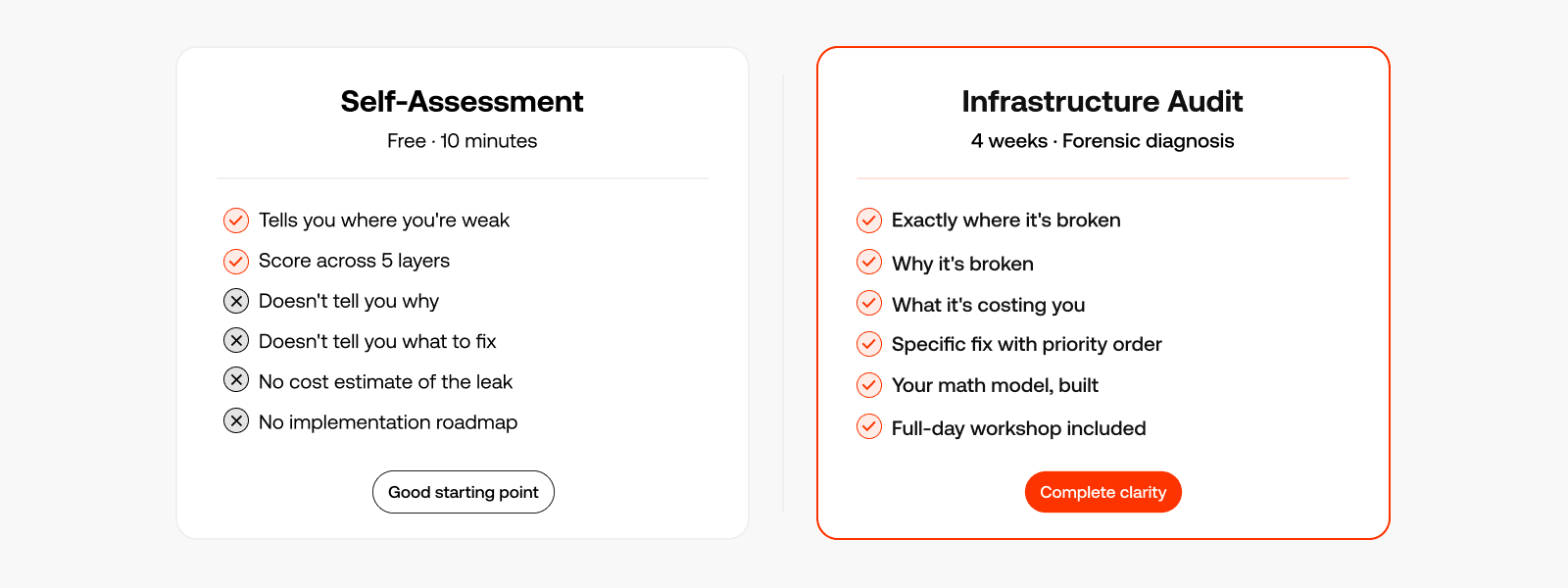
The Free GTM Self-Assessment gives you a baseline: 20 questions that map to the five layers above. You'll score yourself on unit economics, messaging, offer design, journey coherence, and tracking. Takes 10 minutes. Most founders score 4-6 out of 10.
You'll identify where your system is weak. But not why it's weak or how to fix it.
The Full Infrastructure Audit is different. It's a deep diagnostic run by the same team that's installed this system across 500+ businesses.
Here's the difference: The self-assessment tells you "your messaging is inconsistent." The full audit shows you exactly where the inconsistency lives (the ad says "clarity" but the LP says "system"), what it's costing you (estimated 25% drop in nurture conversion), and what to fix (specific copy rewrites with customer language from your own research).
The self-assessment tells you "your close rate is low." The full audit maps the five reasons why (weak qualification, unclear timeline, unaddressed objections, generic nurture, sales team isn't empowered by the pre-sell) and which one is the forcing function (the pre-sell is broken, so fix that first, sales quality second).
This is why the full audit often saves $500K-$2M in wasted spend and recovered revenue.
What You Get: The Complete Diagnostic
The Infrastructure Audit is a 4-week engagement:
Week 1: Intake & Analysis - Your ads, landing pages, emails, sales scripts, and CRM are reviewed - Your team is interviewed on current metrics, constraints, and goals - Your customer research is analyzed (or conducted if it doesn't exist) - Preliminary findings are documented
Week 2-3: Deep Diagnostic - Unit economics are modeled (revenue target → required customers → math-driven budget allocation) - Objection mapping is completed from customer research and competitor analysis - Offer is audited against the top 5 objections (is each one addressed?) - Journey is mapped end-to-end for coherence and message strength - Tracking systems are audited for gaps and misalignment
Week 4: Delivery & Recommendation
You receive: - The Infrastructure Report (25-40 pages): Every finding, every breakpoint, every recommendation with priority and estimated impact - The Math Model: Revenue target → required CAC → budget allocation by channel (your unit economics, specific to your business) - The Research Summary: Your top 10 customer objections, verbatim, mapped to offers and messaging - The Journey Specification: Exactly what content goes where, in what sequence, addressing which objection at each stage - The Tracking Specification: How to set up UTMs, CRM stages, conversion events, and dashboards so data flows without manual work - The Implementation Roadmap: Which fix to tackle first, second, third, in order of impact
Plus: a full-day workshop with the Marketing.MBA team walking your internal team through the findings and next steps.
Why This Works When Other Approaches Don't
Generic Marketing Audits review your tactics. They tell you "your CTR is low" or "your email subject lines need work." They audit outputs, not architecture. A 0.5% improvement in CTR doesn't save a broken system. It just makes it break slower.
The Infrastructure Audit audits inputs, the mathematical, research, offer, journey, and tracking layers that determine whether any tactic can work. Fix the system, and tactics compound. Leave the system broken, and tactics are just noise.
Agencies perform audits too. They audit your accounts, because the audit is the sales process. They identify problems, recommend solutions, then sell you $50K/month in media buying to fix them. Their incentive is to recommend more spend, not better infrastructure. If the audit concludes "you need a stronger pre-sell," that doesn't generate recurring revenue for the agency. "You need to double your ad budget with us" does.
The Infrastructure Audit is independent. It's not selling you a service afterward. It's selling you clarity so you can decide what to do. (And if you choose to work with us on implementation, that's a separate conversation, but the audit stands alone.)
Internal teams are too close. Your marketing team built this system incrementally. They've optimized the landing page seven times. They've A/B tested subject lines. They don't see the structural problem because they've been inside it the whole time. An outside diagnostic with 500+ other systems in the reference set sees patterns no internal team can see.
Who This Is For
If your business has crossed $1M in revenue and you're in one of these situations: - You're scaling spend but CAC is climbing instead of dropping - You know your LTV but you're not sure your CAC math actually works at scale - Your close rate feels low but you can't trace it to a specific breakpoint - You have leads but they feel "soft", high objection rates in sales - Multiple channels are running but you can't tell which one is actually producing customers - You've hired for growth but the infrastructure isn't there to support the hire - You're about to do a Series A or major fundraise and need to prove your GTM is working
Then the Infrastructure Audit is built for you.
If your business is under $1M or you're just getting started, the free self-assessment is the right starting point.
Why Marketing.MBA
We've installed this diagnostic across 500+ businesses. Not startups burning through venture capital. Bootstrapped founders. SaaS operators at $1M-$30M ARR. Agencies hitting growth plateaus. Personal brands where engagement is high but conversion is stuck.
The framework: 14 years of performance marketing (Raoul Plickat), $1B+ in bootstrapped revenue (CopeCart), Germany's Marketer of the Year (2022, 2023), built Europe's largest personal brands.

The results speak in numbers, not promises:
Christian Bischoff: 6,000 event tickets sold, $330K direct sales, $5.6M over three years from the same installed system
Philipp Plein: $8M in sales in six days, brand perception control + direct-response precision compressed into a single launch window
Jürgen Höller: Germany's #1 motivational trainer, predictable acquisition infrastructure replacing campaign-by-campaign guesswork
Sales trainers, consulting companies, and finance trading apps across industries and business models
$1.5B+ in verified revenue across our client portfolio. Not attributable to luck or favorable market conditions. Attributable to the same five-layer diagnostic you're about to undergo. See the full case study portfolio.
Your audit uses the same framework, the same rigor, the same standard of proof we use internally. It's built specific to your business, your ICP, your numbers, your breakpoints.
Frequently Asked Questions
Q: How long does the audit take? A: 4 weeks from intake to delivery. Week 1 is gathering data and context. Weeks 2-3 are deep analysis. Week 4 is the report and workshop.
Q: Do you need my raw data? A: Yes. Ads account access (read-only), Google Analytics, email platform metrics, CRM export. We sign a standard NDA. Your data stays yours.
Q: What if we don't have customer research yet? A: The audit includes customer research interviews (10-15 calls with your recent customers). We build the research layer as part of the diagnostic.
Q: Will the audit recommend hiring you for implementation? A: Only if implementation makes sense for your specific situation. The audit is independent. Some clients do the fixes themselves. Some bring us in to help. The recommendation is based on what's actually broken, not what generates revenue for us.
Q: What's the difference between the Infrastructure Audit and GTM-OS Enterprise? A: The Audit is diagnostic, it identifies problems. GTM-OS Enterprise is implementation, we build and install the system using the audit findings. Audit first, then decide if you want hands-on implementation.
Q: Who should attend the Week 4 workshop? A: Whoever owns the GTM (founder, CMO, head of marketing, head of sales). 1-5 people typically. It's a working session, not a presentation.
Q: Can we start with the free self-assessment? A: Yes. Most do. The self-assessment is quick (10 minutes), costs nothing, and gives you a baseline. From there, you know whether a full audit makes sense.
Q: What happens after the audit? A: You get the report and workshop. Then you decide: implement yourself, work with us, or table it for now. We don't push you into a follow-up engagement. But we do stay available if you have questions on the findings.
Next Step: Apply for Your Infrastructure Audit
The audit is limited to 2 new clients per month, this keeps the quality high and the turnaround fast.
Option 1: Start with the Free Self-Assessment Takes 10 minutes. Get your baseline score on the five layers. No commitment.
[Take the Free GTM Self-Assessment]
Option 2: Apply for the Full Infrastructure Audit 4 weeks. Complete diagnostic + report + workshop. Limited to 2 new clients/month.
[Apply for Your Infrastructure Audit]
The Risk-Reversal
If after the Week 1 intake you don't believe the audit will move the needle for your business, we'll refund 50% of the fee. No questions, no friction.
We're confident in what we'll find because we've found the same breakpoints in 500+ systems. But we want you confident too.
Ready to find every leak in your revenue engine?
[Start Here: Free Assessment or Paid Audit]
Marketing.MBA. GTM operating systems for 7-figure businesses. $1.5B+ in verified results across 500+ businesses.