How to Reduce Customer Acquisition Cost for B2B SaaS (It's Not What You Think)
You're not spending too much on ads. You're spending on the wrong system.
Most SaaS founders at $2-10M ARR hit the same wall: CAC climbs, profit margins squeeze, and no amount of new creative, audience testing, or platform switching fixes it. You bring in a performance agency. They promise better creative, smarter targeting, campaign optimization.
CAC drops for two weeks. Then it climbs again.
The frustration isn't that ads are expensive. It's that you can't tell which part of your spend actually produced clients. You have a $500K ad budget, but you can't trace $500K in revenue back to it. Some channels feel efficient, others feel wasteful, but you're not sure which because your tracking is fragmented.
This guide reveals why that happens, and how to fix it using the same framework that's driven $1.5B+ in results across 500+ businesses.
Why Your CAC Keeps Rising (It's Not What You Think)
The standard narrative is that you need better ads, smarter targeting, or a different platform. So you test new creative, hire a performance expert, or move budget to TikTok.
This is why you keep failing.
High CAC is not an advertising problem. It's a system problem.
When ads feel expensive, it's because something upstream is broken, not the media buying. If your messaging doesn't match your offer, prospects book calls with low intent. If your sales process is chaotic, even high-intent leads slip through. If your pricing doesn't align with your value delivery, close rates crater. If your funnel has no continuity between awareness and sales, trust collapses.
Trying to fix high CAC by testing new ad creative is like trying to fix a leaking pipe by turning up the water pressure. The leak doesn't get smaller. The waste just gets louder.
Here's the diagnostic:
If sales is doing heavy convincing during calls, the deterministic layers failed. The prospect shouldn't arrive at the sales call uncertain. The nurture, the messaging, the offer, all of it should have pre-sold so thoroughly that the call feels like a confirmation, not a debate. When your sales team is fighting to close leads, it's not a sales problem. It's a system failure upstream.
This is where most SaaS companies go wrong. They scale spend into a broken funnel. CAC rises. Everyone looks at the media buying. Nobody looks at the infrastructure.
The 5 Structural Causes of High CAC
Every high-CAC SaaS company has the same root issues. They just appear in different forms.
Cause 1: No Mathematical Backpressure
You cannot build a profitable unit unless the math works first.
Start here: Revenue Target → Price Point → Required Customers/Day → Close Rate → Required Calls → Show Rate → Required Bookings → Max Cost Per Booking → Required Daily Budget.
If you want $5M ARR at a $10K ACV, you need 500 customers. If your close rate is 20% and your show rate is 60%, you need 4,166 booked calls per year (about 8 per day). If your close rate is 30%, you need 5.5 per day. If your show rate drops to 50%, you need 11 calls per day.
Now multiply: at $200 cost per booking, you're spending $1,600-2,200 per customer just to get them on a call, before they even talk to sales.
If the math doesn't clear, STOP. Do not proceed to creative, copy, or media buying.
Most SaaS companies never do this. They launch campaigns with "let's see what works." What works? Random spend. Unpredictable CAC. Scaling disaster.
Your first job is not to optimize ads. Your first job is to prove the unit economics can exist.
Cause 2: Research Gap. Copy That Doesn't Sound Like Your Customers
Your ads sound like your marketing team wrote them. Your customers know instantly that you're not talking to them.
Effective copy uses customer language verbatim, their objections, their metaphors, their fears, their goals. Not marketer language. Not industry jargon. Not ChatGPT summaries of what SaaS founders "probably" worry about.
Requirements before any copy ships: 50+ customer quotes minimum (from interviews or conversations, not surveys); Top 20 objections mapped (what stops prospects from buying?); Customer language database populated (exact phrases, metaphors, analogies they use); Competitor analysis complete (what are customers choosing instead?); Cross-domain pattern insights identified (what patterns show up across different customer segments?).
What happens when research is missing? Your ads make promises that don't address the real objections. Prospects click because they're curious, not because you solved their problem. They land on the page, realize you're not talking about their situation, and leave.
This is why your click-through rate is high but your conversion rate is low.
Your ad should sound like your customer talking to a friend, not like a company talking to a market.
Cause 3: Offer Weakness. Missing the Structural Objections
Even with good research, most offers don't address the real barriers to purchase.
An offer is weak when: the top 5 objections aren't structurally addressed in what you're selling; the price isn't justified by the value equation; risk reversal is missing or insufficient; the offer describes what you do, not what changes in the prospect's life.
A weak offer forces your sales team to do the selling. Heavy convincing on calls is not a sales problem. It's an offer problem. The prospect shouldn't arrive uncertain. The offer itself should have removed doubt.
For SaaS: most offers say "You get X features, Y integrations, Z support." That's a feature list, not an offer. The offer is "You install an operating system that makes your GTM predictable instead of chaotic. Here's the cost. Here's what changes. Here's your risk reversal."
When your offer is structural, the close rate rises. When your offer is weak, your sales team spends 60% of each call overcoming objections that should have been pre-solved by the offer itself.
Cause 4: Journey Incoherence. Different Stories at Every Touchpoint
Your prospect encounters your brand across five touchpoints: ad → landing page → email → sales call → onboarding.
If each touchpoint tells a different story, the belief chain shatters.
Ad says: "Install a GTM operating system." LP says: "Get better GTM frameworks and tools." Email says: "Learn how to reduce CAC." Sales call sounds like: "Let's discuss your specific situation." Onboarding is: "Here's your template library."
The prospect is confused. Is this about frameworks? Tools? CAC reduction? A custom workshop? Each touchpoint should reinforce the same core claim, from different angles, with different proof, but always toward the same destination.
When journey is incoherent, trust erodes at each step. The prospect doesn't decline because of a single bad touchpoint. They decline because the experience feels scattered.
The prospect should feel more convinced with each interaction, never less. If they feel less convinced, it's a journey problem.
Think of it this way: you're renting cognitive real estate in your prospect's mind. Every touchpoint either reinforces your claim on that space or undermines it. Coherent journeys pay the rent. Incoherent journeys get you evicted, and a competitor moves in.
Cause 5: Tracking Gaps. Optimizing Blind
You cannot optimize what you cannot measure.
Tracking requires: UTM structure (source → medium → campaign → content); CRM stages mapped to conversion funnel (lead → MQL → SQL → opportunity → customer); Conversion tracking implemented end-to-end (from ad click to close); Dashboard built (leads → SQLs → opps → revenue by channel/campaign/week); Weekly GTM review rhythm (what metrics are reviewed, by whom, what decisions follow?).
Without this, you have no feedback loop. You spend on ads, you get leads, you book some calls, some close. But you don't know which ads produced the customers. You don't know if the pattern repeats.
You're optimizing blind.
This is why high CAC persists. You're changing tactics (new creative, new audience, new platform) but you have no data showing which tactic actually worked. So you change again. And again. And CAC keeps rising.
The Math Your Agency Isn't Showing You
Here's what the math actually looks like when you work through it.
Let's say you're a $5M ARR SaaS company with $10K ACV. You need 500 customers per year (about 42 per month).
Your current metrics: Show rate: 55% (of booked calls, this many actually join); Close rate: 25% (of shows, this many buy); Average sales cycle: 45 days.
Working backward: To close 42 customers/month, you need 168 shows/month (42 ÷ 0.25); To get 168 shows, you need 305 booked calls/month (168 ÷ 0.55); Cost per booking at $200? $61,000/month just to get people on calls.
Now assume your payback period is 6 months. Your LTV is $60K. Your CAC is $61K. You're barely profitable if everything else goes right.
If your show rate drops to 50%, you need 336 booked calls/month. CAC becomes $67K. Payback extends to 7 months. Growth stalls.
If your close rate drops to 20% (still common), you need 42 shows/month, which requires 420 booked calls. CAC becomes $84K. You're unprofitable at $10K ACV.
When you see it laid out like this, the reason your CAC is high becomes obvious. It's not one broken thing. It's the compound effect of small failures at every layer.
Show rate is 55% because your sales calendar is a mess and half your prospects join late/don't show up. Close rate is 25% because your messaging doesn't pre-sell, so sales is re-explaining everything on the call. Cost per booking is $200 because your offer isn't compelling enough to filter intent at the ad level.
Fix any one of these, and the whole chain improves. Fix all five, and CAC becomes your competitive advantage.
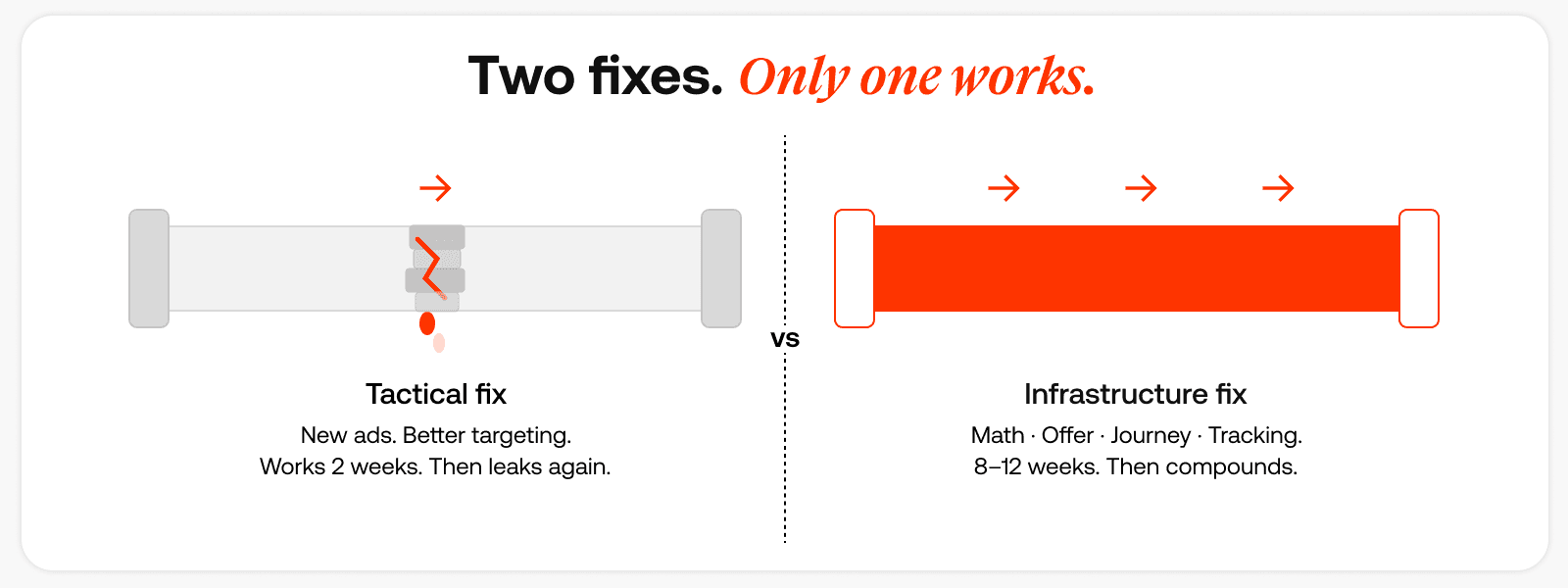
The Infrastructure Fix vs. The Tactical Fix
There are two ways to lower CAC. Only one compounds.
The Tactical Fix: New ad creative. Better targeting. Higher bid. Platform testing. Agency swap.
This is what every SaaS founder tries first. It works for 2-4 weeks. Then CAC rises again. Why? Because you didn't fix the system. You just changed the input into a broken machine.
A broken machine processes inputs faster, but it still produces broken outputs.
The Infrastructure Fix: Math validation → research → offer redesign → journey coherence → tracking implementation.
This takes 8-12 weeks. It's boring. It requires you to confront the fact that your offer might be weak, your messaging might be off-target, your sales process might be chaotic. Nobody's excited about "let's map our CRM stages properly."
But here's what happens after: every campaign you run from that point forward benefits. You don't need to constantly test and retarget. You don't need to hire new agencies. You don't need to "optimize your way" to profitability.
The system works. CAC stabilizes. You can predict revenue.
Compare the math: Before, CAC was $65K with a 55% show rate, 25% close rate, and 6.5 month payback period. The Tactical Fix at month 3 produces CAC of $60K, 57% show rate, 26% close rate, 6.1 month payback. The Infrastructure Fix at month 3 produces CAC of $35K, 68% show rate, 38% close rate, 3.5 month payback.
Tactical fixes give you 5-10% improvements that fade. Infrastructure fixes give you 40-50% improvements that compound.
Here's why: With infrastructure in place, you run one proven funnel repeatedly. Your ads are coherent with your offer. Your nurture pre-sells. Your sales process is standardized. Each month, you get better at executing the system, not searching for it.
And infrastructure compounds across platforms. When a prospect sees your brand on Facebook, then on YouTube, then in their LinkedIn feed, then in an email, each exposure amplifies the others. The sales cycle shortens because the prospect has been pre-sold in multiple environments. They arrive at the call already familiar, already trusting. This multi-platform compound effect is why infrastructure-first companies see their CAC decrease as they scale, while tactical companies see it increase.
The data across 500+ businesses confirms the pattern. Webinars alone triple ROAS within 90 days, moving typical returns from 1.4-2.1x to 4-6x, because they convert mid-intent leads (who would otherwise sit in nurture for months) into high-intent buyers. Up to 50% of webinar revenue comes from the follow-up sequence, not the live event. That's infrastructure at work: a system that converts intent into revenue long after the initial campaign ended.
With tactical fixes, you're always searching. New creative month 1. New audience month 2. New platform month 3. You're building no repeatability, no data, no system.
Which one creates competitive advantage? The system.
Your CAC Diagnostic Checklist
Answer these 10 questions honestly. If you answer "no" to more than 3, your CAC problem is structural.
Mathematical Backpressure 1. Do you have a written revenue target and the required customer/day to hit it? 2. Have you calculated the maximum cost per booking you can afford and still be profitable?
Research Backpressure 3. Have you interviewed 50+ customers and mapped their top 20 objections? 4. Does your ad copy use exact language from customer interviews, not marketer language?
Offer Backpressure 5. Does your offer structurally address the top 5 objections before prospects talk to sales? 6. Can you clearly articulate why your price is justified by your value delivery?
Journey Backpressure 7. Do your ads, LP, emails, and sales call all deliver the same core message (from different angles)? 8. Is there a deliberate transition architecture between each stage (not just "hope they convert")?
Tracking & Attribution Backpressure 9. Can you trace leads → SQLs → opportunities → revenue by channel and campaign? 10. Do you have a weekly GTM review rhythm where data drives decisions?
Scoring: 8-10 yes: Your CAC problem is tactical. Optimize what you have. 6-7 yes: You have some system. Infrastructure will compound your gains. 3-5 yes: Your CAC problem is structural. Tactical fixes will waste money. 0-2 yes: You need a complete infrastructure overhaul before scaling further.
If you scored 5 or lower, your next move is not to test new ads. It's to diagnose which layers are broken.
How to Build a Structural CAC Reduction (The Roadmap)
This is what a real GTM infrastructure installation looks like.
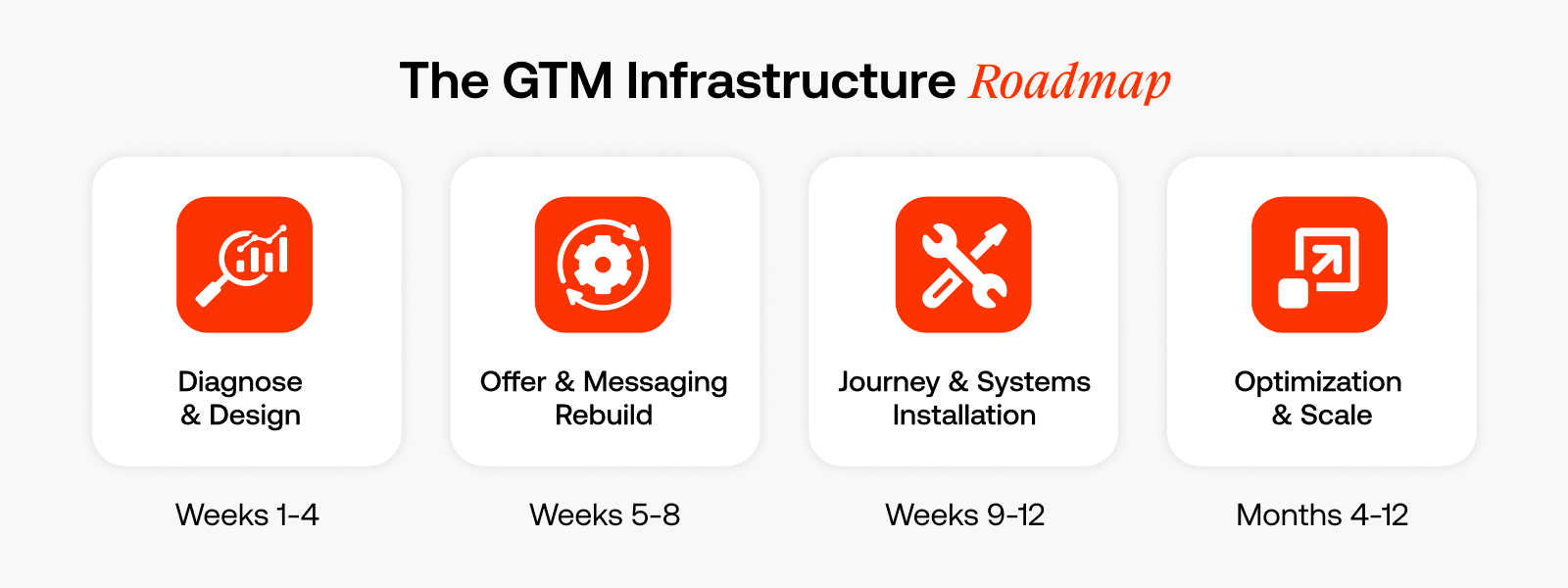
Weeks 1-4: Diagnose & Design. Calculate your unit economics mathematically; Map your ICP and their top 20 objections (through customer interviews); Audit your current funnel (ads → LP → nurture → sales → close); Define your positioning and core claim.
Weeks 5-8: Offer & Messaging Rebuild. Redesign your offer to structurally address objections; Rebuild ad messaging using customer language; Build your landing page with coherent narrative; Design your 90-day email nurture sequence.
Weeks 9-12: Journey & Systems Installation. Implement CRM stages and lead scoring; Set up UTM tracking and conversion tracking; Build your GTM dashboard (leads → revenue); Document your sales process and qualification criteria; Train your team on the new system.
Months 4-12: Optimization & Scale. Run experiments (not random tests, hypothesis-driven); Monitor CAC by channel and campaign weekly; Adjust messaging and targeting based on data; Scale what works; kill what doesn't.
This is the Infrastructure Audit that 500+ businesses have used, from SaaS companies and consulting firms to sales trainers and finance trading apps. Most see 40-50% CAC reduction in the first 90 days.
The audit isn't about creativity or tactics. It's about architecture. It maps exactly where your funnel breaks and what to fix first. The same diagnostic helped Pressmaster.ai grow 4x ARR in 7 months, helped a finance trading app scale from $11K to $718K+ revenue with ~$99 CAC, and powered Copecart's growth to $1.3B+ GMV. See the full case studies portfolio.
FAQ: CAC Reduction for B2B SaaS
What is a good CAC for B2B SaaS?
It depends on your ACV, close rate, and payback period. A general rule: if your payback period is longer than 12 months, your CAC is too high. Most 7-figure SaaS companies aim for 4-9 month payback. That means CAC should be 33-75% of your ACV. At $10K ACV, that's $3.3K-$7.5K CAC.
How long does it take to reduce CAC?
Infrastructure fixes take 8-12 weeks to implement and show clear results. Tactical fixes show temporary improvements (2-4 weeks) but don't compound. Structural improvements compound, each month, the system gets more efficient.
Should I reduce ad spend to lower CAC?
No. Reducing spend doesn't lower CAC; it just reduces volume. If your CAC is high because your system is broken, reducing spend won't fix it. Fix the system first, then scale.
What's the difference between CAC and CPA?
CAC (Customer Acquisition Cost) is the total cost to acquire a paying customer. CPA (Cost Per Acquisition) is typically used interchangeably, but sometimes refers specifically to the ad spend per acquisition. For clarity: track both cost-per-click, cost-per-lead, cost-per-SQL, cost-per-opportunity, and cost-per-customer. CAC is the final number.
How do I know if my CAC problem is structural or tactical?
If new creative or audience testing gives you 5-10% improvements that fade within weeks, it's tactical. If your sales team is doing heavy convincing, your offer is weak, or your messaging doesn't use customer language, it's structural. Use the diagnostic checklist above.
What metrics should I track daily?
Daily: ad spend and cost per click. Weekly: leads generated, cost per lead, SQL rate, cost per SQL, booked calls, show rate, close rate, CAC. Monthly: new customers, LTV, payback period, ROAS.
Can I reduce CAC without hiring a consultant?
Yes. Use the Infrastructure Audit framework above. Go through each constraint layer (math → research → offer → journey → tracking). Most companies skip at least two of these. Start there. Many self-diagnose and fix the issue without external help.
How does CAC relate to my GTM strategy?
CAC is the ultimate measure of whether your GTM works. If CAC is rising, your GTM is breaking. If CAC is stable and profitable, your GTM is working. Don't optimize CAC in isolation, optimize your entire go-to-market system.
Next Steps: Get Your Infrastructure Audit
High CAC isn't a media buying problem. It's a system problem.
If you scored 5 or lower on the diagnostic above, the single highest-ROI move is to get a clear map of which layers are broken, and in what order to fix them.
The Infrastructure Audit does this in one week. It's a deep analysis of: Your mathematical feasibility (can this unit actually work?); Your messaging coherence (does your offer match your market?); Your journey architecture (are prospects getting confused?); Your tracking gaps (what's not measured?).
You get a written audit with specific, actionable fixes. It maps exactly which constraint layer is driving your CAC up, what it's costing you each month, and which fix to prioritize first. The average result: 40-50% CAC reduction in the first 90 days.
Book your Infrastructure Audit →
Related Reads