Founder Dependency: Why Your Business Cannot Grow Faster Than You Can
Founder dependency is the condition in which a business cannot generate demand, close sales, make decisions, or deliver quality without the active involvement of its founder. When founder dependency is present, growth is not capped by market size or offer quality. It is capped by you.
The founder growth ceiling is the revenue plateau that results. It is not a leadership problem. It is a system architecture problem. This guide defines the condition precisely, introduces the 5-component Founder Dependency Score so you can measure it, and maps the operating system that removes it.
The founder growth ceiling, defined
Founder dependency means at least one of five go-to-market components still runs through you: demand generation, trust, sales, decisions, or delivery and handoff. Remove any one of them from your calendar and revenue suffers.
The founder growth ceiling is the revenue level at which that dependency becomes the binding constraint on the business. Below it, personal effort is enough. Above it, personal effort is the bottleneck.
Three conditions confirm you have hit it:
Revenue is roughly flat for two or more quarters despite real market opportunity.
You cannot step away for two weeks without a measurable drop in pipeline or close rate.
Your most reliable lead source is still your personal network or referrals you generated.
This is a diagnosable, measurable condition. It has a specific mechanism and a specific cure.
The signs you have hit it (not the ones everyone lists)
Most writing on this subject stops at surface-level symptoms: too many hours, too many decisions, no real vacation. Those are real. The commercially meaningful signs go deeper.
Revenue stalls when you step back. Not because demand dried up. Because demand was never separated from your personal effort. "Right now revenue is just slipping away from me." It feels like a slow leak. It is structural.
Referrals are your most reliable channel. You are not generating demand. You are harvesting trust you personally built. Referrals are high-quality leads. They are not a system. They scale only as fast as your personal relationship network does.
Deals close when you are on the call. Your team qualifies prospects. You close them. "When it only sells because I am on the first call, you can feel where it breaks." The sales motion has never been separated from your credibility.
Your team is forever chasing the next new client and neglecting existing ones. Without a repeatable pipeline, everyone compensates by hunting. It is the random-acquisition pattern that appears when there is no demand architecture underneath the business.
A hire or an agency did not fix it. You delegated a task. The system dependency remained. That is the diagnostic tell: task delegation does not move the structural needle.
Your infrastructure was never built for the growth you hit. "Our infrastructure was never built for the growth we hit." Founders build the offer, then bolt processes onto it as volume forces the issue. The operating system never gets installed.
"You work 60 hours a week. Everything depends on you, and your revenue still feels fragile." That sentence captures the state precisely. Not lazy, not underqualified, not unlucky. Founder-dependent.
The false belief that keeps founders stuck
Two beliefs prevent founders from diagnosing this correctly. Both need to be named and dismissed before the right intervention can be applied.
False belief 1: "It is a delegation problem. Document processes, hire the right person, hand it off."
Delegation is a task-level intervention. Founder dependency is a system-level condition. SOPs move individual tasks off your plate. They do not install a repeatable demand engine, a transferable trust layer, or a sales motion that closes without you. "Founders try to do it all themselves: the marketing, the systems, the technology." Documenting that pattern is not solving it.
False belief 2: "It only matters when I sell. I will deal with it at exit."
The dominant framing for "founder dependency" on Google is exit risk: valuation discount, key-person risk, M&A due diligence haircuts. That framing is correct. It is also incomplete.
Founder dependency is an exit problem. It is also a growth problem, right now. It caps revenue today. It drains margin today because your highest-cost resource (your time) is performing tasks a system could carry. Treating it as an exit-prep item means accepting years of avoidable ceiling.
"I just want to acquire once, and then let referrals and multipliers carry it." That preference makes the false belief explicit: hope that passive mechanics will replace active founder effort, without installing the system that makes them reliable.
The required belief shift: founder dependency is a diagnosable, component-level GTM-system failure. You can measure it today and remove it with a structured intervention. Not at exit. Now.
Founder dependency is a whole-GTM failure, not a sales problem
Most advice stops at one component: "get out of sales." That is correct for one of five components. It is not the full diagnosis.
Founder dependency exists across five GTM layers. Each can be founder-trapped independently. You can hire a strong salesperson and still be founder-dependent if you remain the only source of demand. You can solve demand and still be trapped if trust has not transferred to the brand or team.
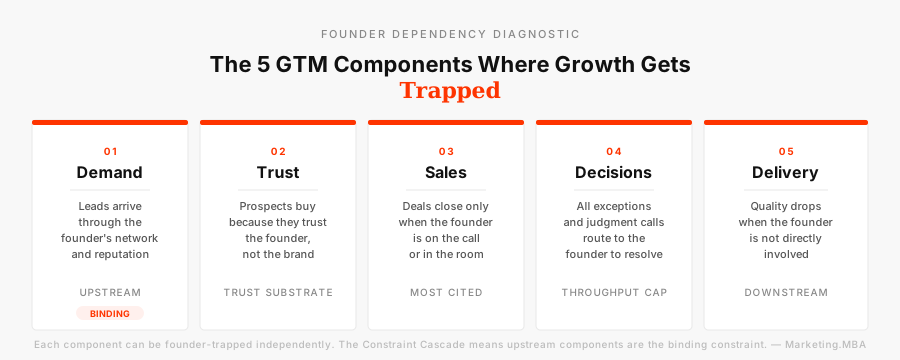
Component 1: Demand. You are the demand engine. Leads arrive through your network, your reputation, your outreach, your conference presence. Remove you and the pipeline drains. This is where the Constraint Cascade begins: the founder is the upstream binding constraint, and every downstream function (sales, delivery) inherits the bottleneck.
Component 2: Trust. You are the Trust Substrate. Prospects buy because they trust you personally. That trust has not yet transferred to the brand, the methodology, the team, or the case studies. "There is no real trust yet. People want to understand how the mechanism works. They want measurable results." Transferring trust is a systematic process. It requires installing the system, not simply doing good work longer.
Component 3: Sales. You close. Your team handles qualification and demos, but the deal does not move without your credibility on the call. This is the component most often cited when people talk about "founder dependency." It is one layer. It is not the full diagnosis.
Component 4: Decisions. Everything routes to you. Pricing exceptions, client escalations, campaign spend, hiring decisions. You are not just a resource. You are the decision-making infrastructure. Every decision that waits for you is a hard constraint on throughput.
Component 5: Delivery and handoff. Clients notice quality drop when you are not directly involved. They chose the firm because of you. The delivery system has not yet been separated from your expertise and reputation.
The five components interact. If trust does not transfer, sales cannot close without you even if you hire a skilled closer. If demand is founder-generated, the pipeline is unscalable regardless of sales capability. The Constraint Cascade means that fixing one downstream component while leaving upstream ones trapped produces limited, temporary relief.
Score your founder dependency (the 5-component diagnostic)
The Founder Dependency Score is a Marketing.MBA diagnostic. It maps which of your five GTM components are founder-trapped and how severely. Score each component from 0 to 4.
0: Fully system-dependent. This component runs without you.
1: Mostly system-dependent. Occasional founder input is needed.
2: Mixed. You are involved but not essential.
3: Mostly founder-dependent. This component stalls or degrades without you.
4: Fully founder-dependent. This component cannot function without you.
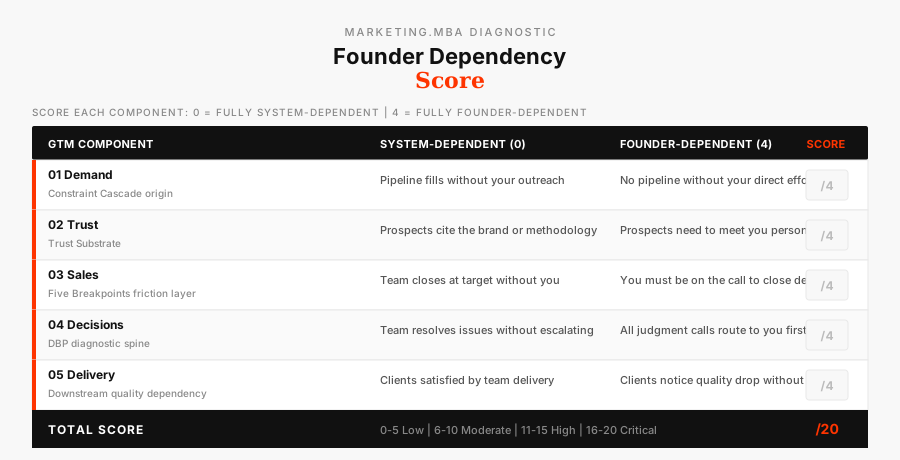
Component | System-dependent (score 0) | Founder-dependent (score 4) | Your score |
|---|---|---|---|
1. Demand | Inbound pipeline fills without your personal outreach or network | No pipeline arrives without your direct effort | /4 |
2. Trust | Prospects cite the brand, team, or methodology as their reason to move forward | Prospects need a personal meeting with you to feel confident | /4 |
3. Sales | A team member closes at or above target without you in the room | You must be on the call to close any significant deal | /4 |
4. Decisions | Team resolves client, budget, and process questions without escalating | All exceptions and judgment calls route to you before any action | /4 |
5. Delivery | Clients are satisfied with team delivery, without your direct involvement | Clients notice and comment when you are less involved | /4 |
Total | /20 |
What your score means:
0-5: Low dependency. You have functional systems in most components. Identify and close the remaining trapped layers.
6-10: Moderate dependency. Two or three components are founder-trapped. Growth is possible but subject to recurring ceilings.
11-15: High dependency. Most components route through you. Sustained growth requires your constant presence. Concentration risk is significant.
16-20: Critical dependency. The business is operationally you. Removing yourself collapses revenue. The ceiling is at its hardest.
Most founders who run this diagnostic for the first time score between 12 and 18. They expected to find a sales problem. They find a system problem.
From founder-dependent to system-dependent: the GTM Operating System
The missing system is a GTM Operating System. It is not a new set of tactics. It is the architectural layer between your proven offer and your revenue: repeatable demand generation, transferable trust, a sales motion that closes without you, and decision infrastructure that does not route through one person.
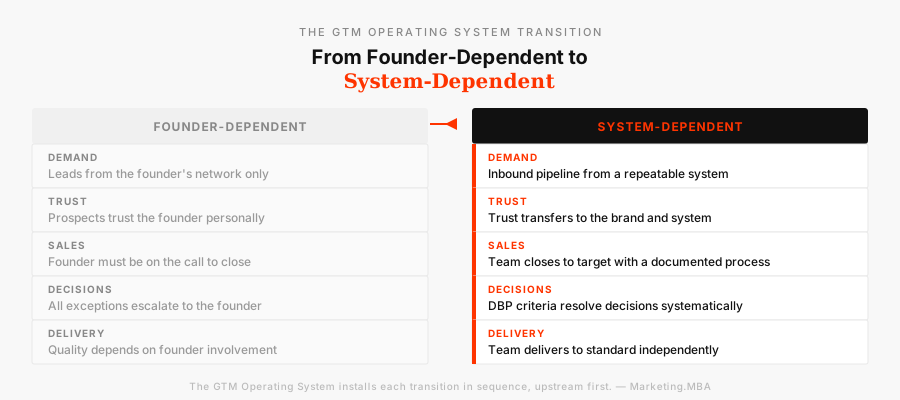
The GTM-OS addresses each of the five components:
Demand. A predictable inbound and outbound system that generates qualified pipeline independently of the founder's personal network. The KFC method (Key First Click) governs this layer: the first meaningful interaction between a prospect and the brand is engineered to carry the authority the founder previously carried personally. For a detailed look at how this is built, read a predictable high-ticket lead generation system.
Trust. The Trust Substrate transfers from the founder to the brand. Case studies, methodology documentation, team credentials, and content that demonstrates competence at the brand level. Prospects buy the system, not the person. Note that rising CAC is usually a system failure, not an ad-cost problem: when trust does not transfer, conversion costs inflate across every channel because every prospect still needs the founder's personal credibility to move forward.
Sales. A documented, repeatable sales process that a trained team member can run to close rate. The Five Breakpoints framework maps the predictable friction points in high-ticket sales where founder involvement tends to creep back in. Each breakpoint becomes a documented override protocol, not a founder escalation.
Decisions. The DBP framework that traces every decision back from revenue installs decision criteria derived from the revenue target, not from founder judgment. The system answers "is this the right decision" by comparing options against mathematical constraints. The founder becomes a quality check, not a routing node.
Delivery. Quality standards, client onboarding protocols, and team training that make delivery founder-independent. The goal is not removing the founder from delivery entirely. The goal is removing the founder as a dependency: the person without whom quality cannot be guaranteed.
"I do not need to be the expert in everything. I need the right system and the right partners." That is the desired state. It is achievable from where most founders are. The full architecture is covered in the GTM operating system for founders at $1M-$10M ARR.
What this is not: founder-led sales is only one slice
Founder dependency is frequently confused with founder-led sales. They are related but not the same problem.
Founder-led sales describes one condition: the founder is the primary closer. It is real, it is significant, and it needs to be solved.
Founder dependency is five conditions. You can build a strong, capable sales team and still score 14 on the Founder Dependency Score because demand, trust, decisions, and delivery are all still routing through you. Revenue still hits a ceiling. The ceiling has moved. It is still there.
This distinction matters for sequencing the intervention. The Constraint Cascade means the most founder-trapped upstream component (usually demand or trust) is the binding constraint. Fixing a downstream component (sales) while leaving the upstream ones intact produces temporary, limited relief.
"I do not want to be dependent on unreliable employees." That is the real fear under the delegation objection. Founders sense that fixing sales alone will not work. They have not yet named the upstream constraints. The 5-component diagnostic names them.
Diagnose all five components first. Then sequence the intervention from upstream to downstream.
Proof: what changes when the system carries the growth
The team behind Marketing.MBA has managed $1.5B+ in client revenue across 400+ brands since 2013. Across that body of work, the pattern is consistent: the businesses that removed founder dependency most effectively did not do it by working harder, delegating more tasks, or hiring more senior individual contributors. They installed a system.
When demand generates itself, founders reclaim their calendar and revenue continues. When trust transfers to the brand, the sales team closes without the founder's credibility on every call. When decisions route through a system rather than a person, throughput scales without adding management overhead.
"There is no real trust yet. People want to understand how the mechanism works. They want measurable results." That is the stage most founders are at when they start this process. Not short on ambition. Short on system.
"We really need someone to fully audit us, once." That is the right instinct. One complete diagnostic beats a hundred partial interventions. It is also how every successful GTM-OS installation begins: with a full picture of which components are founder-trapped and which are already running on system.
How to start removing founder dependency this quarter
The intervention sequence matters. Removing founder dependency is not a single project. It is a structured installation across the five GTM components, starting at the binding constraint.
Step 1: Score your five components. Use the Founder Dependency Score above. Identify which components score 3 or 4. Those are your binding constraints.
Step 2: Map the upstream cascade. Is demand the bottleneck? Fix demand first. Is trust the issue? Install the Trust Substrate before optimizing sales. Working downstream of an unresolved upstream constraint wastes effort and budget.
Step 3: Install a repeatable demand system. This is the highest-leverage starting point for most founders. The KFC method for predictable lead generation is the framework that governs the demand layer in the GTM-OS architecture.
Step 4: Separate trust from your name. Document your methodology. Build case studies that show results at the brand level. Let the brand carry the trust you currently carry personally.
Step 5: Build a sales process that closes without you. Document the call structure, the objection handling, the follow-up sequence. Train a closer. Use the Five Breakpoints to identify where founder involvement creeps back in and build protocols to prevent it.
Step 6: Run the full audit. The Founder Dependency Score gives you the component view. A complete diagnostic maps the revenue leaks across demand, messaging, funnel, and attribution. To run a GTM audit to find every revenue leak, start with the free self-assessment or schedule the full Infrastructure Audit.
The goal this quarter is not full founder-independence. The goal is to identify the one or two binding constraints and start the installation that makes growth independent of your personal effort.
Frequently asked questions
What is founder dependency?
Founder dependency is the condition in which a business cannot generate demand, close sales, make decisions, or deliver quality without the founder's direct involvement. It is a structural system condition, not a personal failing. It is measured across five GTM components: demand, trust, sales, decisions, and delivery. A business with high founder dependency cannot grow faster than the founder can personally show up.
What are the signs of founder dependency?
The most commercially significant signs: revenue stalls or declines when the founder steps back; the most reliable lead source is the founder's personal network or referrals; deals close only when the founder is on the call; quality or client confidence drops when delivery is handled without the founder; and key decisions route to the founder before any action is taken. Working 60-hour weeks while revenue feels fragile is the lived experience. The 5-component Founder Dependency Score makes it measurable.
Does founder dependency only matter when you sell the business?
No. Exit risk and valuation discount are real consequences of founder dependency. But founder dependency also caps growth today. It concentrates your highest-cost resource (your time) in tasks a system could carry, it prevents the pipeline from scaling beyond personal effort, and it makes the business fragile every time the founder is unavailable. Treating it as an exit-prep issue means accepting years of avoidable ceiling.
How do you reduce founder dependency?
Start by diagnosing which of the five GTM components are founder-trapped using the Founder Dependency Score. Then install the GTM Operating System component by component, starting upstream: demand first, then trust, then sales, then decisions, then delivery. The intervention is not "hire more people" or "document your processes." It is installing an architectural system that makes each component function without routing through the founder.
How is founder dependency different from founder-led sales?
Founder-led sales is one component: the founder is the primary closer. It is a real and significant part of founder dependency. But founder dependency covers five components: demand generation, trust, sales, decisions, and delivery. A business can have a strong sales team and still score 14 on the 20-point Founder Dependency Score because the other four components still route through the founder. Diagnose all five before deciding which to fix first.
How do you measure founder dependency?
Use the Founder Dependency Score: score each of the five GTM components (demand, trust, sales, decisions, delivery) from 0 (fully system-dependent) to 4 (fully founder-dependent). Total score ranges from 0 to 20. Scores of 12-18 are common for founders at the $1M-$10M stage who have not run this diagnostic before. The score identifies which components are the binding constraints and in what sequence to address them.
Diagnose your ceiling before it diagnoses you
"You have to understand that it is wrong to think you must be the expert in everything yourself." That realization is the starting point for every founder who successfully removes the dependency.
You have a proven offer. You have real clients. The business is working. The question is whether the growth system underneath it will carry you past the ceiling you are approaching, or whether revenue will stay locked to the hours you can personally put in.
The Founder Dependency Score above is your first step. Score your five components. Find your binding constraint. Then take the next step: run a GTM audit to find every revenue leak and build the system that makes growth independent of you.
The team behind $1.5B+ in client revenue across 400+ brands has worked through this problem with founders across service firms, consultancies, agencies, and sales-assisted SaaS companies since 2013. The pattern is consistent. The system is installable. The ceiling is removable.
Author byline: To be assigned by human editor. E-E-A-T requirement flagged to manager. Do not publish without a named author.