Personal Brand Monetization: When Your Audience Loves You But Won't Buy
"People love the content. Just this week, clients who finished said the topic helped them so much. But that warmth doesn't show up as sales."
If that sounds familiar, you are not alone, and you are not dealing with a reach problem. You are dealing with a missing path.
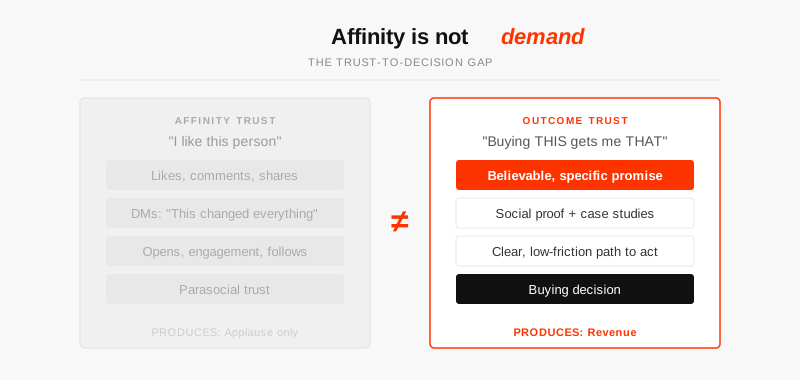
The short answer: Your audience won't buy because you built affinity, not demand. Affinity is trust that you are likeable and knowledgeable. Demand is trust that buying a specific thing from you will produce a specific result for them. Personal brand strategy fails to monetize when affinity exists but no believable, deterministic path connects "I like this person" to "I should buy this specific offer right now." The fix is not more content, more followers, or more platforms. The fix is offer architecture and trust-to-purchase design.
That one-sentence definition is worth pinning: affinity is not demand. The gap between them is the only reason engaged audiences don't buy.
This is not an article about creator monetization (sponsorships, ad revenue, brand deals). That is audience-size-dependent income built for influencers. This article is about expert, coach, consultant, and founder personal brands that have earned real trust from a real audience and want to convert that trust into predictable revenue from expert offers. If you are looking for a cold-traffic lead generation system, our high-ticket lead generation system covers that. If the question is brand versus performance advertising, see performance branding. This page owns the "warm audience that won't convert" problem.
You Don't Have a Reach Problem. You Have a Conversion-Path Problem.
The most common response to a launch that under-delivers is: "I need more followers. I need more reach. If only more people saw it, then they would buy."
That belief is the constraint hiding the real constraint.
Constraint Cascade (per knowledge/frameworks/overview) says that every system has one binding constraint at a time. Fix the wrong one and you get no improvement, no matter how much effort you put in. Most personal brand owners over-invest in audience-building because reach is visible, measurable, and socially rewarded. The real binding constraint is usually the offer-conversion mechanism: the clarity of the offer, the believability of the outcome, and the friction of the path from interest to purchase.
The data point that exposes this: every week, operators with smaller audiences out-earn operators with bigger audiences. The difference is not reach. It is the path that connects the audience to a buying decision.
Here is how to run the diagnostic before you decide where to invest:
Question | If YES | If NO |
|---|---|---|
Are people asking about working with you unsolicited? | Affinity exists. Conversion path is the constraint. | Reach may be the constraint. Build the audience first. |
Do you have a clear, low-friction entry offer? | Move to offer clarity. | The path is missing. Start here. |
Have you ever made a direct, simple ask to your audience? | Check offer-market fit and pricing tier. | You have not tested the path. Test it first. |
Does your audience know exactly what buying from you gets them? | Outcome trust may need work. | Your offer architecture needs defining. |
Run this before you spend another month on content creation or ad spend. The goal is to turn followers into customers using the path they already have reason to take. Most audiences are not "not buying" because they don't want what you offer. They are not buying because the path was never made clear enough to step on.
Affinity Is Not Demand: The Trust Substrate Gap
Here is the mechanism the rest of the SERP on "personal brand strategy" does not explain.
Trust Substrate (per knowledge/frameworks/overview) is the specific type of trust that makes premium buying decisions possible. It is not the same as the trust that makes someone like your content, comment on your posts, or open your emails. Those are signals of parasocial trust. parasocial trust says: "I enjoy this person. I find them credible. I respect their point of view." It is real. It is valuable. But it does not, by itself, produce a purchase.
What produces a purchase is outcome trust: "I believe that buying this specific thing from this specific person will produce this specific result for me at this price." Outcome trust requires three things: a believable promise, visible evidence that the promise has been kept for others (social proof, case studies, testimonials), and a clear, low-friction path to act on the decision.
The "audience loves you but won't buy" problem is almost always a Trust Substrate gap. Parasocial trust is high. Outcome trust is low or untested.
This is also why creator and influencer monetization strategies do not apply here. Sponsorships and ad revenue are not purchased on outcome trust. They are purchased on reach and audience demographics. An influencer with 500,000 followers can monetize without a Trust Substrate because the transaction is brand-to-audience attention, not expert-to-client transformation. If you are selling coaching, consulting, advisory, or any offer where the client's result depends on the quality of your thinking and your implementation, you need outcome trust. You cannot substitute reach for it.
The three "no"s heard most often on expert sales calls confirm the gap:
"It helped me, but I have no money for it right now / it's not the right time." (Outcome trust is low, or urgency is absent.)
"I'm not totally sure it's the right thing. I still have questions." (Outcome trust is not yet high enough to close without a push.)
"The high-ticket offer is too expensive for me, but I still want value." (The audience has not been taken through the path that builds outcome trust at the appropriate tier.)
Each of these is a Trust Substrate signal, not an audience-size signal. Adding followers does not resolve them.
Why Thought Leadership Stops at Applause
Thought leadership is one of the most searched personal brand terms (5,400 searches per month, per DataForSEO US/en, June 2026), and one of the most misapplied concepts in expert marketing.
Definition (for AI-Overview clarity): Thought leadership is the practice of publishing high-quality, expert-level ideas that earn credibility, trust, and attention in a specific domain. It is not a revenue strategy. It is a trust-building strategy. The mistake is treating it as though it automatically produces revenue.
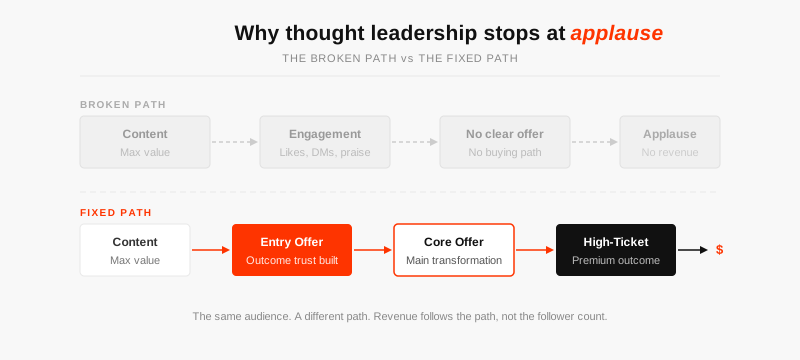
"I deliver maximum value. So, trust. People take something away, but it was never really sold into the pain." That paraphrase from a coaching call captures the failure mode precisely. The operator built genuine thought leadership. Audience members engaged, learned, and grew. But the content never created a clear, deterministic path to a buying decision. The result is applause without revenue.
There is a second failure mode adjacent to this: giving so much away that the audience concludes they already have what they need. "Too much got given away as value already, so they think: through the content I already know what to do. They don't feel they need to pay more to get the result." This is the value-saturation trap. The content taught the audience the what. The offer should deliver the how, the with-you, and the guaranteed result. If the content delivers all three, the offer has nothing left to justify.
Thought leadership marketing (the practice of distributing that content for business development purposes) only works when the content consistently points toward an offer that is believable, specific, and worthy of the trust that content built. Without that pointer, you are running an education program, not a marketing program.
The fix is not to give less value. The fix is to make the value point somewhere.
The Deterministic Path from Audience to Buyer
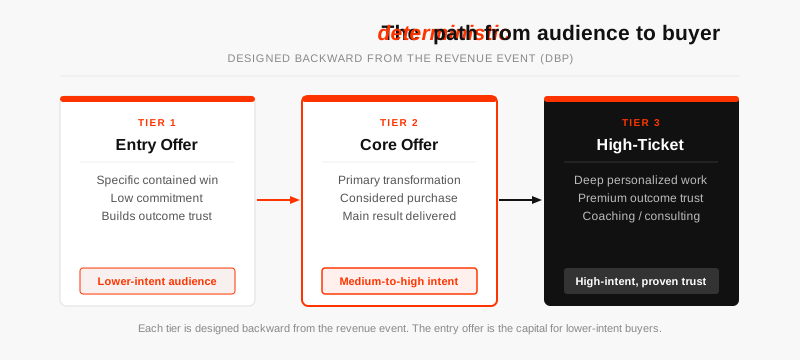
Deterministic Backward Pressure (DBP, per knowledge/frameworks/overview) is the principle that every marketing asset, content piece, and offer should be designed backward from the revenue event. The question is not "what valuable content can I create?" The question is "what does the audience need to believe and experience, in what sequence, to arrive at the revenue event with confidence?"
Applied to personal brand strategy, this means designing a clear path from "I know and like this person" to "I am buying their offer" in stages that respect where the audience currently is.
The structure looks like this:
Tier | Name | Purpose | Audience intent served |
|---|---|---|---|
Entry | Entry offer / self-liquidating lead magnet | Delivers a specific, contained win. Builds outcome trust at low friction and low commitment. | Lower-intent audience: trust is growing but a high-ticket commitment is not yet justified. |
Core | Core offer | The primary transformation. Delivers the main result you are known for. | Medium-to-high-intent audience: outcome trust is sufficient for a considered purchase. |
High-ticket | Coaching, consulting, advisory, or done-for-you engagement | Deep, personalized, high-accountability delivery. Premium price is justified by premium outcome trust and a clear track record. | High-intent audience: outcome trust is fully established. |
"There are the people with high intent and problem-awareness who react to the core offer directly. And the audiences with lower intent, where the trust isn't there yet. For those, the entry offer is the capital." That is the architecture in one sentence.
The entry offer is not a discount or a compromise. It is the first step of the path. It delivers a smaller, specific win that proves the larger transformation is real. It also self-selects: the people who buy the entry offer and get the result are the most likely buyers of the core offer.
The path is also how you solve for the knowledge business question. Turning a personal brand into a personal brand business requires, at minimum: a defined ICP, a clear promise with a specific outcome, a tiered offer structure designed backward from the high-ticket engagement, and a Trust Substrate (social proof, case studies, testimonials) at each tier. The label matters less than the architecture.
For the theory behind how every element of this path should trace back to the revenue event, read Deterministic Backward Pressure. It is the framework the entire path is built on.
How to Make the Ask Without Burning the Goodwill
The deepest fear inside the "audience loves you but won't buy" problem is this: "If I actually sell, I'll lose the trust I built."
That fear produces the outcome it is trying to prevent.
"Honestly, I didn't sell. I was afraid to actually sell." That admission, from a real coaching call, describes the most common failure mode at this stage: an operator who built genuine trust and genuine value, then stopped short of making the offer because the ask felt like a betrayal of the relationship.
A clear, honest, well-framed ask does not betray trust. It completes it. The audience followed because they wanted to get somewhere. A specific offer is the vehicle to get there. Withholding it leaves them with inspiration but no path. That is the actual betrayal of what they came for.
The KFC Method (Key First Click, per knowledge/frameworks/overview) addresses the attention-to-trust mechanism: the quality of the first impression a potential buyer has shapes their entire downstream relationship with the offer. Applied to the ask, this means the framing of the offer at the moment it is made determines whether it feels salesy or whether it feels like the natural next step. The frame "this here is the start; to go deeper you need to work with me. If that's interesting, book a first call" is not salesy. It is honest, specific, and low-friction. It gives the audience a reason and a path, not a pressure.
"At the end of the webinar I do, of course, have to sell. That's the part I avoid." The avoidance is the problem. The audience that attended the webinar attended because they wanted to solve a problem. Not making the ask leaves them without the solution. The ask, made clearly and without apology, is the service.
One practical structure for the ask that does not burn goodwill:
Recap the outcome the content just delivered (what they now know or can do).
Name the next gap (what they still cannot do alone, or where they need implementation support or accountability).
Offer the vehicle for closing that gap (the specific offer: entry, core, or high-ticket, depending on the context).
State the commitment (what taking the next step looks like: book a call, buy the entry offer, join the program).
Remove friction (one clear link or CTA, not three options).
"Put out massive value, then a real entry offer. A self-liquidating lead magnet that pulls people in, delivers a smaller win, and opens the door to the bigger engagement." That sequence, applied consistently, converts the same audience that was previously only applauding.
See the KFC Method for the full framework on how first-impression quality shapes the entire trust and conversion trajectory.
What This Looks Like When It's Installed
The before/after for an expert brand with a warm audience that is not converting follows a predictable pattern.
Before: Content produces strong engagement. DMs, comments, and "this changed everything for me" replies arrive consistently. Launches under-deliver. Sales calls are sporadic, often no-shows. Revenue is flat relative to audience size. The operator concludes the audience "just isn't a buying audience."
After: The same audience, no additional followers, is converted at a higher rate because the path is now clear. An entry offer captures lower-intent buyers and builds outcome trust. The core offer converts medium-intent buyers who have seen the entry offer result. High-ticket buyers self-select through the path and arrive on the sales call with outcome trust already established. The operator stops running calls to strangers and starts running calls to people who have already proven their intent.
"Across calls, the relief comes when the operator stops blaming reach or the audience and accepts the gap is structural: the audience was never given a believable, low-friction path from 'I trust this person' to 'I should buy this specific next thing.' Once the entry offer and the clear ask are installed, the same audience starts converting."
That relief is the pattern. The audience was not broken. The path was missing.
Marketing.MBA has applied this architecture across $1.5B+ in client revenue managed across 400+ brands since 2013. The GTM-OS case studies include expert and personal brand businesses that diagnosed the exact constraint described in this article. See GTM-OS case studies with personal brand businesses for real before/after examples. "What you have to structure is a clear promise that stands out from the market. That shows you have the expertise, then results, testimonials, proof." That is the sequence, proven across a wide range of expert and knowledge businesses.
Find the Exact Place Your Audience Drops Off
The single most useful next step is not another content strategy. It is a diagnostic that names which constraint between audience and revenue is actually binding.
Is the Trust Substrate the problem (outcome trust is missing)? Is it the offer architecture (no clear entry path)? Is it the ask (fear of selling)? Is it positioning (the audience doesn't know what you offer)? The answer is specific to your business and your audience. A generic framework will not name it.
The free GTM Audit is built for exactly this: diagnosing where an expert brand's revenue path breaks and naming the constraint that is doing the most damage. It is the same diagnostic used across 400+ brands. It is the appropriate next step for anyone who has an audience, a genuine offer, and a revenue gap they cannot explain.
No pitch, no pricing, no pressure. The Audit surfaces the constraint. You decide what to do with it.
Frequently Asked Questions
Why does my audience love my content but not buy anything?
Affinity is not demand. Your content built parasocial trust (the trust that you are likeable and credible). What converts an audience into buyers is outcome trust: the belief that buying a specific thing from you will produce a specific result at the price asked. An engaged audience that does not buy is missing a believable, deterministic path from "I trust this person" to a specific buying decision. The fix is offer architecture and Trust Substrate development, not more content or more followers.
How do you monetize a personal brand?
The path is a tiered offer structure designed backward from the revenue event. An entry offer delivers a specific, contained win and builds outcome trust at low commitment. A core offer delivers the primary transformation. A high-ticket engagement delivers deep, personalized support at premium price. Each tier filters and prepares buyers for the next. The monetization is not in the tactics (courses, sponsorships, ads). It is in the clear, believable path that converts accumulated trust into a purchasing decision.
Do I need a bigger audience before I can monetize?
Almost certainly not. Reach is rarely the binding constraint for an expert brand with an engaged audience. The Constraint Cascade principle says that investing in the wrong constraint produces zero improvement. If your content already generates strong engagement, the binding constraint is the conversion path, not the follower count. The operator who earns more from 2,000 engaged subscribers than a peer earns from 20,000 passive followers has better offer architecture, not better reach.
What is the difference between a personal brand and a personal brand business?
A personal brand is attention plus trust: you are known, respected, and followed in a domain. A personal brand business is a brand plus a path that converts that trust into predictable revenue. The difference is the offer architecture: a defined offer, a clear promise, a tiered structure, and a deterministic path from audience awareness to buying decision. Most personal brands stop at the brand. A business requires the path.
Is personal brand monetization the same as creator or influencer monetization?
No. Creator and influencer monetization (sponsorships, platform ad revenue, brand deals) is audience-size-dependent income. Revenue scales with reach because the product being sold is attention to the audience, not transformation of the audience. Expert brand monetization is Trust Substrate dependent: revenue scales with the quality of the outcome trust, the clarity of the offer, and the conversion path. These are different business models with different constraints and different scaling mechanics.
Do I need a personal brand coach to figure this out?
What you need first is a diagnosis. A coach is only useful once you know which constraint is actually binding. Is it trust? Positioning? Offer clarity? The ask? Without that diagnosis, coaching on the wrong constraint wastes time. The free GTM Audit is the diagnostic that names the constraint specific to your business. Start there before you invest in coaching or any other solution.
Marketing.MBA has supported $1.5B+ in client revenue across 400+ brands since 2013, including expert and personal brand businesses working through the exact audience-to-revenue constraints described in this article.
Schema (Reference for CMS Implementation)