What Is Reality Engineering? The Complete Guide to Marketing's Most Misunderstood Concept
⏱️ Reading time: ~16 minutes
TL;DR: Reality engineering is the practice of deliberately shaping a market's perception so a brand's growth becomes predictable and its dominance feels inevitable.
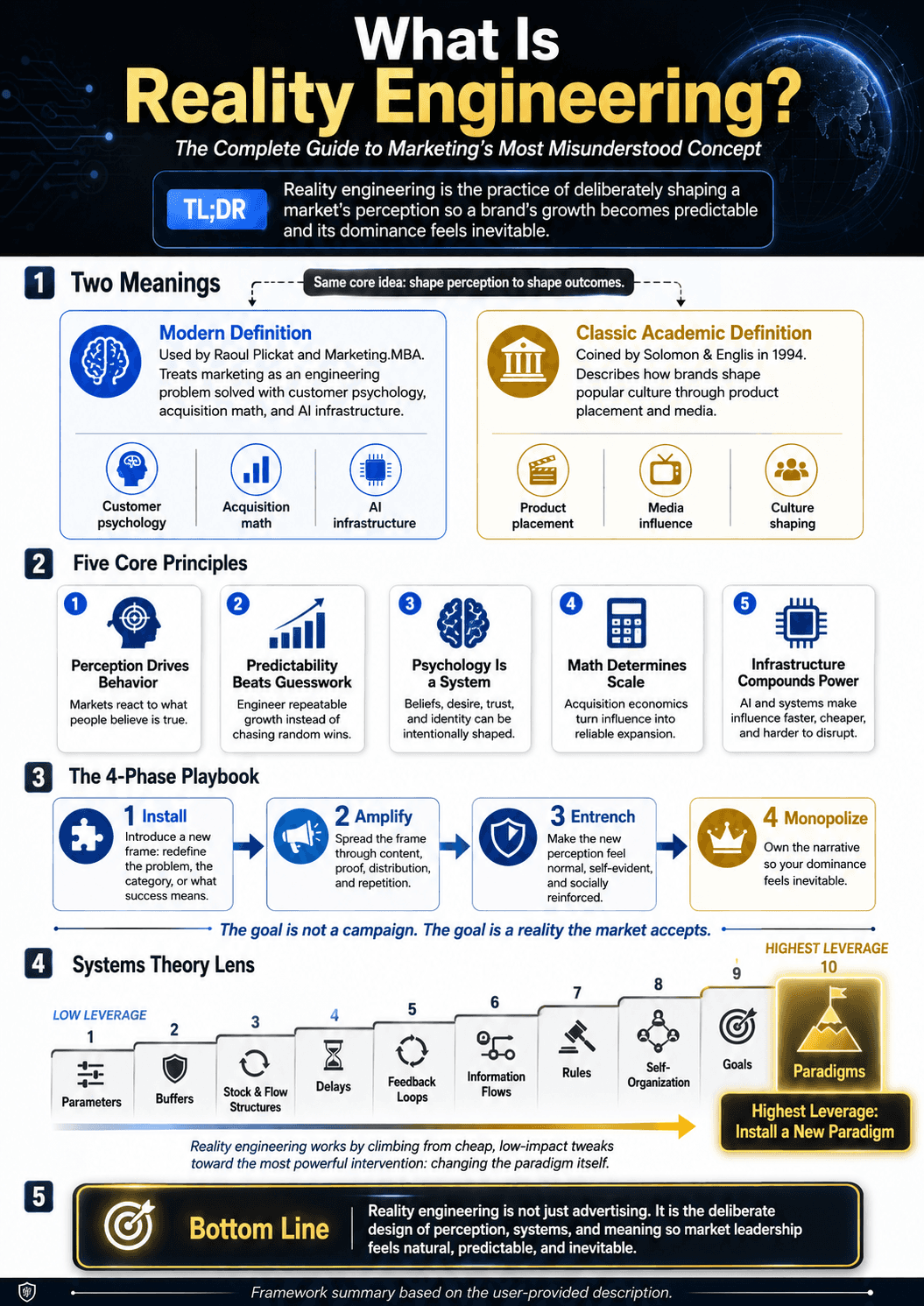
It has two meanings: a modern, data-driven definition (used by Raoul Plickat "The Face of Marketing" and Marketing.MBA) that treats marketing as an engineering problem solved with customer psychology, acquisition math, and AI infrastructure; and a classic academic definition (coined by Solomon & Englis in 1994) describing how brands shape popular culture through product placement and media.
It runs on five principles, a four-phase playbook — Install, Amplify, Entrench, Monopolize — and, in systems-theory terms, the practice of climbing Donella Meadows' leverage-points hierarchy from cheap parameters up to the highest-leverage intervention: installing a new paradigm.
A few years ago I watched the most profitable month of my career arrive on a dashboard: $11,290 a day in, $67,000+ a day back, the same equation thirty-one days running. It did not start that way. It started with two weeks of total silence — money leaving, no sales, nothing but the conviction that the system would close. You commit first; reality answers later. That gap between commitment and proof is where reality engineering lives, and this guide is about how to build a brand that survives it on purpose.
This article breaks down exactly what reality engineering is, where the term came from, how the modern data-driven definition differs from the academic original, the frameworks that make it work, and how to apply it. If you have ever wondered why some companies bend the market to their will while others fight for scraps, this is the mental model that explains it.
What Is Reality Engineering? A Quick Definition
Reality engineering is the practice of deliberately shaping the perceived reality of a market so that a brand's growth becomes predictable and, eventually, inevitable. Instead of reacting to what the market already believes, the reality engineer constructs the beliefs, associations, and buying patterns the market will hold tomorrow. It does not try to persuade in the moment; it installs long-term cognitive frameworks that make acting on the offer feel inevitable.
Put more sharply: reality engineering is the deliberate design of customer perception, identity, and decision-making structures so that the brand's narrative becomes indistinguishable from the customer's own reality. It does not try to persuade in the moment. It installs long-term cognitive frameworks that make acting on the offer feel inevitable — less a sales pitch, more an operating system running quietly in the prospect's mind. And from a rainmaker's perspective: you simply dominate your market and extract as much cash and profit out of it as possible within a full moon cycle. It's aggressive, and it's a kick better than anything else. Nothing comes close.
The term carries two distinct but related meanings:
The modern, data-driven definition, used by contemporary digital marketers and high-ticket B2B entrepreneurs such as Raoul Plickat at Marketing.MBA, treats marketing as an engineering discipline — using mathematical models, customer psychology, and automated AI systems to engineer a market reality where growth is planned rather than hoped for.
The classic academic definition, introduced in 1994 by consumer researchers Michael R. Solomon and Basil G. Englis in their study Reality Engineering: Blurring the Boundaries between Commercial Signification and Popular Culture, describes how marketers systematically shape and construct the social environment and popular culture to embed their brands into everyday life through tools like product placement and cultural symbols.
The difference is one of layer and toolset. The academic version operates on culture using media, celebrities, and entertainment. The modern version operates on the entire go-to-market system using data, automation, and acquisition math. Same underlying idea — perception can be deliberately constructed — two eras of technology apart.
The Modern Definition: Reality Engineering as Marketing Infrastructure
In the world of agencies, high-ticket coaching, and B2B growth, reality engineering reframes marketing as an engineering problem rather than a creative guessing game. Most businesses run their marketing on hope: they produce content, run ads, chase likes, and pray something resonates. When it works, they cannot explain why, so they cannot repeat it. Reality engineering rejects that. It asks: what if you treated marketing the way a civil engineer treats a bridge — analyze the loads, apply known principles, and build to a specification so the result stands because it was engineered to? As Marketing.MBA frames it, the goal is to "engineer certainty" while competitors guess. Three pillars make this version distinct.
Pillar One: The Asymmetric Advantage
The first goal is an asymmetric advantage — a competitive edge that works precisely because competitors cannot replicate it. In practice, this means building a brand presence so omnipresent and psychologically anchored that prospects feel it is the only logical choice the moment they have a problem. You are not one option among many compared on price. You are the category.
This is what every serious marketer is really hunting: an asymmetry — a crack in a market where a small amount of money goes in and a disproportionate amount comes back, and keeps coming back. The closest word for it is rain: one day the ground is dry, the next, money is falling from the sky and you are the only one who knows why. You cannot brainstorm an asymmetry into existence or copy one from a swipe file — by then the crack has closed. It either exists in reality or it doesn't, and the engineer's job is to build the system that finds it and bends the market around it. Because that system takes years of integrated execution to assemble, the moat is the system itself, not the budget. This is why reality engineering is tied to category creation: rather than competing inside a category whose rules favor incumbents, you create a new frame in which your brand is, by definition, the leader.
Pillar Two: AI-Driven Infrastructure
The second pillar replaces slow, manual processes with automated AI systems. Traditionally, building a go-to-market strategy took weeks: market research, positioning, buyer-journey mapping, ad copy, landing pages, email sequences. Reality engineering treats this as infrastructure to automate. The clearest example is REMI, the proprietary AI inside Marketing.MBA's GTM Operating System, designed to build entire go-to-market strategies and marketing assets in roughly 40 minutes — work that historically took specialized teams weeks. When the production of strategy and assets becomes near-instant and consistent, the brand iterates, tests, and compounds at a speed manual competitors cannot match. The best implementations use AI to amplify human judgment, not replace it: the machine handles speed, context, and research at scale, while a person supplies the strategic insight that data alone cannot.
Pillar Three: Hard Financial Data
The third pillar grounds every decision in financial reality — cost per acquisition, closing rates, payback periods, strict cash returns. The KFC Method (Key First Click) maps the buyer journey into defined stages — first click, first opt-in, re-engagement, retargeting — and engineers what content appears at each. Beneath it sits deterministic backward pressure (DBP): every upstream action traces backward from the final revenue event. You start with the sale you want and engineer backward, link by link, to the first impression. Metrics reflect this rigor: instead of follower counts, reality engineers track signals like first-time impression ratio (FTIR), central to the performance branding approach, and cost per acquisition by touchpoint depth. The discipline is simple and brutal: you can fake a meeting or a strategy deck, but you cannot fake ROAS. The phrase that captures the philosophy is blunt — your market does not buy products, it buys engineered realities.
The Five Core Principles of Reality Engineering
Beneath the tactics, reality engineering runs on five recurring principles:
1. Identity encoding. People don't buy products; they buy proof of identity. Every purchase answers, "Who am I becoming if I buy this?" — and reality engineering encodes that answer deliberately.
2. Narrative control. Reality is the story people tell themselves. The engineer shapes that story so the brand becomes the lens through which prospects see status, risk, and reward.
3. Cognitive infrastructure. The goal is to build mental operating systems — frameworks, slogans, metaphors — that live in the customer's head rent-free. Apple's "Think Different" was an identity operating system, not a computer pitch; L'Oréal's "Because You're Worth It" sold self-worth, not cosmetics.
4. Perception engineering. Manage contrast so competitors feel outdated or risky, and anchor desire by framing your brand as the inevitable future.
5. Time-layered persuasion. Don't just chase today's click; build "gravity wells" — stories, proof, and rituals that keep pulling prospects back until conversion feels less like a decision and more like a homecoming.
Put together, these mean you stop working with numbers and start engineering reality around them — predicting what people will think, feel, and do based on what you show them. A single word or image, placed correctly, decides what thousands of strangers will believe about themselves tomorrow.
From Product Marketing to Reality Marketing
The ambition of reality engineering is best understood as a three-rung ladder. Product marketing says, "Here's what we do" (it competes on features). Identity marketing says, "Here's who you become with us" (it competes on meaning). Reality marketing says, "Here's the only world that makes sense — and we own it" (it barely competes, because it has changed the frame).
This matters most in crowded markets — SaaS, coaching, luxury, agencies — where functional benefits no longer differentiate. When everyone can claim the same features, the winner is the brand that shifts the question, so the prospect is no longer choosing between offers but between realities: one in which their identity survives intact, and one in which it does not.
The Academic Origin: Solomon and Englis (1994)
Reality engineering was first introduced in 1994 by Michael R. Solomon and Basil G. Englis. Their insight extended the sociological idea of the "social construction of reality" to marketing: if reality is socially constructed, marketers are among its most active constructors. Sophisticated marketers, they argued, do not merely react to trends — they systematically shape what the public sees as normal, successful, and desirable, producing a "blurring of boundaries" between commercial messaging and genuine culture.
The primary tool is product placement: inserting a car, drink, or phone into films, shows, and games so it feels like a natural part of everyday society. An ad announces itself as persuasion; a placement slips beneath the viewer's guard, borrowing the credibility of the surrounding story. Beyond placement, cultural vehicles — music, celebrities, and media — establish consumption symbols and shift what feels aspirational. The classic illustration predates the term: in 1947, De Beers introduced "A Diamond Is Forever," manufacturing a tradition (the diamond engagement ring), tying it to status, and even inventing a spending rule. A common stone became the universal symbol of eternal love — reality engineering in its cultural form.
Reality Engineering vs. Related Concepts
Reality engineering sits within a lineage of ideas about constructing perception. Its earliest ancestor is Edward Bernays' "engineering of consent" — the argument that influencing public opinion could be approached scientifically. Bernays deliberately chose engineering over persuasion, and his core insight (people buy identity and belonging, not accurate descriptions) underlies both definitions. A modern cousin is narrative engineering: designing the dominant story through which a whole industry is understood, as Apple and Tesla did by embedding their products into the cultural imagination. The mechanics are not unique to commerce — at national scale they appear in what political scientist Joseph Nye called soft power: shaping outcomes through cultural attraction, language, media, and education rather than coercion. The lesson for brands is that perception-shaping is a general-purpose technology: whoever controls the dominant story, the shared vocabulary, and the channels of distribution shapes which choices feel normal.
Modern vs. Academic Reality Engineering: A Comparison
Dimension | Modern Digital (Plickat / B2B) | Classic Academic (Solomon / Englis) |
|---|---|---|
Core focus | Systems, AI automation, mathematical predictability | Cultural influence, media representation, consumer psychology |
Primary tools | AI models, attribution infrastructure, funnel metrics | Product placement, entertainment media, celebrity endorsements |
Operating layer | The brand's entire go-to-market system | The shared social environment and popular culture |
End goal | Predictable, scalable client-acquisition systems | Blurring the line between real culture and commercial messaging |
Measured by | CAC, close rates, FTIR, payback, cash return | Brand integration into everyday "normalcy" |
The simplest way to hold both: the academic definition explains why perception can be shaped, and the modern definition explains how to shape it on purpose, at scale, with a forecast attached.
The Reality Engineering Playbook: Install, Amplify, Entrench, Monopolize
Reality engineering campaigns move through four phases, each with a distinct job. Skipping one is the most common reason brands stay stuck competing on attention instead of owning a category.
Phase 1 — Install: Anchor the Identity. Define the void between who the prospect is and who they want to become, reflect their self-image back amplified, and create a hook operating system — a sticky phrase, symbol, or metaphor. "Think Different" and "Because You're Worth It" are install-phase assets that ran for decades.
Phase 2 — Amplify: Build Narrative Gravity. Make your reality stronger than the existing one through contrast engineering (positioning competitors as outdated realities, e.g. "Funnels are dead") and story weaving (placing your product inside a larger cultural story). Replace dry metrics with identity transformations ("I became the kind of founder who…").
Phase 3 — Entrench: Build Cognitive Infrastructure. Build structures that persist without you: ritual creation (tie the brand to a recurring habit), linguistic embedding (own category language so rivals reinforce your frame — coin a term like REMI and competitors sound like footnotes), and cultural seeding (phrases and symbols that spread on their own).
Phase 4 — Monopolize: Lock In Perception. Make the alternative feel irrational or identity-breaking. Safeguard status, preload the future ("In two years, everyone who matters will be here — will you?"), and deploy proof in three layers:
White (overt): openly attributed authority — reports, statistics, thought leadership.
Gray (covert): influence routed through third parties so it reads as spontaneous — client case studies and evangelists.
Black (aggressive): the direct competitor teardown — naming the alternative as outdated or risky. The sharpest tool in the kit, and the one most likely to backfire if the critique isn't true.
Phase | Mechanism | Example framing |
|---|---|---|
Install | Identity anchor | "Most marketers sell tactics. We engineer realities." |
Amplify | Narrative gravity | "Funnels are dead. Identity programming wins." |
Entrench | Cognitive infrastructure | A named framework (e.g., REMI) competitors must cite |
Monopolize | Perception lock-in | "If you're not reality-engineering, you're selling like an amateur." |
A word on ethics: the point is to show these tactics, not hide them. The real line is truth — white, gray, and black tactics are all legitimate when the underlying claim is true. A teardown that accurately exposes a worse option is a service; one built on a smear is a liability. An engineered reality anchored in a genuine mechanism compounds; one built on a hollow promise collapses the moment lived experience contradicts the story.
Climbing the Leverage Hierarchy: Reality Engineering and Donella Meadows
Why does reality engineering produce returns disproportionate to the effort? Systems theory answers precisely. In her essay "Leverage Points: Places to Intervene in a System," Donella Meadows ranked twelve places to push on a system, weakest to most powerful. The weakest are numbers and parameters — prices, budgets, discounts — because everyone fights over them and they rarely change behavior. That is exactly where ordinary marketing lives: raising the budget, tweaking a price, chasing a lower cost-per-click.
Move up her hierarchy and leverage grows: feedback loops, information flows, the rules of the system, the power to self-organize, the goals of the system — and near the very top, the paradigm out of which the whole system arises. Reality engineering is the deliberate practice of climbing that hierarchy. Install and Amplify operate on information flows and goals; Entrench rewrites the rules (own the language and the frame propagates on its own); Monopolize, done right, installs a new paradigm — the market no longer evaluates you inside the old reality, it lives inside a new one where your brand is simply how things are.
There is a hard lesson the climb teaches: asymmetries decay. The crack that paid 5x last year pays 3x, then 1.5x. The instinct is to reach for the dials — new creative, new audiences, smarter bids. But turning dials is adjusting your sprinklers; the paradigm is the weather. When 5x becomes 1.5x, no sprinkler setting will save you — the weather changed. You have two moves: kill the paradigm that made you rich and build a bigger one, or spot the one already forming and assemble it first. Deterministic backward pressure is what makes the climb controllable: Meadows tells you where to intervene; DBP tells you how, by starting at the paradigm you intend to create and tracing backward through goals, rules, and information flows down to the parameters. You are not pushing harder than competitors — you are pushing at a higher point on the system.
Reality Engineering Examples You Already Recognize
On the cultural side: the De Beers diamond engagement ring (an invented tradition and spending rule), product placement of a sports car in a blockbuster, or an energy drink fused with extreme-sports media until the brand becomes inseparable from the sport. On the identity side: slogans that became operating systems — Apple's "Think Different" and L'Oréal's "Because You're Worth It," neither of which describes a product, both of which install an identity the buyer wants to claim. On the modern systems side: a high-ticket brand that becomes the name everyone in a niche cites — not from one viral moment but from an engineered content and acquisition system placing the right message at every stage, producing documented multiples on ad spend and revenue that can be planned quarters ahead. In every case, the market's sense of "what is normal and best" was constructed on purpose, by identifiable people, for measurable reasons.
How to Apply Reality Engineering to Your Business
First, stop optimizing vanity metrics and track revenue math — CAC, close rate by touchpoint depth, payback period, FTIR. Second, work backward from the sale, not forward from the idea; if a piece of content has no job in that chain, it doesn't belong. Third, build a mechanism, not just a message — the distinct reason your brand produces the outcome, which turns a copyable campaign into an asymmetric advantage. Fourth, connect your marketing into one architecture — positioning, offers, acquisition, nurture, sales, and tracking as a single operating system with shared data. Fifth, use AI as infrastructure, not novelty, to compress strategy-to-asset time so you compound faster than manual competitors. Done together, these convert marketing from a recurring gamble into an engineered system whose growth you can plan.
Frequently Asked Questions About Reality Engineering
Is reality engineering the same as manipulation? It depends on intent and honesty. It is a method, not a morality. The most durable engineered realities are built on truth, because audiences eventually detect inauthenticity and the system collapses without it. Ethical reality engineering aligns perception with a real, deliverable outcome rather than fabricating one.
Who coined the term reality engineering? The academic term was introduced in 1994 by Michael R. Solomon and Basil G. Englis. The modern, AI-focused definition has been popularized in high-ticket B2B and digital marketing by figures such as Raoul Plickat and used as a core framework at Marketing.MBA.
What is the difference between reality engineering and branding? Branding crafts an image and emotional impression. Reality engineering is broader and more systematic: it engineers the entire perceived reality of a market — the category frame, the buyer's beliefs, and the acquisition system — and ties every element to measurable financial outcomes.
How does reality engineering relate to Donella Meadows' leverage points? Meadows ranked twelve places to intervene in a system, with parameters (prices, budgets) weakest and the paradigm most powerful. Reality engineering works up that hierarchy — past the dials most marketers tweak — to intervene at rules, goals, and ultimately the paradigm. Installing a new paradigm is the highest-leverage marketing move there is.
Do I need AI to do reality engineering? No. The cultural form existed for decades before modern AI. But AI dramatically accelerates the modern version by compressing research, strategy, and asset production from weeks into minutes, letting a brand compound faster than manual competitors.
How quickly does reality engineering produce results? In its modern, systems-based form, compounding effects — lower acquisition cost, higher close rates, shorter sales cycles — typically become measurable around 60 to 90 days, strengthening over time as the system feeds data back into itself.
Conclusion: Stop Guessing, Start Engineering
Reality engineering rests on a single uncomfortable truth: the reality your market operates in is not fixed. It is constructed — and if you don't construct it deliberately, a competitor who understood the game first will construct it for you. The academic definition taught us brands have always shaped culture through media and symbols; the modern definition weaponizes that with data, AI, and acquisition math, turning perception-shaping into a repeatable engineering discipline. The brands that win the next decade won't be the ones with the biggest budgets or the cleverest single campaign — they'll be the ones that built a system to make their dominance feel inevitable. Competitors fight for attention. Reality engineers compete one level up, for the reality in which those decisions are made.
If you want to install this kind of engineered growth system — connecting positioning, offers, acquisition, nurture, sales, and tracking into one architecture, supported by AI infrastructure and real attribution — that is exactly what Marketing.MBA builds. Apply for an Infrastructure Audit at Marketing.MBA to see where your current setup is leaving money on the table and which reality engineering elements to install first.
Stop relying on luck. Start engineering certainty.