


In week one you are not workshopping angles. You are shipping. Format bank, 8-beat skeleton, topology matrix and a fixed build order, ready to load and run.
Write from evidence, not memory: right now the survey answers sit in a spreadsheet and the ad gets written from whatever you can recall. Learn to assemble copy straight from your customers, so the market recognises itself in the first line.
Build belief, not hooks: a hook does not change what a reader already believes about your price, your category, or people like them. Understand the key structure underneath a purchase, which is the layer competitors cannot copy by looking at your ads.
$1.5 B+
in client revenue
$100M+
managed ad spend
279,89%
Avg. 1st yr revenue growth
500+
scaled brands
Nothing's noticably broken. Everything reads fine. But because your foundations aren't solid, nothing converts.
You are testing hooks when the problem is belief
Twelve new hooks a week, same conversion rate. A hook changes what the reader notices, not what they already believe.
The research is sitting in a spreadsheet nobody turned into sentences
You ran the survey, then wrote the ad in your own words anyway. The line that would have converted is still in row 41.
You are writing to a demographic instead of a person
Age, job title, revenue band. None of it tells you what they were thinking at eleven on a Sunday night.
Every asset starts from a blank page
The frustrating part was never the writing. It is the starting. No format bank, no build order, so quality tracks your mood.
You are bidding against everyone for the 5% who are in market this quarter
Everyone spends into the same small pool. The other 95% hear nothing from you, so they decide inside someone else's frame.
You persuade by instinct, and instinct cannot be handed to anyone else
Sometimes it lands and you are not sure why. That holds until a client prefers the version that will underperform.
After working through the Copywriting Mastery Training, you will…

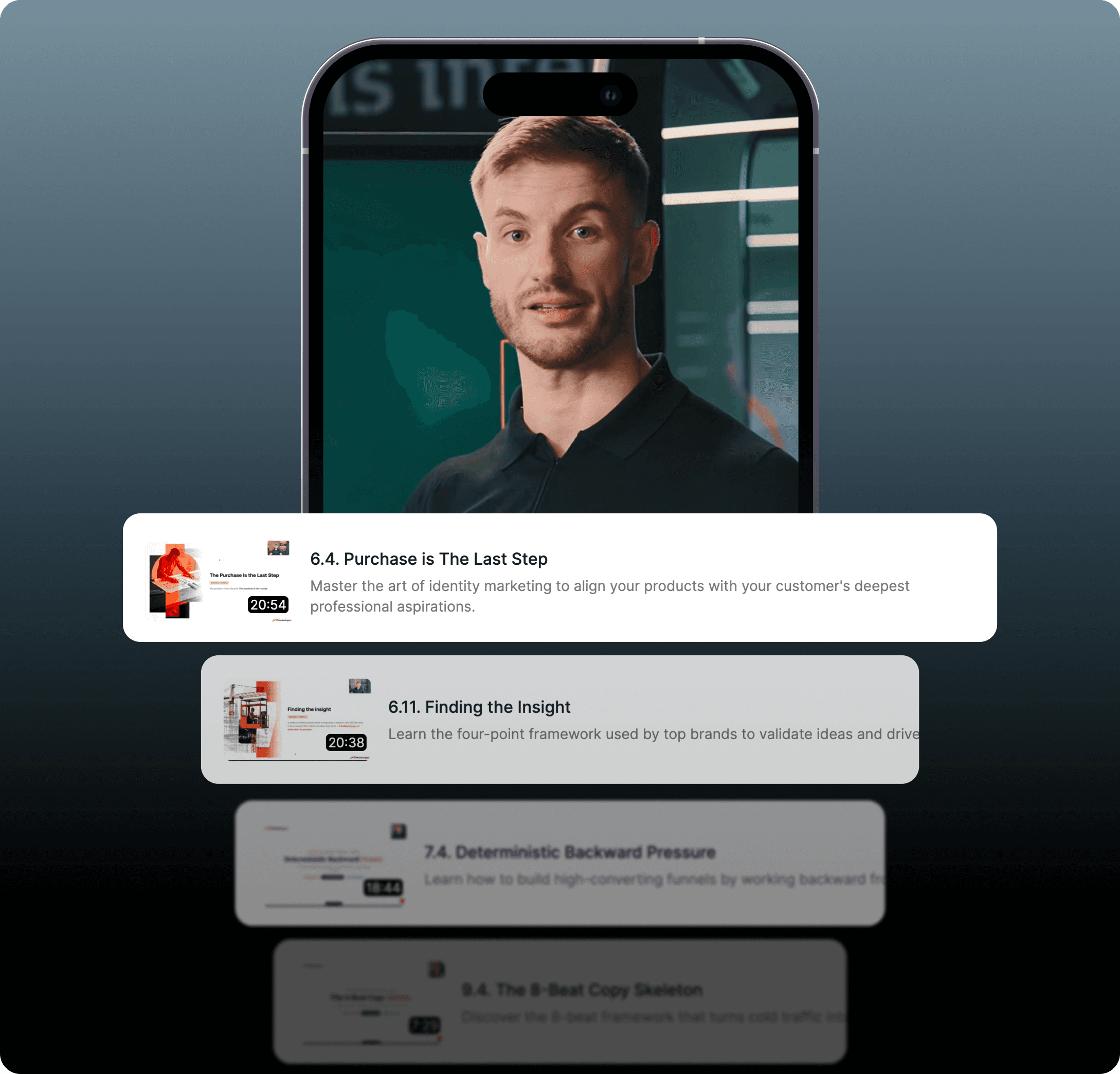
Engineer belief instead of testing hooks
Map the causal structure a purchase depends on, then write the asset that installs it. This is the part competitors cannot copy by looking at your ads.
Produce an avatar brief a stranger could execute from
ICP analysis, KYA brief, product CV and USP, in a documented form. The brief becomes the asset, so the next writer does not restart the research.
Reach buyers before they are in market
Build the frame the 95% will use when they eventually decide, so the moment they are ready you are already the default rather than one of six tabs.
Read your own account and know what to change
Topology levels, the media buyer's mindset, the decision tree and true lead value. You stop guessing which number matters and start moving the one that does.
Generate ads on a build order
Pick the format, load the skeleton, fill the eight beats, ship in a fixed sequence. Volume stops depending on inspiration and starts depending on the process.
Write out of a language bank
Collect the sentences your market already uses, then assemble copy from them instead of from your own vocabulary. The recognition the reader feels is the whole mechanism.
*save $200 - valid only until XX.XX.2026 at 23:59
These are the content modules

4 lectures
Research
Your market has already written your copy. Research is the act of collecting it.
You set up the listening apparatus, run the survey properly, then sort what comes back into a language bank you pull from while writing. It closes on aligning spend against the ICP the research has just described.
The correct research process
Setting up Hotjar
Build up the language bank
Optimising ad targeting to ICP
Market research and campaign iteration
6 lectures
Avatar creation and analysis
A demographic cannot tell you what your buyer was thinking at eleven on a Sunday night. An avatar can.
ICP analysis turns survey data into a profile. KYA turns the profile into a brief. The product CV turns objections into headlines. You finish with a documented USP and a copyboard any writer can execute from.
ICP analysis
KYA, know your avatar
The Miro process
Product CV and copyboarding
The E3IM copy model
Build your USP

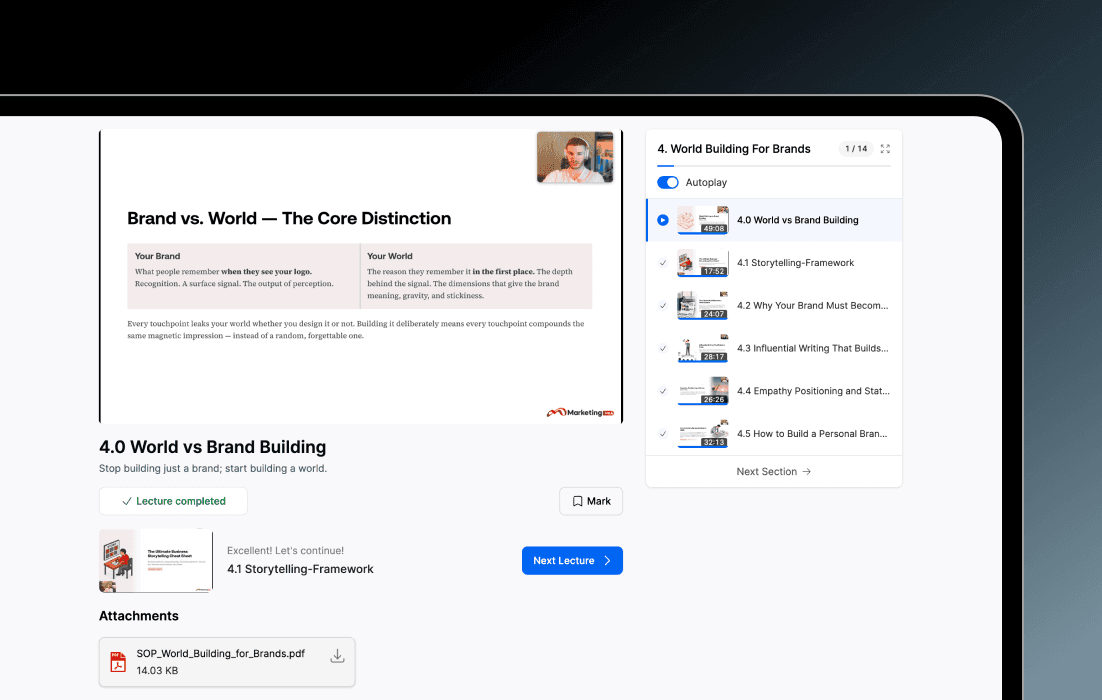
14 lectures
World building for brands
Stop building a brand. Build a world the buyer can move into and take a position inside.
Fourteen lectures on storytelling frameworks, on how a brand becomes a news source by publishing its own data, on how empathy and status decide positioning, and on building a personal brand worth more than the ad account.
World versus brand building
Storytelling framework
Why your brand must become a news source
Influential writing that builds a tribe
Empathy, positioning and status
How to build a personal brand in 2026
Miro playbooks
8 lectures
Advanced copywriting
The technical layer. Sentence by sentence, the mechanics that decide whether a line lands or slides past.
Schwartz's picture words and connectors, the sentence structures top writers reuse, and the Gain-Logic-Pain matrix. Then the tooling: a 17-step writing system, an 85-question checklist, and the ad copy workbook the team writes against.
Image and connector words
Writing styles
The messaging matrix
The simple writing system, 17 steps
The 85-question copy checklist
The ultimate ad copy workbook


13 lectures
Dark advertising, the architecture of belief
You are not writing arguments onto a page. You are building the structure the argument has to stand on.
Causal topology first, then flow, coherence, semantics and syntax as the delivery mechanisms. The second half moves from one mind to the market: installing a belief, entrenching it until competitors follow, and the platform physics deciding its form.
Causal topology
Flow and coherence
Semantics and syntax
Purchase is the last step
From one mind to the market
Install and amplify
Entrench and monopolise
Colonisation of the mind
The ultimate insight
Platform physics
Finding the insight
Occupy the labels
5 lectures
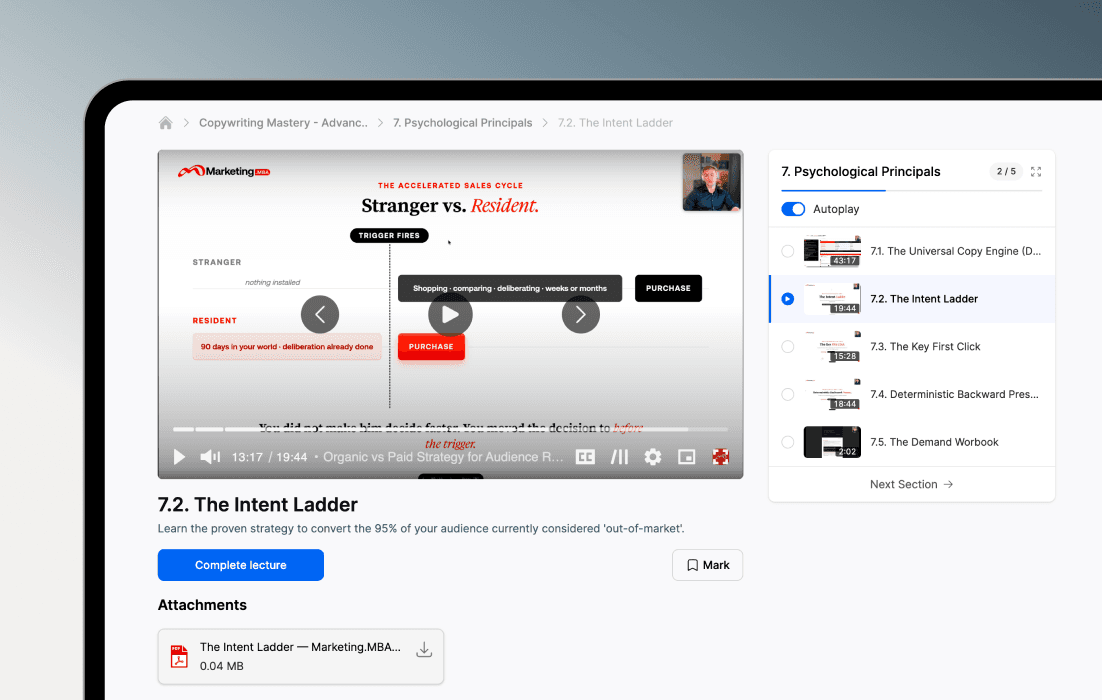
Psychological principles
Desire, identity, belief. The three levers underneath every buying decision, named so you can aim them deliberately.
The universal copy engine gives you the three levers. The intent ladder reaches the 95% who are not in market yet. The key first click and deterministic backward pressure build the funnel backwards from the sale.
The universal copy engine
The intent ladder
The key first click
Deterministic backward pressure
The demand workbook
4 lectures
Processes and workflows
The part that makes all of it repeatable when it is no longer only you doing the writing.
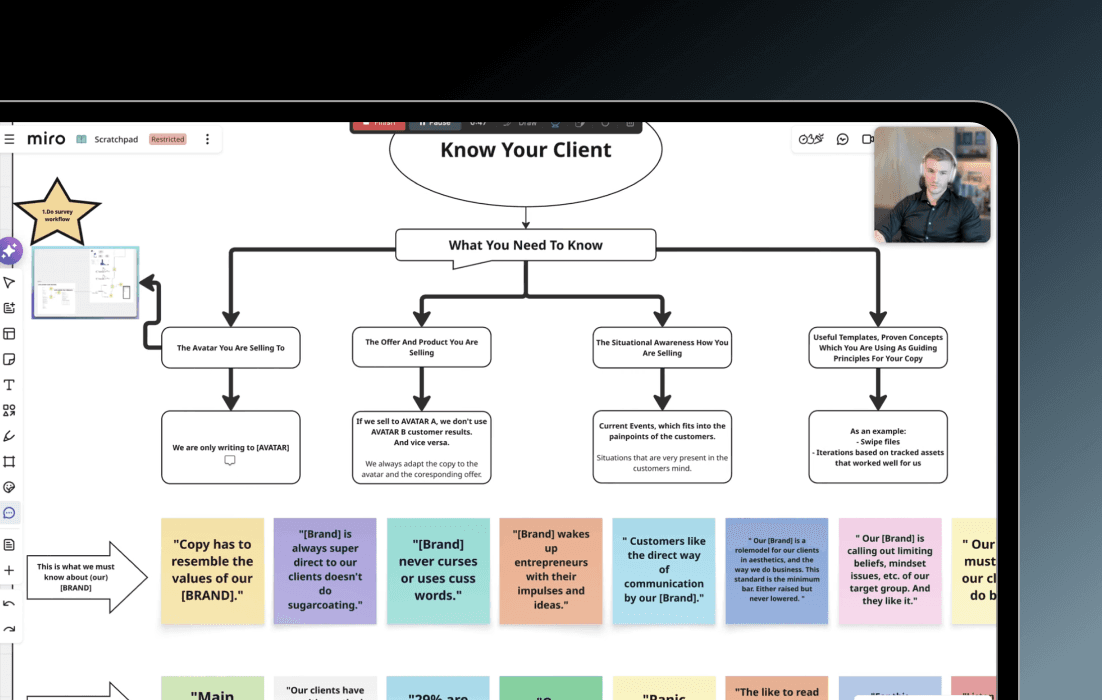
Four Miro boards you duplicate rather than interpret: competitor monitoring feeding straight into production, a know-your-client process for values and standards, nine principles for email and content, and the big idea framework.
Research and competitor monitoring
Know your client
Nine timeless principles
The big idea framework
11 lectures
Writing ads
You do not write ads one at a time. You generate them from a system, then read what the system tells you.
The ad engine, topology question matrix and format bank supply the raw material. The skeletons and pillar blueprint give it structure. Then measurement: topology levels, the media buyer's mindset, and a decision tree for true lead value.
The ad engine, five stages
The topology question matrix
Format bank and library
The beat skeletons
The 8-beat copy skeleton
The pillar blueprint
Format rankings and build sequence
Topology levels
The media buyer's mindset
Mistakes that shrink growth
The decision tree

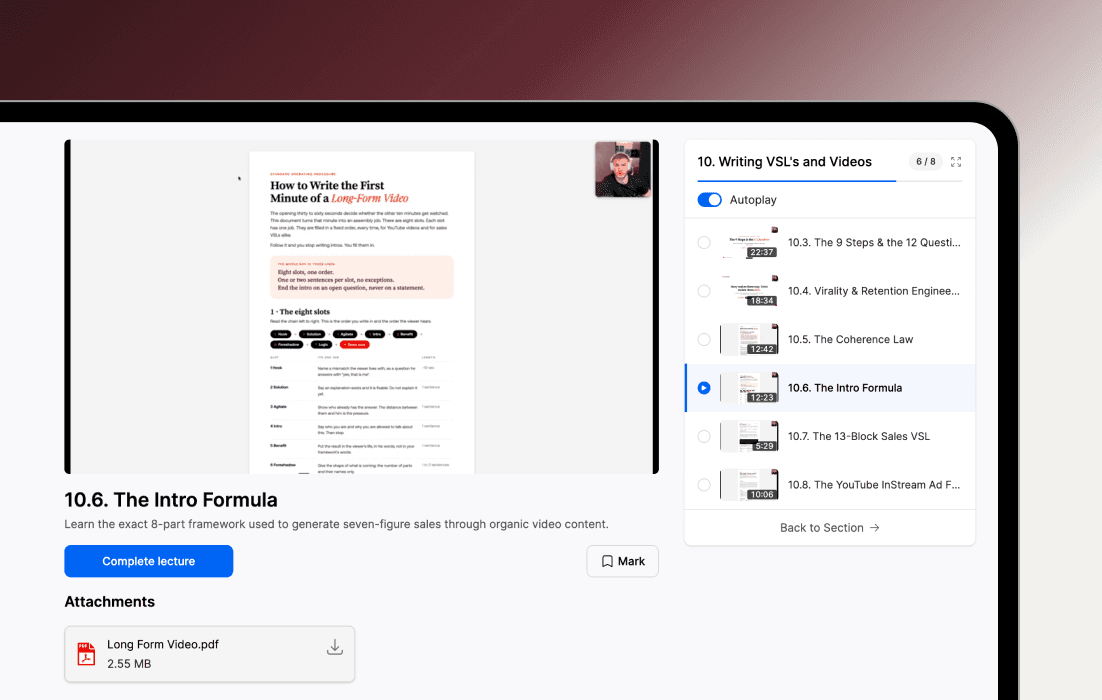
8 lectures
Writing VSLs and videos
Everything you publish is a VSL. The only open question is what it is selling.
Nine steps and twelve questions for the script, then retention engineering for the edit. The intro formula handles the first minute. The 13-block sales VSL handles long form. The InStream framework survives the skip button.
Everything is a VSL
The 9 steps and the 12 questions
Virality and retention engineering
The coherence law
The intro formula
The 13-block sales VSL
The YouTube InStream ad framework
Three people get the most out of this, and one person should not buy it.
Founders and operators who buy their own traffic
You approve the spend and you also write the ad. Those two jobs are currently competing for the same evening, and the writing loses. This gives you a system that produces the asset without needing your best three hours.
Copywriters and in-house creative leads
You can already write. What you are missing is the research and belief layer that lets you charge for a result instead of for a draft, and lets you win the meeting when the client prefers the weaker version.
Media buyers and growth leads
You can read an account better than most people can write one. Creative is the variable you cannot control, and it is the one that decides your CPA. This gives you the copy half so you stop waiting on someone else's inspiration.
Learn copywriting directly from an expert, not from a course business.
Raoul Plickat is a leading marketing operator and the founder of Marketing.MBA. With his expertise, Raoul primarily serves founder-led brands, mid-sized businesses and large corporations, and therefore knows the critical success factors for sustainable, profitable growth.
He presents all 73 lectures in this course himself. The material is not curated from other people's books. It is the internal system the agency and the consultancy run on live client accounts, recorded in the same form the team uses it: the Miro boards, the workbooks, the checklists, the build orders.
*save $200 - valid only until XX.XX.2026 at 23:59

The complete copywriting blueprint at a glance

Value: $3,700

Value: $3,700

Value: $3,700
BONUS
Value: $3,700
Included: FREE
BONUS
Value: $3,700
Included: FREE
BONUS
Value: $3,700
Included: FREE